On this page
Begin with a conditional question
A star’s habitable zone is a range of distances where a planet with a suitable atmosphere could maintain liquid water on its surface. The atmosphere condition matters. An orbital distance alone does not determine a real surface temperature, pressure or water inventory.
The useful question is whether a world might have conditions worth investigating. A location in this zone is not a detection of oceans, breathable air or organisms. When reading a planet announcement, keep the measured properties separate from the possibilities explored by a model.
THE BIG IDEAS
- A habitable-zone location is conditional on planetary properties.
- Equal incoming starlight does not guarantee equal climates.
- Potential habitability and evidence of life are different claims.
Compare stars before comparing distances
A more luminous star generally places a comparable received-light zone farther out. Around a less luminous star that zone is closer in. A single distance such as one AU therefore does not identify the same environment around every star.
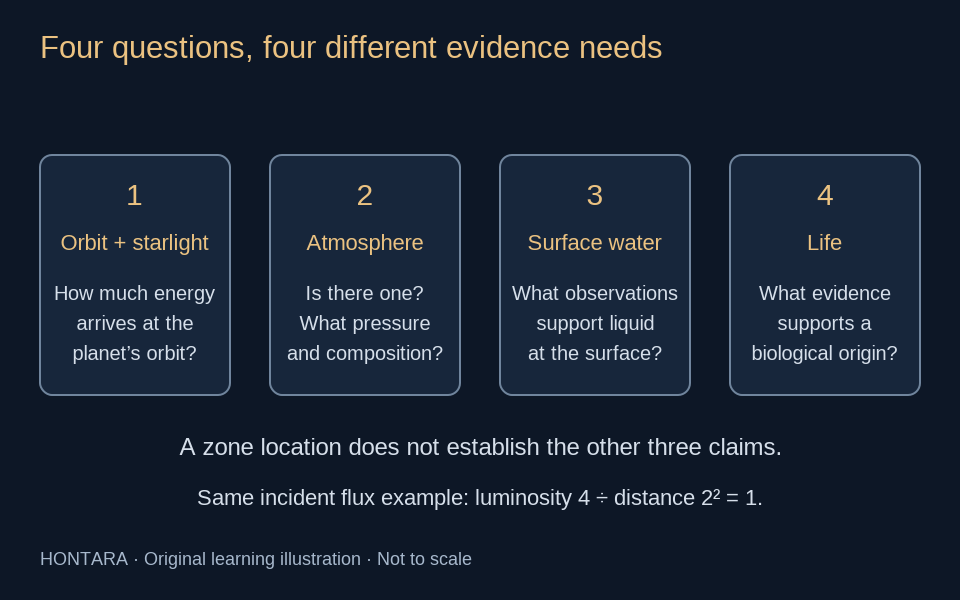
For a simple comparison, received energy per unit area scales as stellar luminosity divided by the square of orbital distance. An invented star with four times the Sun’s luminosity supplies Earth-like incident flux at two AU: 4/2² = 1 in relative units. This equality concerns incoming energy, not equal climates or identical planets.
Ask what else is needed
A planet’s reflectivity changes how much incoming energy it absorbs. Its atmosphere can redistribute heat and alter the radiation escaping to space. Atmospheric loss, stellar activity, orbital behaviour and the planet’s history can also affect whether surface liquid water persists.
Imagine two fictional planets receiving the same stellar flux. One has little atmosphere; the other has a substantial greenhouse atmosphere. Their surfaces need not share a temperature. Without measurements or well-supported constraints on these properties, calling both Earth-like would conceal major unknowns.
Build an evidence ladder
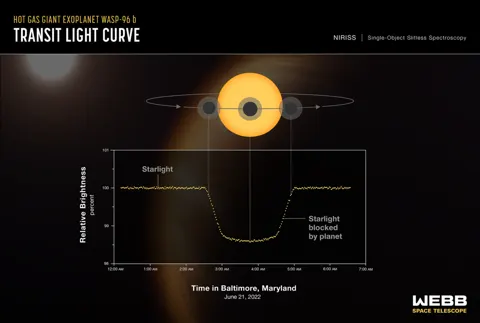
Write four separate claims: the orbit lies in a modelled zone; an atmosphere is detected; surface liquid water is supported; life is supported. For each claim ask what observations and modelling justify it. A transit can help constrain size and orbit but does not by itself establish the other three claims.
The conventional zone concerns surface liquid water. It does not rule out liquid beneath an icy surface outside that range, nor does it cover every conceivable environment for life. Use the term for its stated purpose and preserve uncertainty as you move from orbital information toward much harder biological questions.
PAUSE AND THINK
Does an Earth-sized planet in a habitable zone necessarily have oceans?
Explore the answer
No. Radius and orbital irradiation do not establish an atmosphere, surface pressure, water supply or climate. Oceans require additional evidence.