On this page
Planets beyond our Solar System
An exoplanet is a planet outside the Solar System. Most known examples orbit other stars, while some planets travel without a host star. Finding them is difficult because stars are bright and planets are comparatively faint. Astronomers often detect a planet through its influence on light or motion rather than through a direct picture of its surface. The method used determines which properties can be measured reliably.
THE BIG IDEAS
- Many exoplanets are detected indirectly.
- Transit and radial-velocity measurements provide different information.
- Habitable-zone location does not demonstrate life.
Watch for a transit
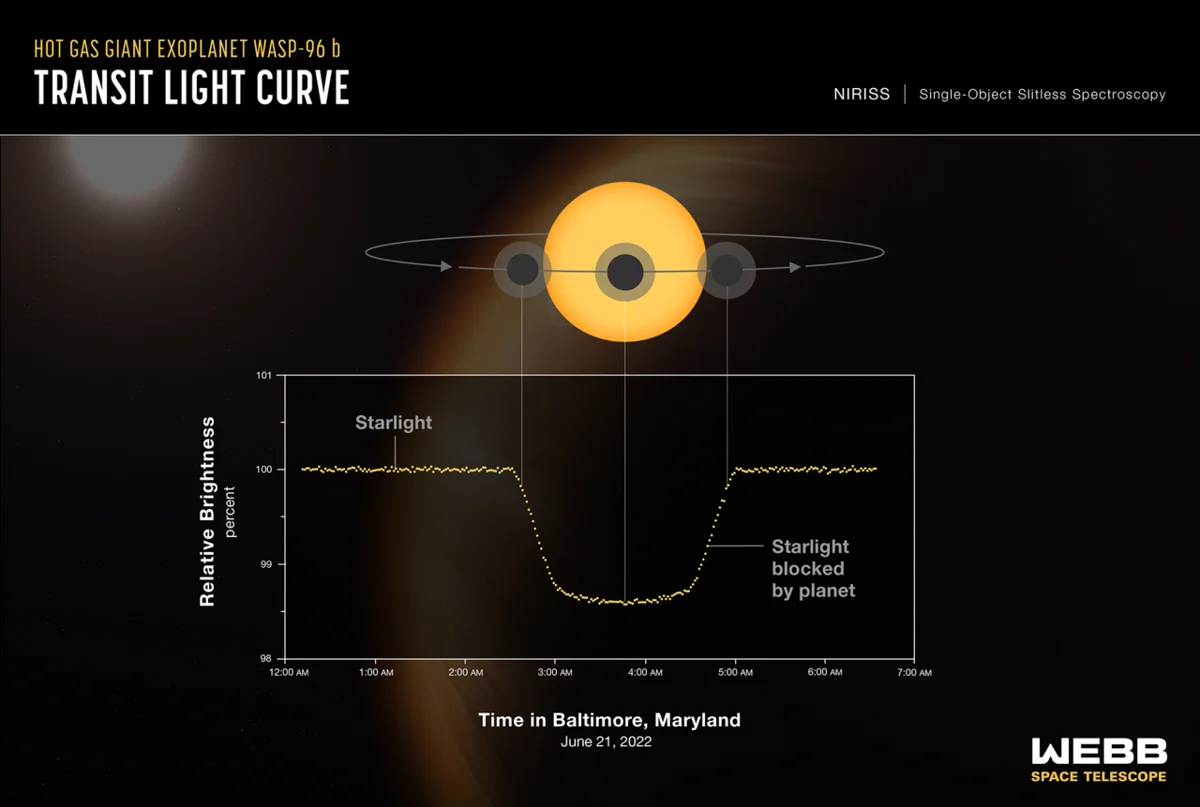
If an orbit is aligned favourably, a planet can cross the face of its star from our viewpoint. This transit produces a small dip in the measured starlight. Repeated dips can reveal an orbital period and help distinguish a regular signal from noise. The depth of the dip gives information about the planet’s size relative to the star. A transit does not by itself provide every physical property of the planet.
Measure a star’s motion
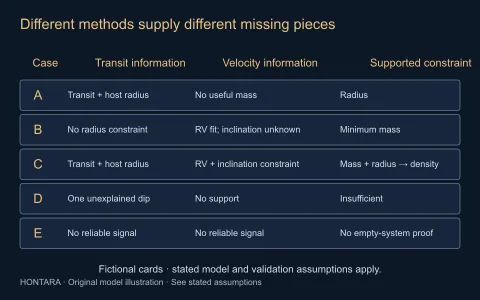
A planet and star both move around their shared centre of mass. Sensitive spectroscopy can detect the star’s motion toward and away from Earth through shifts in its spectral lines. This radial-velocity method constrains the planet’s mass, with interpretation depending on orbital geometry. When transit and radial-velocity information are available together, scientists can estimate average density. Density helps distinguish broad possibilities but does not uniquely reveal a planet’s detailed interior.
Other methods and their limits
Direct imaging separates faint planetary light from the bright star under suitable conditions. Gravitational microlensing detects a temporary brightening caused when an intervening system bends light from a background star. Each technique has biases toward particular orbits, sizes or distances. The catalogue of detected planets is therefore not a simple unbiased census. Researchers account for detection limits before drawing conclusions about how common different kinds of planets are.
Habitability is a question rather than a label
A planet in a star’s habitable zone receives a range of stellar energy that could permit liquid surface water under appropriate atmospheric conditions. That does not prove it has water or life. Atmosphere, geological history and stellar activity all matter. Even an Earth-sized planet can have a very different environment. Good reporting distinguishes a measured feature, an inferred possibility and a claim that has not been established.
PAUSE AND THINK
Why is combining transit and radial-velocity observations especially useful?
Explore the answer
The two methods can constrain size and mass together, allowing an estimate of average density and a better physical interpretation.