On this page
THE BIG IDEAS
- A transit radius ratio needs a host-star radius for an absolute size.
- Velocity alone often leaves an inclination-dependent mass constraint.
- A missing detection does not prove an empty system.
Identify the quantities behind the methods
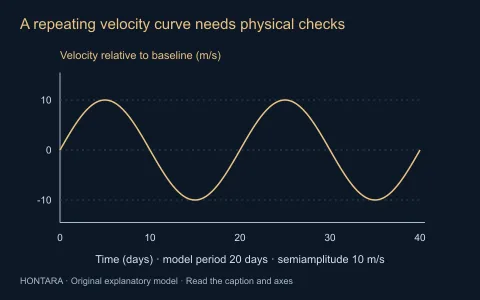
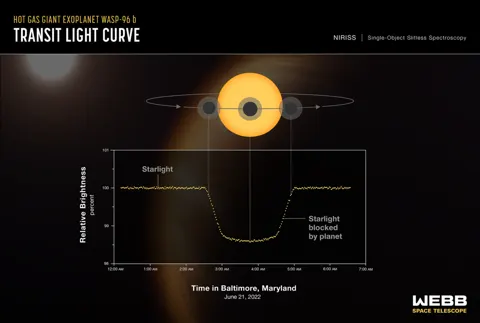
A transit constrains a planet-to-star radius ratio through a suitable light-curve model. A stellar radial-velocity model constrains a mass combination that depends on orbital inclination and other parameters. Host-star properties are therefore part of the inference rather than optional decorations.
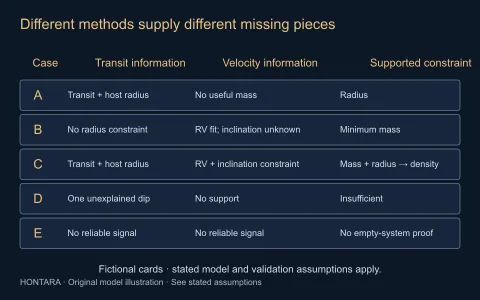
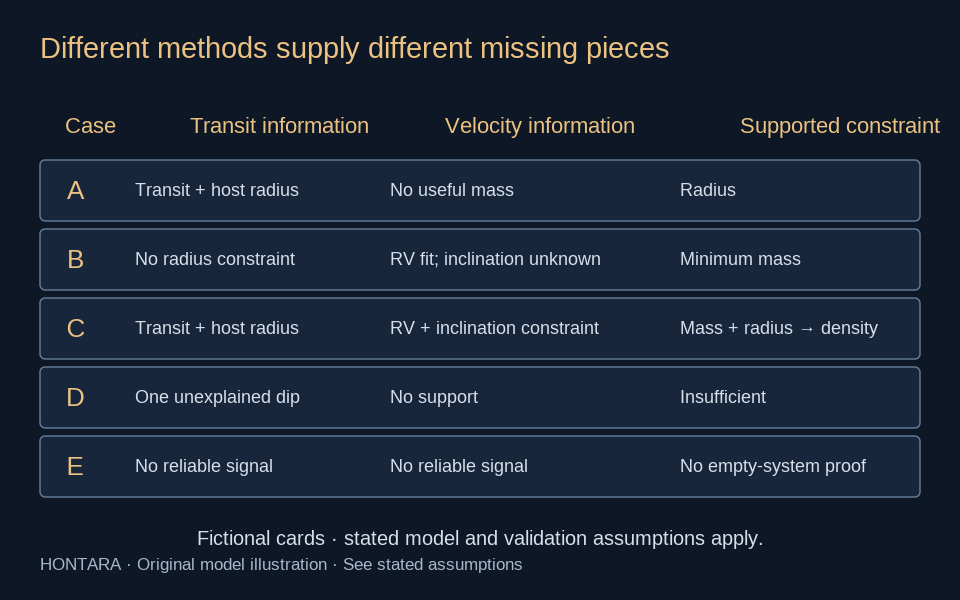
Use five fictional cards and a three-column answer table for radius, mass and density information. For cards that explicitly assume a planet interpretation, suppose elementary blending and stellar-activity checks have been passed. This assumption lets you compare information content without pretending the short cards reproduce a real validation programme.
Compare a transit-only and velocity-only case
A has a repeating transit signal, a suitable transit fit and a known stellar radius, but no useful mass constraint. B has a repeating stellar-velocity signal interpreted under a planet model with known host mass and orbital parameters, but its inclination and the planet’s radius are unknown.
A can yield a planet-model radius but does not supply bulk density by itself. B supplies an inclination-dependent minimum mass rather than a unique true mass; without a radius it also lacks the required inputs for bulk density. Write the missing quantity beside each conclusion.
Combine information in case C
C has suitable transit and radial-velocity fits, known host properties and an inclination constrained by the transit geometry. The stated model radius is two Earth radii and mass is eight Earth masses. These inputs support a bulk-density comparison within that model.
Use density proportional to mass divided by radius cubed. C’s density relative to Earth is 8/2³=1. Equal bulk density does not establish the same internal layers, surface conditions or composition as Earth. Keep the calculation separate from those additional claims.
Keep weak evidence unresolved
D contains one isolated brightness dip with no supporting observations. E contains no reliable transit or radial-velocity detection in the supplied record. Neither short card justifies a radius-plus-mass estimate or a confirmed-planet claim from this evidence alone.
E also does not establish that the star has no planets. Geometry, precision and observing duration affect what a survey can detect. State insufficient information rather than turning an absent detection into an inventory of every possible object around the star.
Compare explanations rather than labels alone
For each card state the strongest supported quantity and one missing input. A should be radius only; B should be a minimum-mass constraint only; C permits radius, model mass and density; D and E remain insufficient for this combined analysis.
Finish with an explanation of why two complementary methods can be more informative than either alone. Their combination still relies on measurement quality, stellar information and a physical model. It does not automatically produce a unique composition or prove biological habitability.
In your table, distinguish an unknown radius from a measured radius of zero. An unfilled measurement is not a small physical planet.
PAUSE AND THINK
If C has Earth’s bulk density, must it have Earth’s exact composition?
Explore the answer
No. Bulk density is one whole-body average. Different internal structures, compositions and pressure conditions can produce similar averages.
RECORD YOUR OWN EVIDENCE
Your activity sheet
You need: The five fictional evidence cards, paper and pencil.
For each invented case, identify whether a planet-model radius, a mass constraint or a bulk density can be estimated from the stated information. Keep a missing measurement different from a non-detection.
Name or group: Date:
| Case | Radius constraint? | Mass constraint? | Density justified? |
|---|---|---|---|
| A | |||
| B | |||
| C | |||
| D | |||
| E |
What extra host-star information is needed to turn a transit radius ratio into a planet radius?
Why is a radial-velocity minimum mass not generally the same as true mass?
For C, use radius 2 Earth units and mass 8 Earth units to compare bulk density with Earth.
Invented evidence cases. Where stated, elementary blend and activity checks are assumed; the cards are not real planet confirmations.