On this page
Watch the star rather than an isolated planet image
A star and planet both move around their common centre of mass. The star’s motion is much smaller when it is much more massive than the planet, but it can still leave a measurable signal. Radial velocity measures the component along our line of sight.
As the star approaches and recedes, its spectral features shift through the Doppler effect. A precision analysis combines many features and corrects observer motion and instrumental effects. It does not simply follow a star visibly wobbling across a photograph.
THE BIG IDEAS
- Radial velocity measures stellar motion along the line of sight.
- An unknown inclination usually leaves a minimum planet mass.
- Stellar activity and instrumental effects require explicit checks.
Relate a repeating signal to an orbit
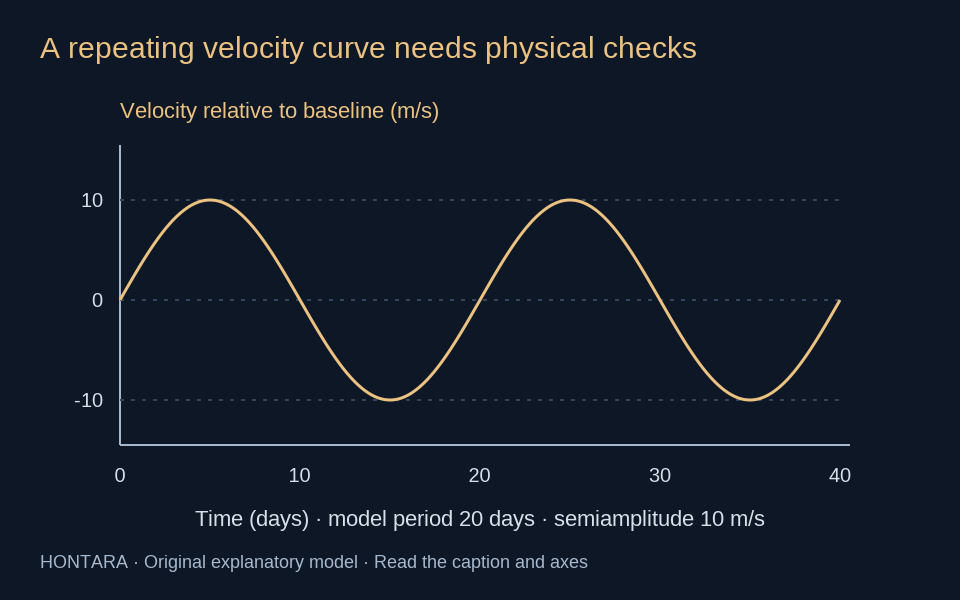
For a simple circular orbit, a model radial-velocity curve oscillates around the system’s baseline velocity. Its period supplies an orbital timescale and its amplitude depends on the planet mass, host-star mass and orbital orientation. Eccentricity changes the curve shape.
Consider invented measurements following the same smooth pattern every 20 days. Repetition suggests a candidate period, but observations need to sample many phases and enough cycles. A curve drawn through three selected points cannot establish a reliable orbit by itself.
Read the inclination limit correctly
In the usual low-planet-mass approximation, the radial-velocity mass combination is proportional to Mp sin i, where i=90° is edge-on. A nearly face-on orbit has a smaller line-of-sight signal than an edge-on orbit with the same physical motion.
If a fitted minimum mass is 10 Earth masses, an illustrative inclination of 30° with sin i=0.5 would imply about 20 Earth masses under the same simplified assumptions. Unknown inclination prevents treating the minimum as the exact true mass.
Look for non-planet explanations
Stellar activity, oscillations, spots and instrumental changes can mimic or contaminate velocity signals. Researchers examine activity indicators, spectral changes, wavelength dependence and the consistency of the orbital interpretation. Multiple instruments and longer time baselines can supply important checks.
A short-period signal is not automatically a planet simply because a periodic function fits it. State the uncertainty, sampling limits and plausible alternatives. A scientific detection rests on the evidence supporting the planetary model relative to competing explanations.
Combine methods without overclaiming
A transit can constrain inclination and planet size, helping turn a radial-velocity minimum mass into a stronger mass estimate. With a radius and mass, bulk density becomes accessible, although a unique interior composition still does not follow from one average.
Astrometry and direct imaging can also constrain orbital geometry in suitable systems. When comparing announcements, separate what each method measured from what the combined model inferred. The changing stellar spectrum is one part of an evidence chain rather than a complete photograph of the planet’s nature.
A useful record labels velocity in metres per second and time in days, marks uncertainty bars and states whether the system’s baseline velocity has been removed. Those labels distinguish a small periodic component from the star’s overall motion and stop an arbitrary vertical offset being mistaken for a planet signal.
PAUSE AND THINK
Would viewing an otherwise identical orbit more nearly face-on increase its radial-velocity amplitude?
Explore the answer
No. The line-of-sight component becomes smaller. In the usual inclination convention the signal scales with sin i.