On this page
Begin with a changing combined light signal
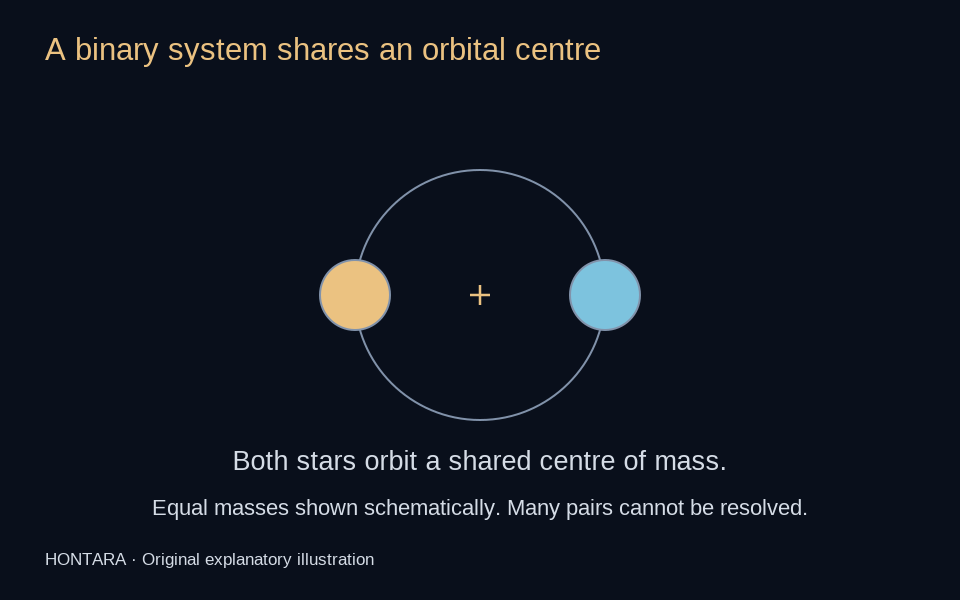
In an eclipsing binary, two stars orbit a common centre of mass and their orbital plane is aligned closely enough with our line of sight for one to pass in front of the other. A telescope may record only their unresolved combined brightness.
The dip occurs because some emitted light is blocked from our view, not because a star stops producing energy. A binary system viewed from another orientation can show no eclipse even though the stars still orbit one another.
THE BIG IDEAS
- A full binary period repeats the same orbital phase.
- Depth depends on brightness contributions and overlap geometry.
- Spectra and complete timing coverage help break light-curve ambiguities.
Identify a full repeating pattern
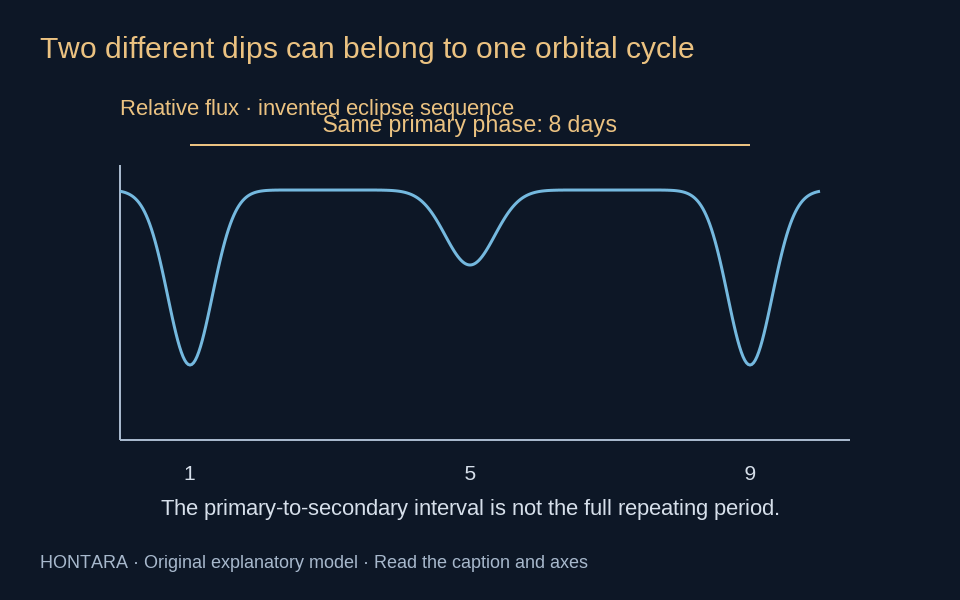
A light curve can show a deeper primary eclipse and a shallower secondary eclipse. The interval from one primary eclipse to the next corresponding primary gives an orbital repetition period. Measuring from a primary dip to the following secondary can return roughly half that period in a simple circular example.
For invented primary minima at days 1 and 9 with a secondary near day 5, the full pattern repeats after eight days. A four-day answer would mistake unlike events for successive identical phases. Unequal spacing can occur in eccentric orbits.
Use depth with the missing geometry in mind
Eclipse depth depends on how much light is blocked relative to the total, the surface brightnesses of the two stars and the overlap geometry. A large but cool star and a smaller hot star need not contribute equal light. A grazing eclipse blocks only part of a disk.
A deeper minimum therefore does not translate directly into a unique radius ratio without a model. Limb darkening, partial versus total coverage and unrelated blended light can also affect the curve. Label a simple illustrative profile as a model rather than a measured solution.
Combine complementary measurements
Eclipse durations and shapes can constrain radii relative to orbital size and the inclination. Spectroscopic radial velocities can add orbital speed information. Together, suitable observations can yield masses and radii far more directly than either a generic brightness sketch or an isolated image.
The interpretation still needs uncertainties and assumptions. A single-band curve with incomplete coverage may admit several combinations of stellar and orbital parameters. More precise arithmetic cannot replace missing observations of the second eclipse or an uncertain period.
Distinguish other causes of variation
Pulsation, starspots and transiting planets can also alter a source’s brightness. Check repeated patterns, spectra, colours and alternative explanations before naming the system. The purpose of a two-dip sketch is to organise questions, not to certify every variable as a binary.
For a practical reading exercise, mark primary and secondary minima, show which interval you use for period and list two model properties that cannot be uniquely recovered from dip depth alone. This separates directly read timing information from a deeper physical inference.
A phase-folded plot can place measurements from several cycles onto one proposed period. Test whether both eclipse shapes repeat consistently. An incorrect half-period can superpose unequal primary and secondary eclipses, hiding precisely the difference that helps identify the full orbital pattern.
PAUSE AND THINK
Why can the time from a deep dip to a shallow dip underestimate a binary’s full period?
Explore the answer
The two dips may be primary and secondary eclipses within one orbit. The same full pattern has not yet repeated.