On this page
THE BIG IDEAS
- The Triangle spans Lyra, Cygnus and Aquila.
- Its sides cover tens of degrees rather than one telescope field.
- Each corner provides a starting point for a smaller checked task.
Learn three anchors before the smaller patterns
The Summer Triangle is an asterism formed by Vega in Lyra, Deneb in Cygnus and Altair in Aquila. It spans several constellation regions rather than being an extra IAU constellation. Start with those three bright anchors before trying to copy all the fainter lines inside them.
The name comes from a northern seasonal association, not a rule that the pattern appears only during one local season. Its visibility changes with the time of night and date. A location-based chart is still needed to determine where the anchors lie relative to your horizon.
Adapt a northern nickname to coastal Karnataka
Evenings roughly July through November often provide a convenient part of the cycle near 14.3° north. Coastal cloud can interrupt those months, so prepare a flexible short task and a chart-based alternative. There is no need to wait for all three corners to be perfectly placed to practise one secure identification.
Approximate maximum geometric altitudes from this latitude are 66° for Vega, 59° for Deneb and 85° for Altair. These are separate culmination values, reached at different times, not a promise that all three attain those heights together. A chart for your selected hour shows the actual arrangement.
Read the reference diagram at the correct scale
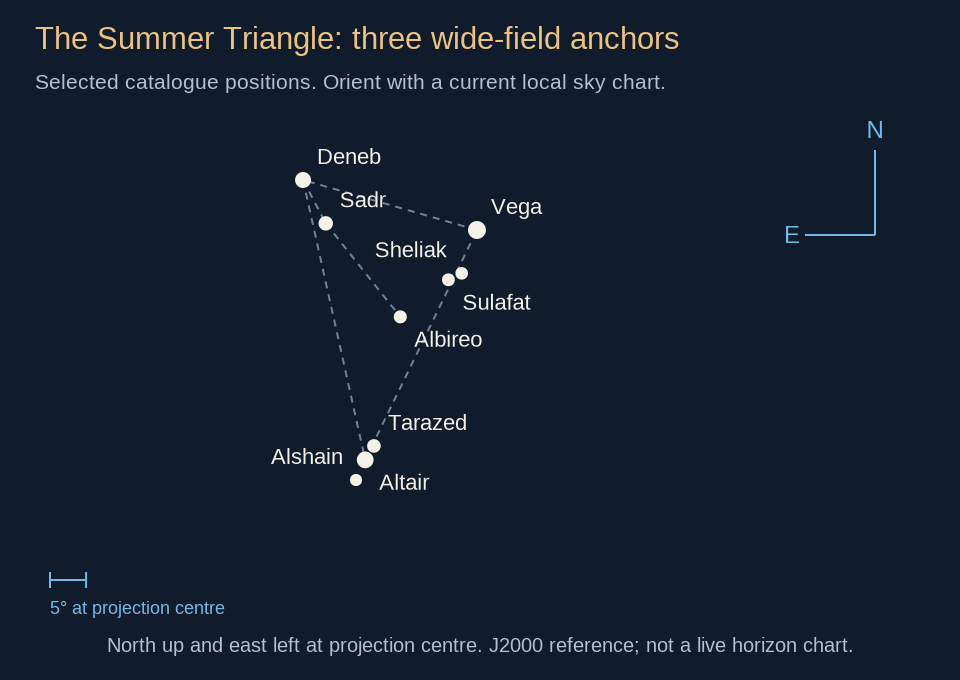
The catalogue positions give side separations of about 24° between Vega and Deneb, 34° between Vega and Altair and 38° between Deneb and Altair. The whole asterism is therefore an unaided-eye framework, not one binocular or telescope field. Smaller fields are useful only after the broad pattern is secure.
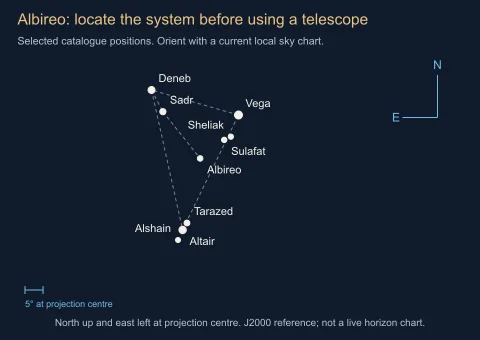
The chart uses celestial north up and east left. Lines indicate selected finding relationships and do not outline physical edges in space. Rotate the reference to match a current horizon view. The varying brightness of symbols helps identification but does not show the true sizes or distances of the stars.
Use each corner as a route to a different question
From Deneb, trace the Cygnus framework through Sadr toward Albireo. Around Vega, compare the compact Lyra pattern with the much larger Triangle. Near Altair, look for the nearby reference stars Tarazed and Alshain. Confirm each small pattern before using it as the starting point for a fainter target.
Under a dark sky, parts of the Milky Way pass through this broad region, but moonlight or haze may conceal the band while leaving the bright anchors visible. Treat a missing band as a result about observing conditions rather than proof that the three-star identification is wrong.
Create a small observing route of your own
Draw the three anchors on one page and choose only one extra task, such as locating Sadr or sketching Albireo through a telescope. Record the planned direction and time, then add the actual conditions. A short route leaves time to check identifications and ask why the instruments show different scales.
Return on another clear evening and compare the Triangle’s position at the same clock time. Keep changes relative to the horizon separate from the almost unchanged star-to-star pattern. Your record connects a memorable shape with Earth’s changing viewpoint over time.
PAUSE AND THINK
Why is the Summer Triangle an asterism rather than an additional official constellation?
Explore the answer
It is a useful pattern connecting selected stars across several existing constellation regions. The IAU constellation system divides the sky into defined regions rather than adding every memorable pattern as another region.