On this page
THE BIG IDEAS
- Trace Deneb through Sadr to Albireo.
- The whole pattern spans many binocular fields.
- Record bright stars and diffuse Milky Way light separately.
Use Deneb as the first anchor
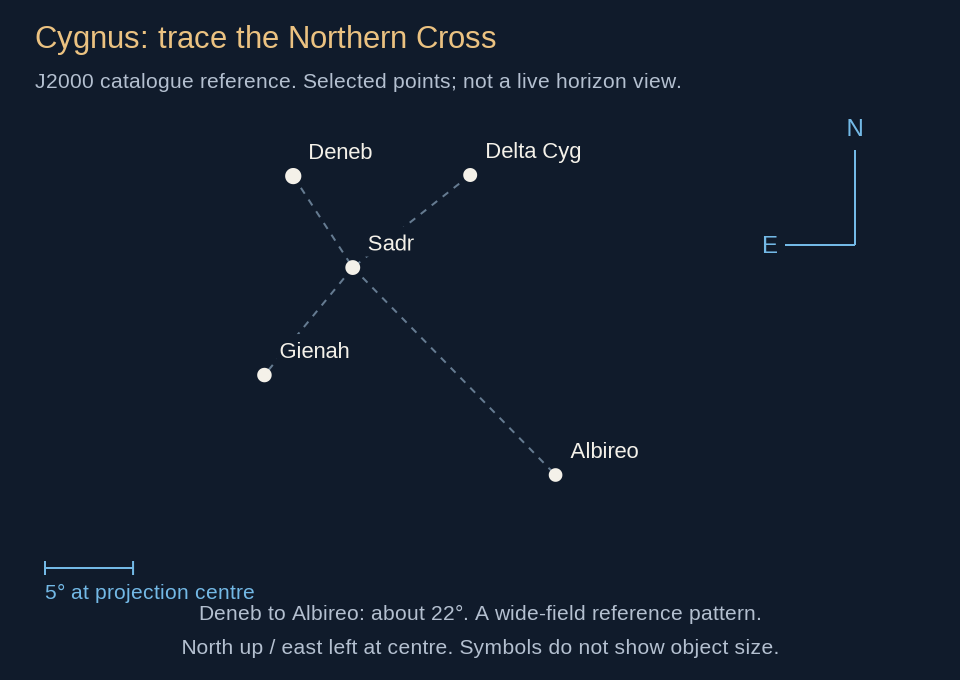
Cygnus contains the Northern Cross pattern and one corner of the much larger Summer Triangle. First identify bright Deneb with a current chart, then look along the cross through Sadr toward Albireo. This chain is a useful framework even when sky brightness hides the surrounding Milky Way.
The finder also marks Delta Cygni and Gienah on opposite wings. Confirm the central crossing before tracing the outer shape. Different traditions draw different figures, while the official constellation is a defined sky region. The dashed lines are selected finding connections rather than physical links between stars.
Plan for coastal Karnataka's sky
From latitude 14.3° north, Deneb reaches a maximum geometric altitude of about 57° and Sadr about 64°. Albireo, farther south, can reach about 76°. These separate transit heights describe upper limits, not a simultaneous view. A date-based chart tells you the actual altitude and orientation at your chosen time.
Evenings roughly July through November often offer a convenient opportunity, with later-night visibility possible in other months. Coastal cloud and haze can interrupt those months. Choose a short bright-star task that can survive gaps in cloud and reserve the faint Milky Way comparison for a transparent moonless interval.
Read the chart at its intended scale
Deneb and Albireo are about 22° apart, much wider than an ordinary binocular field. Use your eyes to establish the large framework and binoculars to inspect small pieces of it. The plotted symbols show selected catalogue positions; they do not reproduce stellar diameters or the full population of the region.
The reference is north up with east left at its centre. It has no horizon and no observing time. Rotate it against a current local sky map before applying a direction such as up. A telescope's reversed view needs an additional orientation check with a known pair or drift direction.
Distinguish a pattern from a Milky Way view
NASA's Cygnus guide connects the swan's central chain with the Milky Way. Under a dark sky, sweep short overlapping binocular fields near that chain and compare the number of visible points. Avoid assuming that every blank patch is a real absence of stars: interstellar dust and local sky brightness affect the view.
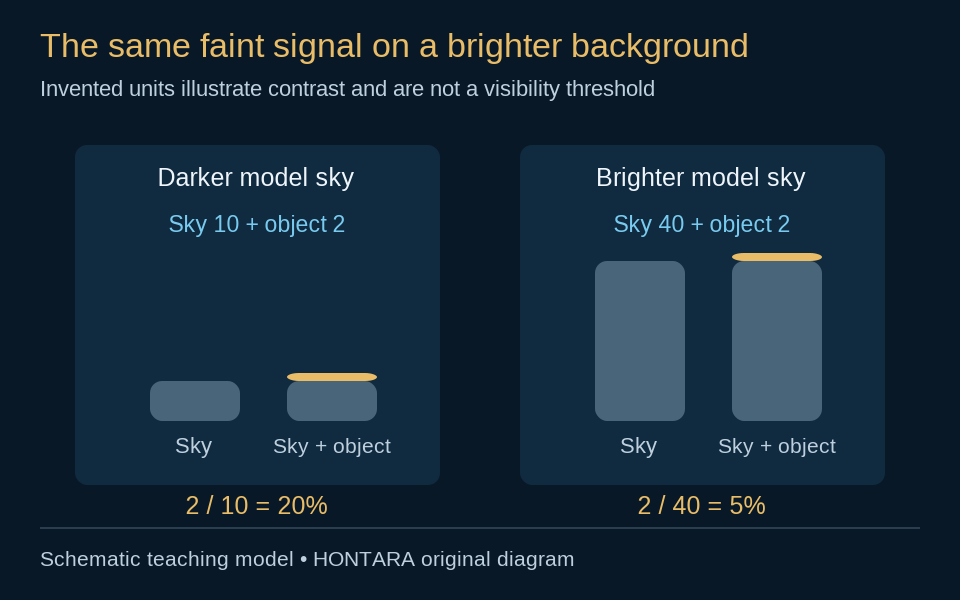
A missing band does not disprove the star identification. Moonlight, nearby lamps and thin cloud can erase faint diffuse light while leaving Deneb easy to see. Make separate notes for the anchor stars, resolved binocular stars and any broad glow. Those are different observational claims with different thresholds.
Finish with one smaller target
Albireo offers a manageable telescope follow-up after the large pattern is secure. Its paired points are a different scale of task from the whole cross. Do not try to infer stellar distances from their apparent positions or assume all stars in the drawing belong to one gravitationally bound group.
Sketch five main points first, then add only features you actually identify. Record the observing time and whether the Milky Way was visible. Return at the same clock time several weeks later and compare the orientation relative to the horizon. The star pattern remains recognisable while Earth's viewpoint changes.
PAUSE AND THINK
Why can the cross be visible when the Milky Way is absent?
Explore the answer
Bright individual stars retain contrast against a brightened sky after faint diffuse Milky Way light has become difficult to see.