On this page
An object shares its patch of sky
When you look toward a faint nebula, your eye receives light from the nebula and from the sky background in the same direction. The object becomes difficult to see when its extra signal is small compared with that background. A bright sky can therefore hide an object even though the object continues sending light toward Earth.
Artificial light sent upward or reflected from the ground can scatter in the atmosphere and produce skyglow. Molecules and aerosols redirect some light toward the observer. Haze can both weaken incoming astronomical light and scatter more nearby artificial light. A cloudless sky can still have poor transparency and strong skyglow, so clear weather alone does not guarantee a good view.
THE BIG IDEAS
- A brighter background reduces the contrast of faint objects.
- Total magnitude does not fully describe a diffuse object’s visibility.
- Local glare and wider atmospheric skyglow are related but distinct.
Work through a contrast example
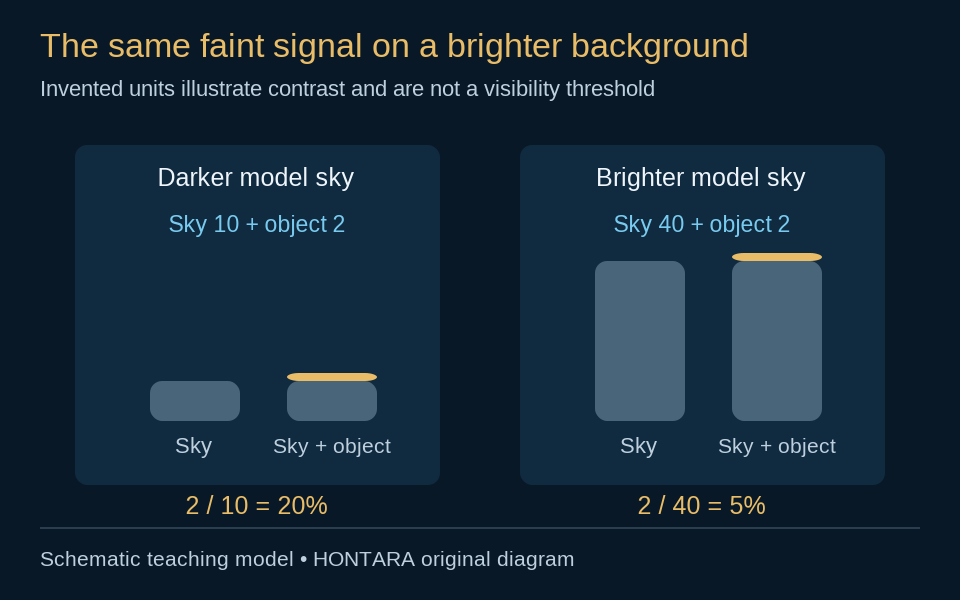
Use invented units to isolate the idea. Suppose a patch of nebula adds 2 units above a sky background of 10 units. Its fractional excess is 2 divided by 10, or 20 percent. If artificial light raises the background to 40 units while the nebula still adds 2, that excess becomes 5 percent.
The object did not fade in this example; the comparison changed. These figures are a teaching model rather than a measured detection threshold for a human eye. Actual visibility depends on the object’s angular size, visual adaptation, colour, optical conditions and the observer. A camera also has noise and exposure limits that this simple contrast fraction omits.
A galaxy spreads its light out
An integrated magnitude describes the total light from an object. A galaxy can have a respectable total brightness yet spread that light across a large apparent area. Surface brightness describes light per angular area and helps explain why a diffuse galaxy is harder to see than a compact star with similar total magnitude.
A telescope gathers more light but also gathers sky background. For extended objects the visual result depends on magnification and exit pupil as well as aperture. Raising magnification can darken the background while spreading the object’s light too. It is useful in some situations but is not a general cure for a bright sky. No eyepiece can remove all unwanted background photons.
Change the observing question
Compare the same sky field under two documented conditions, such as before and after a nearby shielded light is switched off with permission. Use the same location, chart and viewing method. Record which marked stars are visible after allowing similar adaptation time. Avoid claiming a regional skyglow measurement from one brief change in local glare.
Under bright conditions choose the Moon, planets or suitable double stars, which tolerate the background better than diffuse nebulae. Shielding a lamp from direct view can improve comfort even if distant skyglow remains. Thoughtful lighting directs light where needed and limits unnecessary output and duration. Keep records of date, lunar phase, haze and nearby lights so differences in visibility have an honest context.
PAUSE AND THINK
In the example, what changed when contrast fell from 20 to 5 percent?
Explore the answer
The sky background increased from 10 to 40 units while the nebula’s added signal remained 2 units.