On this page
October 2027 at a glance
| Phase | Date and time |
|---|---|
| First Quarter | |
| Full Moon | |
| Last Quarter | |
| New Moon |
Times mark when the Moon reaches each phase. Select a date to see the sky near Honavar that evening.
| Landmark | Altitude | Azimuth |
|---|---|---|
| Alpheratz | 45° | 63° |
| Deneb | 59° | 353° |
| Fomalhaut | 38° | 148° |
Regional reference: 14.3° N, 74.4° E. Geometric positions rounded to whole degrees. North 0°, east 90°, south 180° and west 270°. Terrain, refraction and weather are not included.
THE BIG IDEAS
- The example map is for one stated date, hour and regional reference.
- Primary Moon-phase times are in IST and are not rise or set predictions.
- Choose one achievable task and record conditions alongside the result.
An autumn sky with widely separated signposts
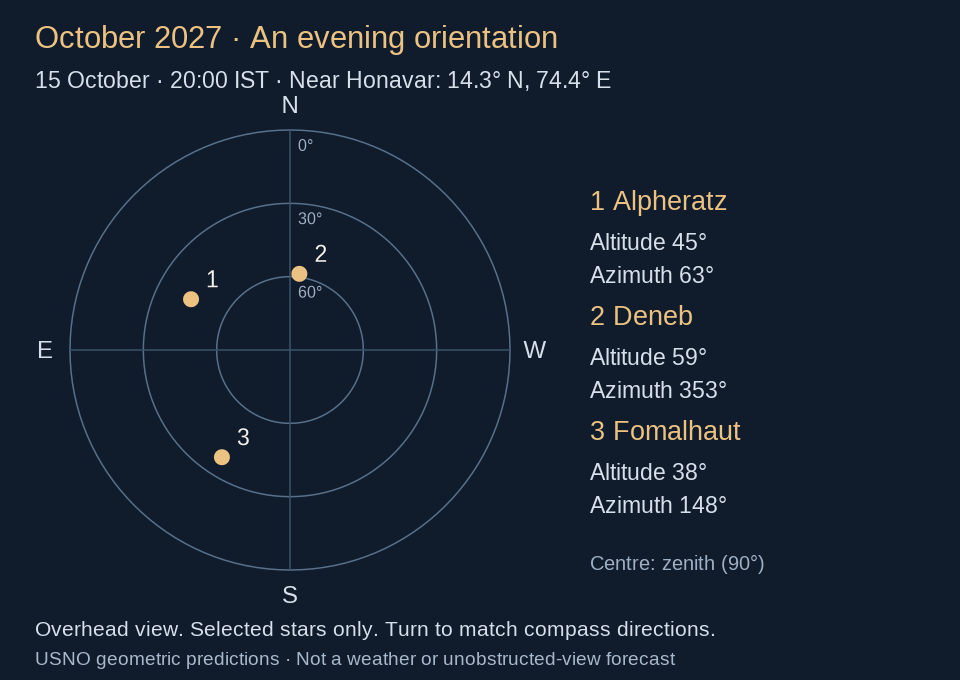
October’s example brings Alpheratz into a useful evening position while Deneb remains in the northern sky and Fomalhaut supplies a southern landmark. Their large separations make this an orientation exercise across the sky rather than a new constellation. Check compass direction before joining any points on a sketch.
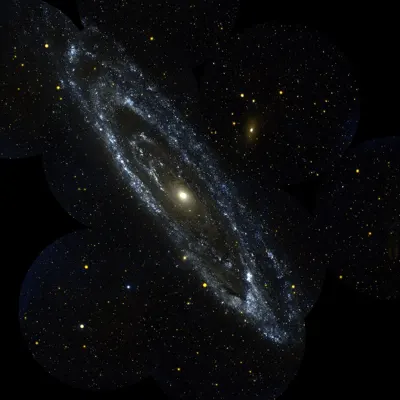
Alpheratz marks a corner of the Great Square region associated with Pegasus and Andromeda. It helps establish the wider field before using the detailed Mirach-to-M31 finder. The Andromeda Galaxy is a faint extended patch in ordinary visual observing conditions, not the bright structured spiral shown by processed photographs.
Use the dated example with your own horizon
The example is calculated for 15 October 2027 at 20:00 IST, using a rounded regional reference near Honavar at 14.3° north and 74.4° east. It gives Alpheratz at about 45° altitude and 63° azimuth; Deneb at about 59° altitude and 353° azimuth; Fomalhaut at about 38° altitude and 148° azimuth. Azimuth is measured clockwise from true north: east is 90°, south 180° and west 270°.
The diagram is an overhead horizon map with the zenith at its centre. Turn it to match compass directions. Positions are geometric predictions rounded to whole degrees; atmospheric refraction, local obstructions and weather are not modelled. Use a chart set to your actual location, date and time for a different session.
Choose a lunar or darker-sky task
This month’s New Moon instant is 29 October at 19:06 IST. Full Moon is 15 October at 19:17 IST. The complete primary-phase table on this page includes the quarter phases, with all dates and clock times in Indian Standard Time.
A phase instant is shared worldwide and is different from local Moonrise or Moonset. New Moon does not guarantee that every hour of the surrounding nights is moonless. Use the phase table to begin planning, then check the Moon’s location and the actual sky brightness for the observing hour.
Make one useful record
For a two-stage task, identify a broad pattern first and then make one careful galaxy attempt with an appropriate wide field. Write the known landmark route separately from the observation of any faint patch. If you cannot confirm M31, keep the chart and conditions with your record so that a later attempt starts with useful information.
Fomalhaut provides a second-direction check when you return to the unaided-eye sky. Its inclusion does not require searching low in twilight or changing to an unsafe observing position. Choose a fully dark suitable time and remember that October weather on the coast can still be unsettled.
PAUSE AND THINK
Does the 15 October map show the sky at the same time every night of the month?
Explore the answer
No. It represents one stated instant. Stars shift relative to the horizon at the same civil clock time as the month progresses. Set a location-aware chart to the actual planned session.