On this page
December 2027 at a glance
| Phase | Date and time |
|---|---|
| First Quarter | |
| Full Moon | |
| Last Quarter | |
| New Moon |
Times mark when the Moon reaches each phase. Select a date to see the sky near Honavar that evening.
| Landmark | Altitude | Azimuth |
|---|---|---|
| Aldebaran | 39° | 80° |
| Capella | 28° | 45° |
| Rigel | 24° | 106° |
Regional reference: 14.3° N, 74.4° E. Geometric positions rounded to whole degrees. North 0°, east 90°, south 180° and west 270°. Terrain, refraction and weather are not included.
THE BIG IDEAS
- The example map is for one stated date, hour and regional reference.
- Primary Moon-phase times are in IST and are not rise or set predictions.
- Choose one achievable task and record conditions alongside the result.
Follow the return of the winter patterns
December’s evening reference brings Aldebaran and Capella higher than in the preceding month while Rigel marks the rising Orion region. These changes make a useful end-of-year comparison with the November map. The actual pattern above a local horizon still depends on the chosen hour and viewing direction.
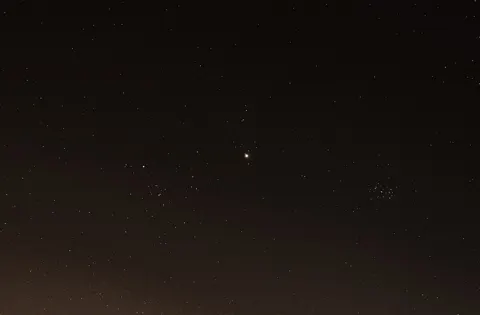
Find Taurus around Aldebaran and use its dedicated guide to place the Pleiades in the larger region. A cluster photograph resolves many more stars than an ordinary unaided-eye view, so begin by describing the bright arrangement you can actually identify. Binoculars need steady support for a comfortable comparison.
Use the dated example with your own horizon
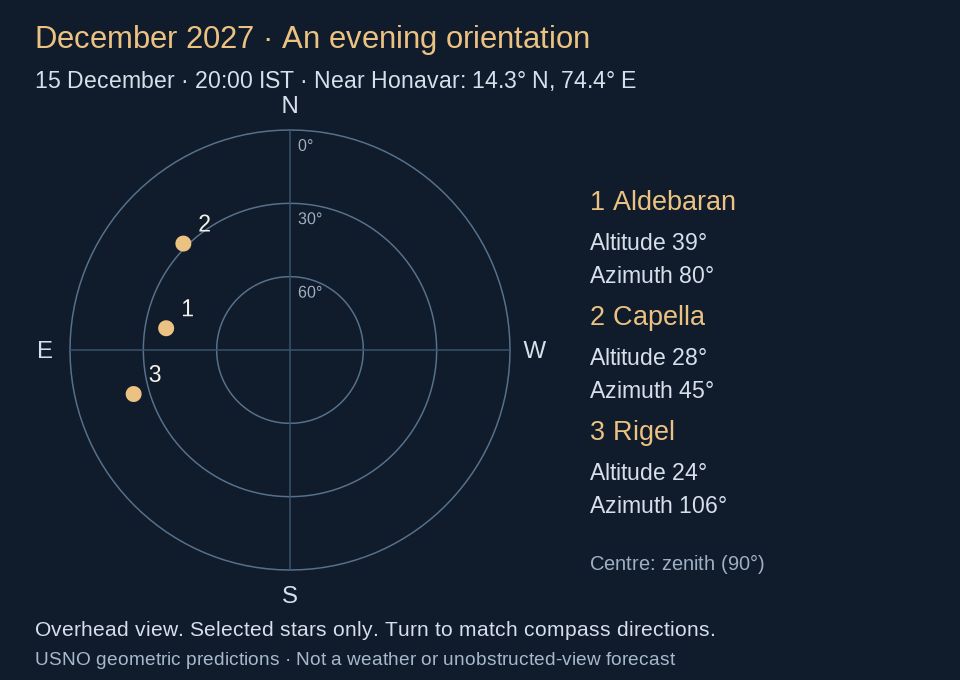
The example is calculated for 15 December 2027 at 20:00 IST, using a rounded regional reference near Honavar at 14.3° north and 74.4° east. It gives Aldebaran at about 39° altitude and 80° azimuth; Capella at about 28° altitude and 45° azimuth; Rigel at about 24° altitude and 106° azimuth. Azimuth is measured clockwise from true north: east is 90°, south 180° and west 270°.
The diagram is an overhead horizon map with the zenith at its centre. Turn it to match compass directions. Positions are geometric predictions rounded to whole degrees; atmospheric refraction, local obstructions and weather are not modelled. Use a chart set to your actual location, date and time for a different session.
Choose a lunar or darker-sky task
This month’s New Moon instant is 28 December at 01:42 IST. Full Moon is 13 December at 21:39 IST. The complete primary-phase table on this page includes the quarter phases, with all dates and clock times in Indian Standard Time.
A phase instant is shared worldwide and is different from local Moonrise or Moonset. New Moon does not guarantee that every hour of the surrounding nights is moonless. Use the phase table to begin planning, then check the Moon’s location and the actual sky brightness for the observing hour.
Make one useful record
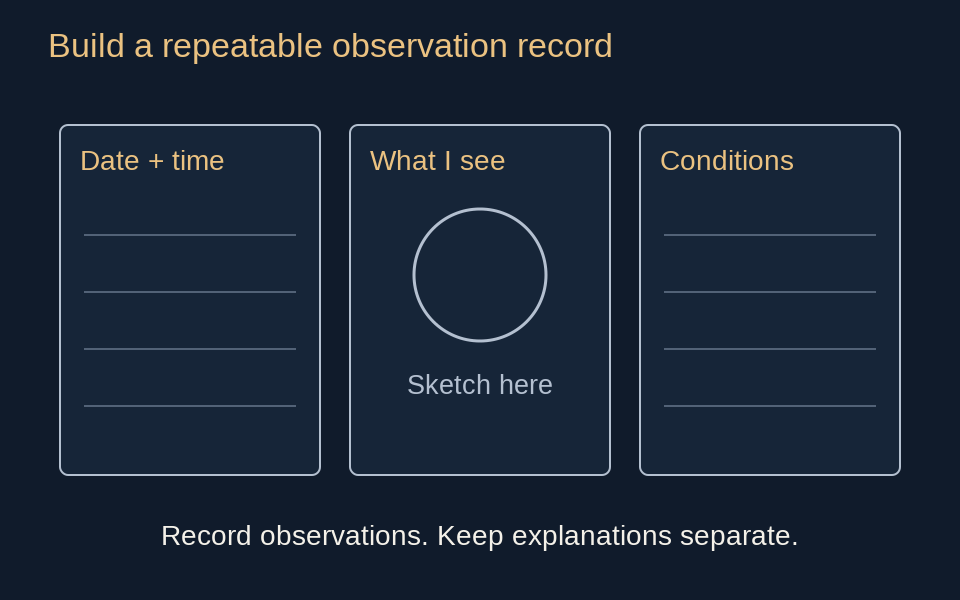
Make a dated sketch showing Taurus and the direction toward Orion. If you can return at the same clock time in January, compare the positions relative to a fixed horizon feature. Keep the distinction between an unchanging local landmark and the moving sky. A physical connection between the stars is not implied by the lines on your page.
Choose the lunar task according to the phase opportunities in this month’s table. Crater shadows near the boundary of lunar daylight can offer more relief than a nearly full disk. For a faint-cluster comparison, use the actual sky brightness and Moon position at the observation time rather than the date alone.
PAUSE AND THINK
Does the 15 December map show the sky at the same time every night of the month?
Explore the answer
No. It represents one stated instant. Stars shift relative to the horizon at the same civil clock time as the month progresses. Set a location-aware chart to the actual planned session.