On this page
May 2027 at a glance
| Phase | Date and time |
|---|---|
| New Moon | |
| First Quarter | |
| Full Moon | |
| Last Quarter |
Times mark when the Moon reaches each phase. Select a date to see the sky near Honavar that evening.
| Landmark | Altitude | Azimuth |
|---|---|---|
| Arcturus | 43° | 77° |
| Spica | 46° | 123° |
| Regulus | 78° | 260° |
Regional reference: 14.3° N, 74.4° E. Geometric positions rounded to whole degrees. North 0°, east 90°, south 180° and west 270°. Terrain, refraction and weather are not included.
THE BIG IDEAS
- The example map is for one stated date, hour and regional reference.
- Primary Moon-phase times are in IST and are not rise or set predictions.
- Choose one achievable task and record conditions alongside the result.
A brightness comparison before the monsoon months
May’s example brings Arcturus and Spica into a more comfortable early-evening position while Regulus remains high. These three landmarks are useful for practising apparent brightness comparisons across a broad area. Set a manageable observing time and do not treat a star’s brightness in a phone photograph as a direct visual measurement.
Begin by identifying each star from its surrounding pattern. Compare Arcturus with Spica in alternating short looks rather than staring continuously at one point. Their colours, heights and atmospheric paths are different. Those differences can influence your impression, so write the observed ranking and the conditions before consulting a catalogue magnitude.
Use the dated example with your own horizon
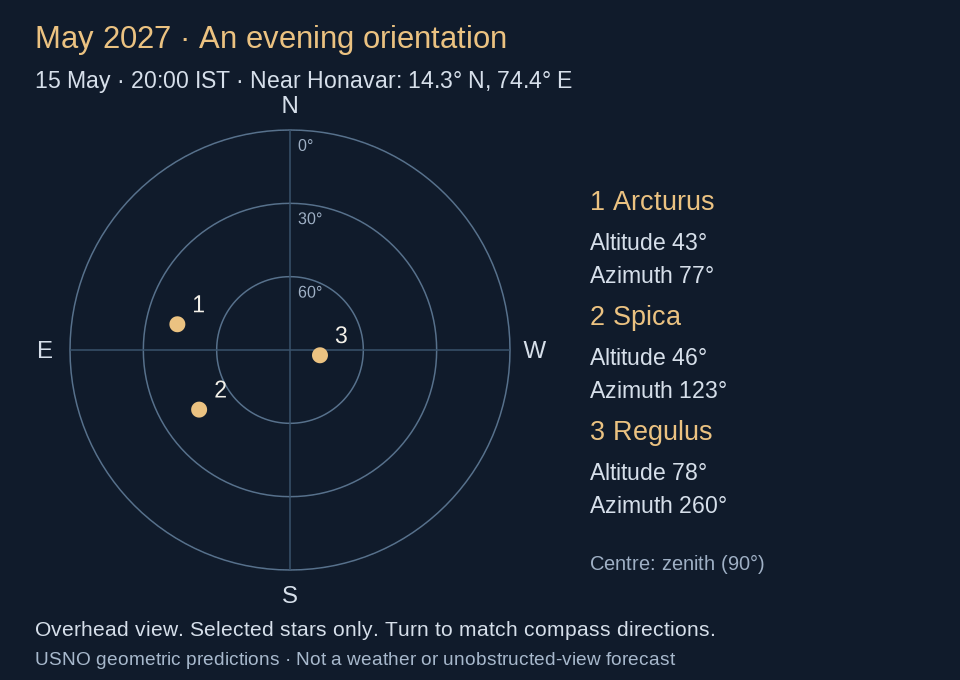
The example is calculated for 15 May 2027 at 20:00 IST, using a rounded regional reference near Honavar at 14.3° north and 74.4° east. It gives Arcturus at about 43° altitude and 77° azimuth; Spica at about 46° altitude and 123° azimuth; Regulus at about 78° altitude and 260° azimuth. Azimuth is measured clockwise from true north: east is 90°, south 180° and west 270°.
The diagram is an overhead horizon map with the zenith at its centre. Turn it to match compass directions. Positions are geometric predictions rounded to whole degrees; atmospheric refraction, local obstructions and weather are not modelled. Use a chart set to your actual location, date and time for a different session.
Choose a lunar or darker-sky task
This month’s New Moon instant is 6 May at 16:28 IST. Full Moon is 20 May at 16:29 IST. The complete primary-phase table on this page includes the quarter phases, with all dates and clock times in Indian Standard Time.
A phase instant is shared worldwide and is different from local Moonrise or Moonset. New Moon does not guarantee that every hour of the surrounding nights is moonless. Use the phase table to begin planning, then check the Moon’s location and the actual sky brightness for the observing hour.
Make one useful record
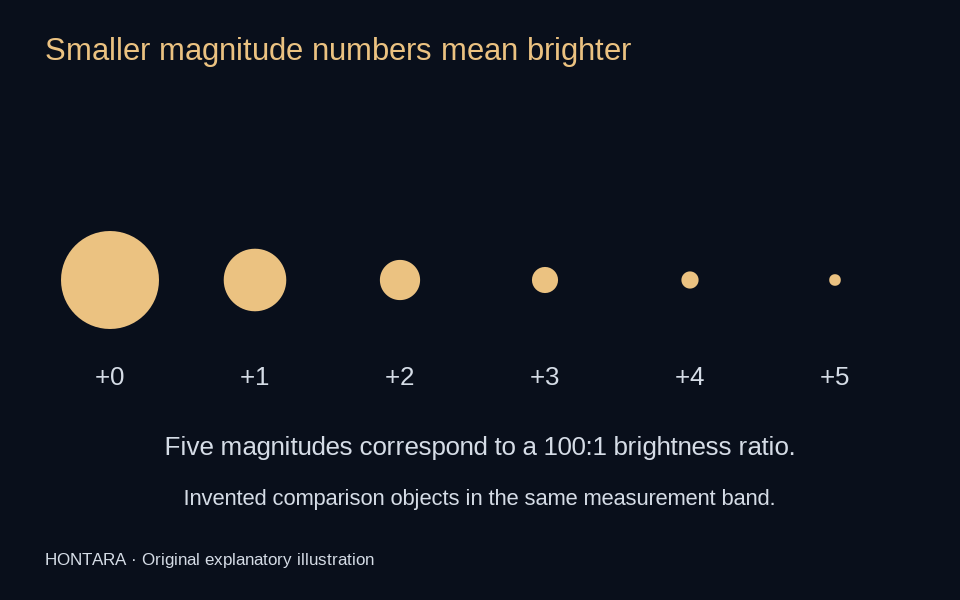
Turn the comparison into an evidence task: record the order you predict, the order you see and one possible reason for disagreement. A catalogue magnitude describes an apparent brightness in a defined measurement context; it is not the physical size of the star. Revisit the magnitude explanation after making your own cautious record.
Coastal humidity and changing clouds can interrupt a clear-looking evening. Keep optics protected when equipment instructions require it and allow a short session to end early. A cloudy night can still support the indoor task of distinguishing distance, luminosity and apparent brightness using the three labelled stellar examples.
PAUSE AND THINK
Does the 15 May map show the sky at the same time every night of the month?
Explore the answer
No. It represents one stated instant. Stars shift relative to the horizon at the same civil clock time as the month progresses. Set a location-aware chart to the actual planned session.