On this page
August 2027 at a glance
| Phase | Date and time |
|---|---|
| New Moon | |
| First Quarter | |
| Full Moon | |
| Last Quarter | |
| New Moon |
Times mark when the Moon reaches each phase. Select a date to see the sky near Honavar that evening.
| Landmark | Altitude | Azimuth |
|---|---|---|
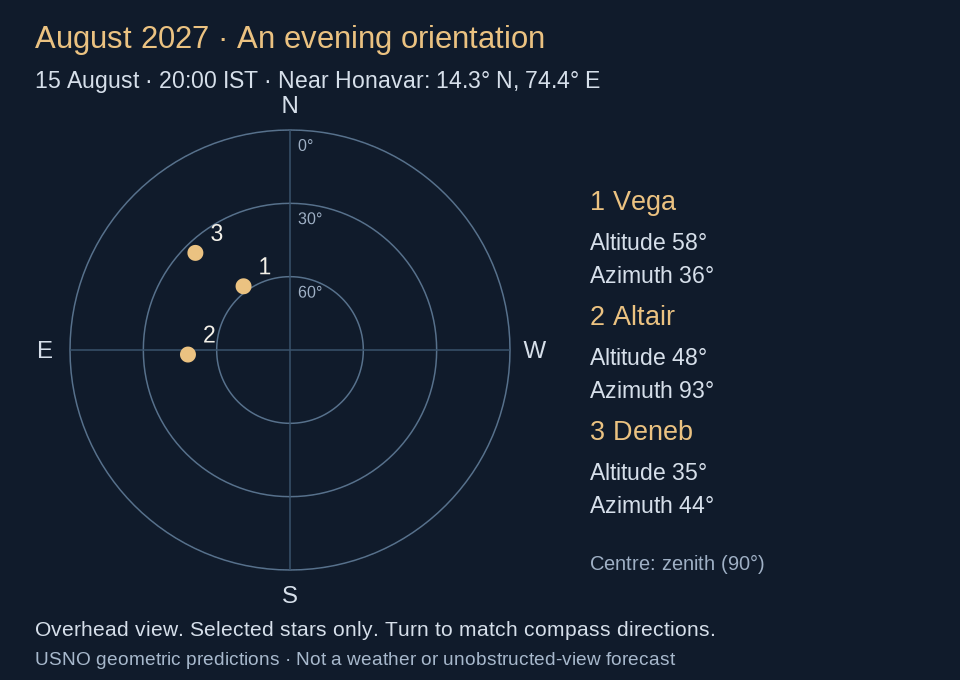
| Vega | 58° | 36° |
| Altair | 48° | 93° |
| Deneb | 35° | 44° |
Regional reference: 14.3° N, 74.4° E. Geometric positions rounded to whole degrees. North 0°, east 90°, south 180° and west 270°. Terrain, refraction and weather are not included.
THE BIG IDEAS
- The example map is for one stated date, hour and regional reference.
- Primary Moon-phase times are in IST and are not rise or set predictions.
- Choose one achievable task and record conditions alongside the result.
Orient a wide triangle above the horizon
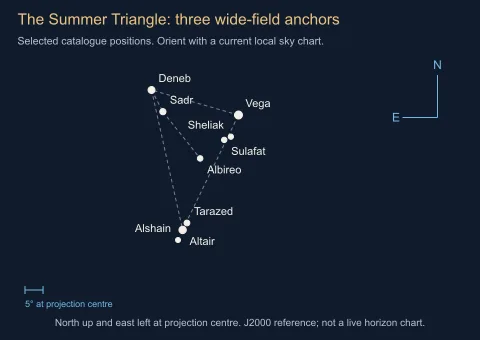
August’s example uses Vega, Altair and Deneb to connect three separate constellations. The familiar Summer Triangle name comes from a northern seasonal viewpoint; its evening appearance at Honavar still needs a date and hour. The triangle is an asterism rather than one officially bounded constellation.
Identify each bright corner from more than its brightness alone. Vega belongs to Lyra, Altair to Aquila and Deneb to Cygnus. Use the separate finder guides to check neighbouring stars. A large angular triangle cannot be taken in as one normal telescope field, so establish it with your eyes first.
Use the dated example with your own horizon
The example is calculated for 15 August 2027 at 20:00 IST, using a rounded regional reference near Honavar at 14.3° north and 74.4° east. It gives Vega at about 58° altitude and 36° azimuth; Altair at about 48° altitude and 93° azimuth; Deneb at about 35° altitude and 44° azimuth. Azimuth is measured clockwise from true north: east is 90°, south 180° and west 270°.
The diagram is an overhead horizon map with the zenith at its centre. Turn it to match compass directions. Positions are geometric predictions rounded to whole degrees; atmospheric refraction, local obstructions and weather are not modelled. Use a chart set to your actual location, date and time for a different session.
Choose a lunar or darker-sky task
This month’s New Moon instants are 2 August at 15:35 IST and 31 August at 23:11 IST. Full Moon is 17 August at 12:59 IST. A partial solar eclipse is visible from Honavar and many other Indian cities on 2 August, weather permitting.
A phase instant is shared worldwide and is different from local Moonrise or Moonset. New Moon does not guarantee that every hour of the surrounding nights is moonless. Use the phase table to begin planning, then check the Moon’s location and the actual sky brightness for the observing hour.
Make one useful record
Make a large paper sketch and mark the three compass-facing parts of the sky used to identify the corners. Then select just one region for a closer look with binoculars or a telescope. This change of scale is the exercise: broad landmarks help you reach a smaller field, but the smaller field needs its own checks.
Clouds during the coastal monsoon can leave short gaps that tempt hurried identification. Wait for a stable enough interval to confirm the neighbours and stop when rain threatens. If you see only one corner, label that point with its supporting evidence and leave the others unconfirmed rather than completing a triangle from memory.
PAUSE AND THINK
Does the 15 August map show the sky at the same time every night of the month?
Explore the answer
No. It represents one stated instant. Stars shift relative to the horizon at the same civil clock time as the month progresses. Set a location-aware chart to the actual planned session.