On this page
THE BIG IDEAS
- Chandrayaan-3 soft-landed in August 2023.
- Its high-southern-latitude site is not the exact south pole.
- Local measurements need context before they are generalised.
A focused set of objectives
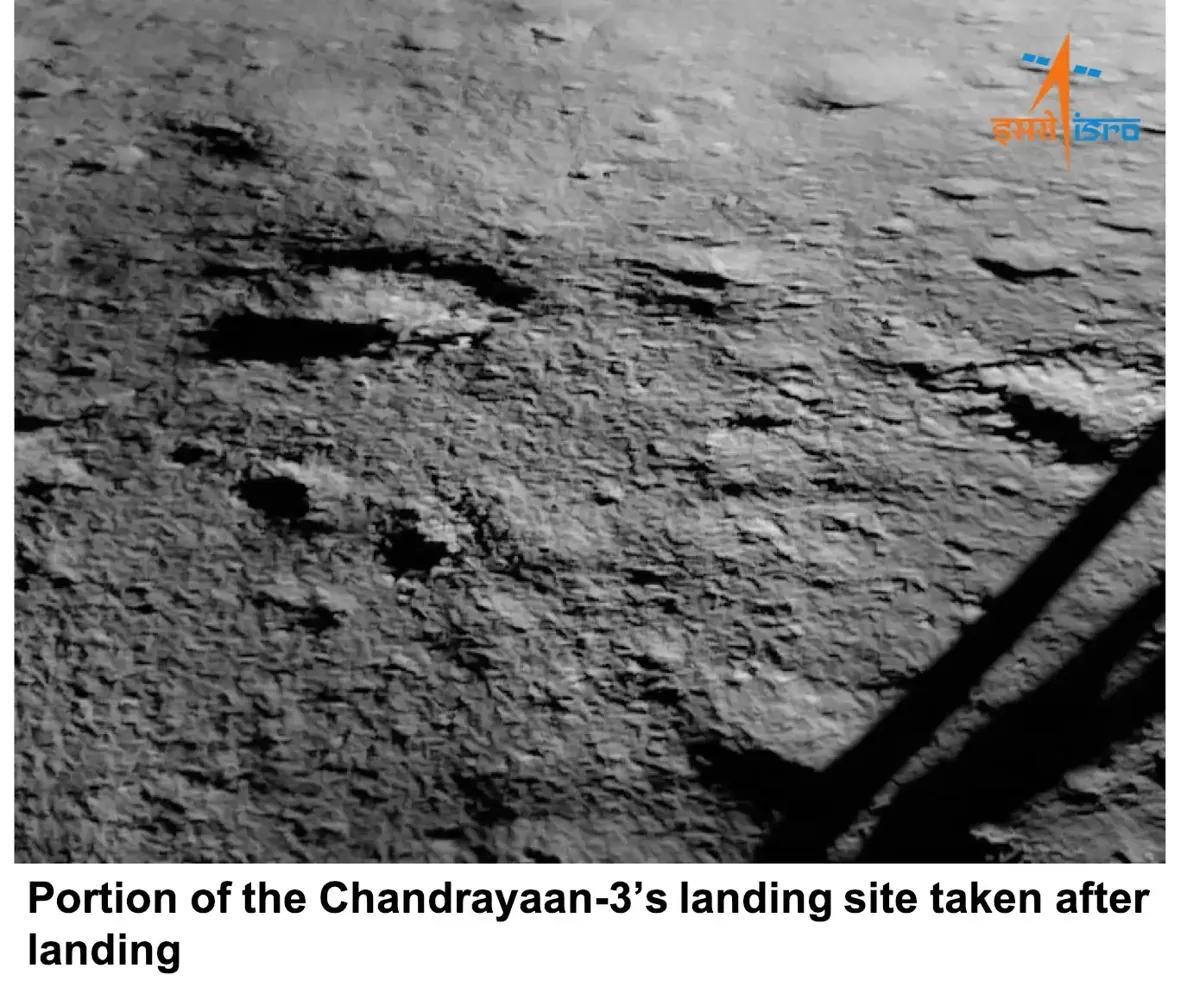
Chandrayaan-3 was designed to demonstrate a safe soft landing, rover movement and scientific experiments on the Moon. The Vikram lander touched down on 23 August 2023 and the Pragyan rover subsequently moved onto the surface. The landing was at high southern latitude, not at the Moon’s exact geographic south pole. That geographical distinction matters when describing the environment and comparing this site with permanently shadowed polar regions.
Getting down gently
A lander approaching an airless world cannot rely on parachutes. It must control speed and direction using propulsion, sensors and guidance software. Chandrayaan-3 used measurements of altitude, velocity and surface conditions to support its descent. Landing legs then had to manage the final contact. These tasks are linked: a reliable touchdown needs a suitable trajectory and terrain as well as a structure capable of absorbing the remaining motion.
Different experiments at one location
The lander carried experiments concerned with temperature-related properties, local seismic activity and near-surface plasma. The rover carried instruments to examine elemental composition, including laser-induced breakdown spectroscopy and an alpha-particle X-ray spectrometer. These names describe physical methods rather than decorative acronyms. In each case an instrument converts an interaction with matter into a signal that can be calibrated and interpreted on Earth.
What the results mean
ISRO reported in-situ measurements confirming sulfur in material near the landing site, along with other elemental observations. In situ means the measurement was made at the location being studied. Such a result describes sampled material within the instrument’s reach; it is not automatically a global map of the Moon. Local measurements become more powerful when compared with orbital data and geological context. Temperature profiles likewise need depth, timing and location information.
A model for careful questions
Instead of asking only whether a rover moved, ask why movement helps: it allows measurements at more than one spot and reveals variation. Instead of treating a photograph as proof of composition, ask which instrument measured the chemistry. Chandrayaan-3 connects engineering demonstrations with scientific evidence. Its achievements are best understood through specific capabilities and observations, without assuming that every future exploration challenge has already been solved.
PAUSE AND THINK
Why is a rover’s chemical measurement different from a photograph of a rock?
Explore the answer
The chemical instrument measures signals linked to elements, while a photograph mainly records appearance. Appearance alone does not uniquely identify composition.