On this page
THE BIG IDEAS
- The orbiter and lander had distinct objectives.
- The unsuccessful landing did not remove the orbiter’s scientific contribution.
- Measurements of solar radiation help interpret lunar X-ray signals.
A mission with several components
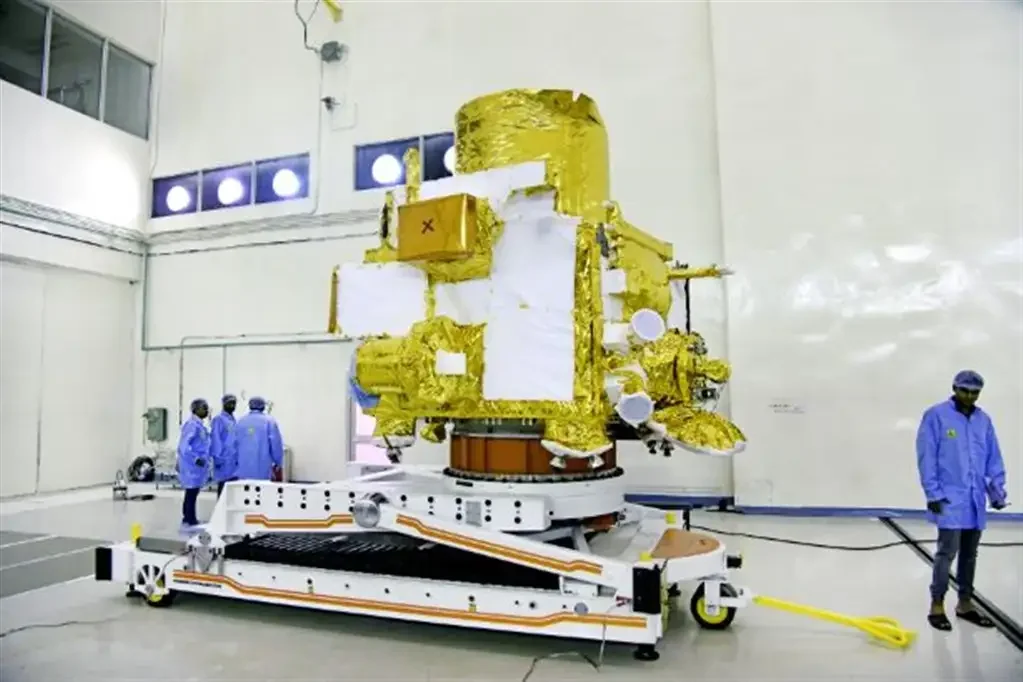
Chandrayaan-2 launched on 22 July 2019 with an orbiter, the Vikram lander and the Pragyan rover. Each component had a different role. The orbiter was intended to investigate the Moon remotely, while the lander and rover were intended to make measurements on the surface. Separating these objectives helps explain the mission fairly: one outcome does not automatically describe every spacecraft or experiment in a complex exploration programme.
The landing attempt and the orbiter
The 2019 descent of Vikram did not achieve the planned soft landing. Communication was lost during the final approach. The orbiter, however, had already reached lunar orbit and carried its own scientific payloads. It continued producing observations after the landing attempt. A useful mission timeline therefore records the launch, orbital insertion, lander separation and descent separately rather than reducing the entire mission to one word such as success or failure.
Mapping composition with X-rays
The CLASS instrument was designed to study characteristic X-rays from the lunar surface. Solar X-rays excite surface material, which can emit signals associated with elements such as magnesium, aluminium and silicon. The accompanying Solar X-ray Monitor helps measure the incoming solar radiation needed to interpret those lunar signals. This partnership between instruments is a good example of calibration: understanding the illumination is part of understanding the surface response.
Looking beyond ordinary pictures
Other orbiter instruments include infrared spectroscopy, radar and cameras. Infrared measurements help investigate minerals and water-related signatures. Radar can probe properties that an ordinary photograph does not reveal, particularly in challenging polar regions. High-resolution imaging adds context for geological features and landing-site studies. Each instrument has its own spatial resolution and limitations, so a coloured map should be read together with its legend, measurement method and uncertainty.
Lessons for an investigation
Chandrayaan-2 shows why space science relies on systems that support one another. A measurement of the Moon may depend on a simultaneous measurement of the Sun and a small landing area can be interpreted using global orbital maps. It also shows how engineering lessons can inform a later mission without erasing useful science from the earlier one. When comparing missions, ask which questions each instrument could answer and which required a different kind of access.
PAUSE AND THINK
Why does a lunar surface experiment need information about the Sun?
Explore the answer
For X-ray fluorescence measurements, incoming solar X-rays help excite the lunar material. Measuring that input helps scientists interpret the emitted signal.