On this page
Use a definition with a stated scope
The International Astronomical Union’s 2006 definition distinguishes planets, dwarf planets and small Solar System bodies. It addresses bodies in our Solar System, so it should not be silently treated as a complete classification rule for every object orbiting another star.
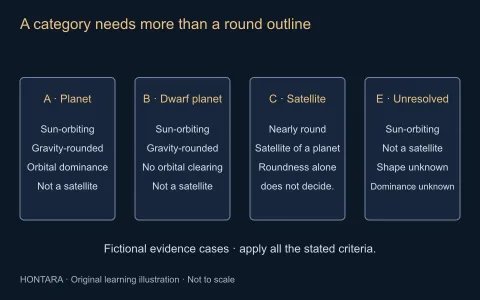
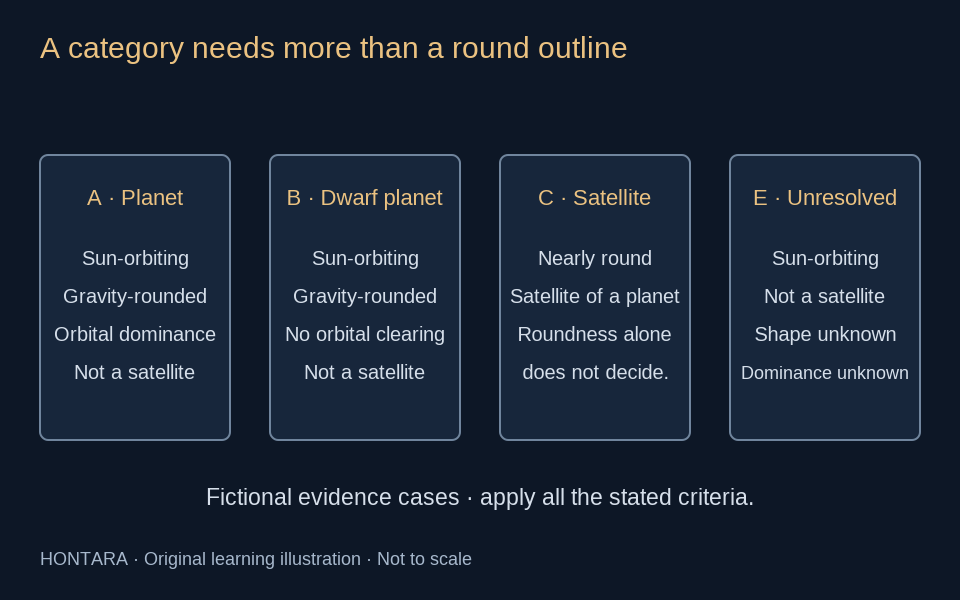
Under that definition a planet orbits the Sun, is nearly round because of its own gravity and has cleared the neighbourhood around its orbit. The dwarf-planet category also requires a Sun-orbiting, gravity-rounded body, but it has not cleared its orbital neighbourhood and is not a satellite.
THE BIG IDEAS
- The 2006 definition has a Solar System scope.
- A cleared neighbourhood means dominance rather than absolute emptiness.
- Size or roundness alone cannot settle the category.
Understand what cleared means
Clearing does not require a perfectly empty orbital lane with no dust, asteroids or other small bodies. The relevant idea is gravitational dominance of the orbital region. A planet can coexist with smaller companions without losing its planetary status.
Likewise, two drawn orbital paths crossing on a flat diagram do not provide the complete dynamical evidence. Their geometry, timing, resonances and the surrounding population matter. Avoid reducing the definition to whether a picture shows another dot somewhere near an orbit.
Separate roundness from classification
Roundness is an important clue about self-gravity, but it is not sufficient by itself. A large rounded moon remains a satellite. A Sun-orbiting rounded body needs its orbital context assessed before the planet/dwarf-planet distinction can be made.
Nearly round also does not mean a mathematically perfect sphere. Rotation and physical properties influence a body’s shape. There is no single diameter in the definition that lets you classify every world from size alone without evidence about its structure and orbit.
Use familiar examples without a ranking
Pluto and Ceres are examples of dwarf planets. The category does not mean that either body is scientifically unimportant. Their surfaces, interiors and histories remain subjects of investigation regardless of the label used in a classification scheme.
For a useful comparison, list which criteria are supported for each object and which observations establish them. The paired evidence-card activity includes an unresolved case on purpose: when information about roundness or orbital dominance is missing, an honest answer may be that the supplied evidence is insufficient.
PAUSE AND THINK
Is a nearly round object automatically a dwarf planet?
Explore the answer
No. A rounded moon is a satellite and a rounded Sun-orbiting object also needs its orbital context assessed. The full definition contains several criteria.