On this page
THE BIG IDEAS
- Require a criterion-based explanation for each label.
- Keep missing evidence different from negative evidence.
- Test transfer with a new case rather than a familiar object name.
Make justification the assessment target
The aim is to classify the supplied cases under the stated 2006 Solar System definition and cite the deciding evidence. A correct label without a reason is incomplete. Include the deliberately unresolved case so learners practise recognising what the evidence does not establish.
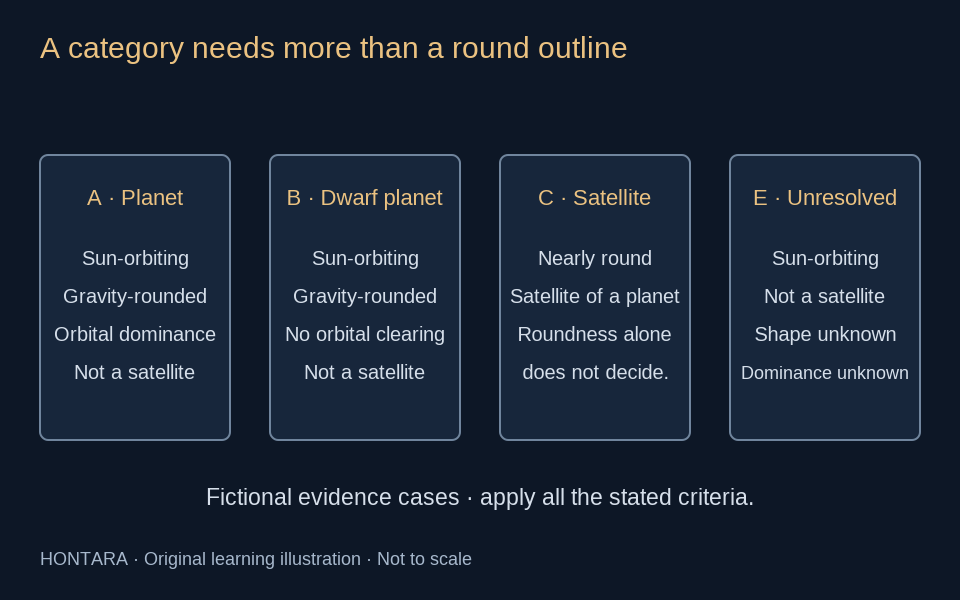
Prepare the five fictional cards from the paired activity and the definition summary. Do not add suggestive object pictures, familiar names or size rankings that let learners guess a category without reading the properties. This is an evidence-sorting lesson rather than a debate over the scientific value of Pluto.
Use a 45-minute sequence
Use five minutes to establish scope, ten to annotate the criteria, ten for individual classifications, ten for pair comparison and ten for an exit case. Keep a visible column for known, ruled out and unknown properties.
Read the cards aloud or provide a text table so the task does not depend on visual appearance. Ask learners to distinguish a missing criterion from a criterion explicitly reported as false. Both can prevent a conclusion, but they require different explanations.
Use the answer guide precisely
A is a planet because all three relevant properties are given. B is a dwarf planet because it is a non-satellite, Sun-orbiting, gravity-rounded body reported not to have cleared its neighbourhood. C is a satellite. D belongs to the broader small Solar System body category.
E remains insufficiently characterised because its self-gravity-controlled shape and orbital dominance are not supplied. Do not award a confident dwarf-planet answer merely because a learner associates the card with small or distant worlds. The cards are invented and do not secretly name real discoveries.
Address two common shortcuts
If a learner treats clearing as complete emptiness, ask whether the presence of any dust would invalidate a planet. Explain the intended dynamical-dominance idea. A flat drawing of crossing paths is also insufficient by itself to evaluate the full dynamical context.
If roundness is treated as the only criterion, return to C. A rounded satellite does not meet the dwarf-planet requirement that the object not be a satellite. The definition’s separate conditions must be considered together rather than replacing one another.
Assess transfer without a memorised name
Offer a new invented Sun-orbiting, non-satellite object known to be gravity-rounded but with no orbital-neighbourhood assessment. Ask which distinction remains unresolved. Expect that the supplied facts do not separate planet from dwarf planet under the stated definition.
For extension compare how a classification statement differs from a physical explanation of an object’s formation or composition. A category can guide questions, but it does not make all members identical. Encourage learners to state the scope of a rule when applying it to a new setting.
PAUSE AND THINK
What should the exit-case answer preserve when orbital dominance is unknown?
Explore the answer
It should preserve the unresolved planet/dwarf-planet distinction rather than making a confident choice from the other known properties alone.
RECORD YOUR OWN EVIDENCE
Your activity sheet
You need: The five fictional evidence cards in this resource, paper and pencil.
Annotate every fictional case with known, false or unknown criteria, then justify the category or explain why it remains unresolved.
Name or group: Date:
| Case | Proposed category | Deciding evidence | Missing information |
|---|---|---|---|
| A | |||
| B | |||
| C | |||
| D | |||
| E |
Identify the single supplied fact distinguishing A from B.
Explain why C tests the roundness-only shortcut.
Write the additional evidence needed to separate the exit case’s two possible categories.
Invented classification cases. Do not treat a name, displayed size or flat orbit sketch as a substitute for the stated evidence.