On this page
THE BIG IDEAS
- Apply all relevant criteria rather than roundness alone.
- Do not infer a detailed object type from missing evidence.
- An unresolved case can be the correct evidence-based result.
Read the rule with its scope
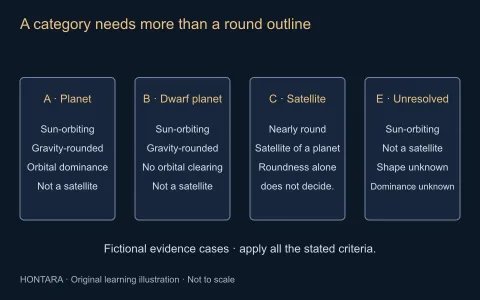
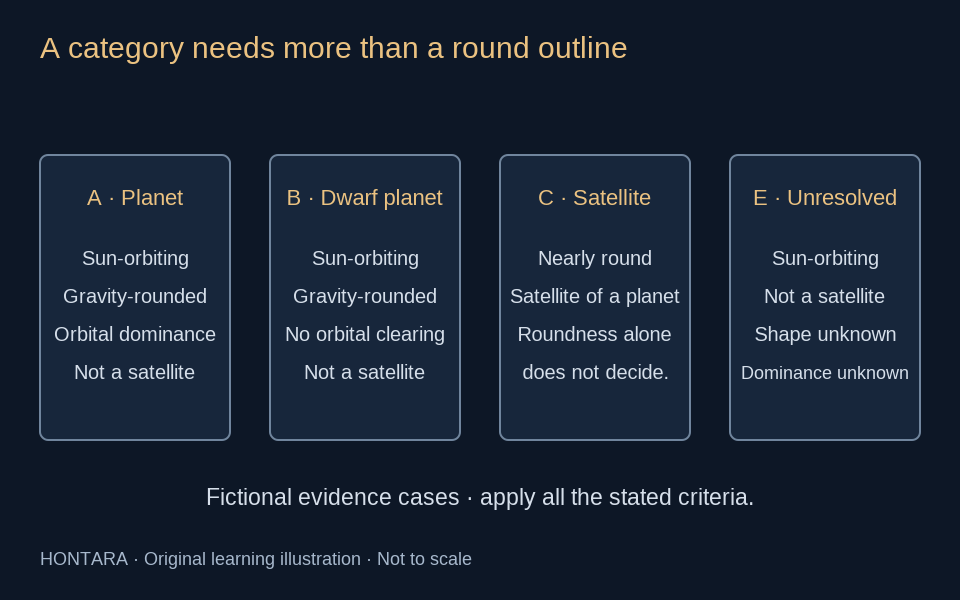
Use the 2006 Solar System definition in the linked explanation. A planet orbits the Sun, is gravity-rounded and dominates its orbital neighbourhood. A dwarf planet is a Sun-orbiting gravity-rounded body that has not cleared its neighbourhood and is not a satellite.
The definition also groups other non-satellite Sun-orbiting objects as small Solar System bodies. Your task is to apply these stated categories, not to invent a universal classification for objects around other stars. Use paper and pencil to record a category and the evidence supporting it.
Compare cases A and B
Case A is an invented non-satellite body orbiting the Sun. Its self-gravity produces a nearly round shape and the supplied dynamical assessment says it dominates its orbital region. Case B shares the first two properties but the assessment says it has not cleared its orbital neighbourhood.
Classify A and B separately and underline the one supplied fact that changes the result. Do not replace the evidence with the apparent size of a drawn dot. No numerical diameter or discovery name is needed to apply these complete fictional cards.
Use the satellite and shape evidence
Case C is a nearly round satellite of a planet. Case D is a non-satellite body orbiting the Sun, with an irregular shape not made nearly round by self-gravity; it does not dominate its orbital region. Choose categories using those explicit facts.
Being nearly round is not sufficient for C to become a dwarf planet. D also should not be called a comet or a particular kind of asteroid from the given information alone. The broader small-body category is supported without inventing unprovided composition or activity evidence.
Leave case E unresolved
Case E is a non-satellite body orbiting the Sun. Reliable evidence about its gravity-controlled shape and orbital dominance is not supplied. Decide whether the named categories can be separated from this information and state what additional observations or dynamical analysis are needed.
An insufficient-evidence answer is appropriate when a required criterion is unknown. Do not fill the gap with a guess based on an attractive picture, an informal nickname or the assumption that every new distant object must belong to one particular category.
Explain and check the reasoning
The intended classifications are A=planet, B=dwarf planet, C=satellite, D=small Solar System body and E=insufficient evidence. Compare your explanation with a partner’s, focusing on the criterion cited rather than whether the same label appears.
Finally explain why clearing is not an absolutely empty orbit and why a body’s category is not a ranking of scientific interest. Classification organises stated evidence under a definition; it does not remove the need to study an object’s own properties and history.
PAUSE AND THINK
What would be wrong with calling E a dwarf planet just because it is described as distant?
Explore the answer
Distance alone does not supply the required evidence about gravity-rounded shape or orbital neighbourhood. The card does not support that classification.
RECORD YOUR OWN EVIDENCE
Your activity sheet
You need: The five fictional evidence cards in this resource, paper and pencil.
Apply the stated 2006 Solar System criteria to each invented case. Use planet, dwarf planet, satellite, small Solar System body or insufficient evidence and cite the deciding fact.
Name or group: Date:
| Case | Proposed category | Deciding evidence | Missing information |
|---|---|---|---|
| A | |||
| B | |||
| C | |||
| D | |||
| E |
Why does a cleared neighbourhood not mean an absolutely empty orbit?
Why is a nearly round satellite not a dwarf planet?
Which case must remain unresolved from the supplied evidence?
Invented classification cases. Do not treat a name, displayed size or flat orbit sketch as a substitute for the stated evidence.