On this page
THE BIG IDEAS
- New Horizons explored Pluto through a flyby rather than an orbit.
- Pluto has a varied surface and geological history.
- The Arrokoth encounter extended the investigation into the Kuiper Belt.
A distant destination
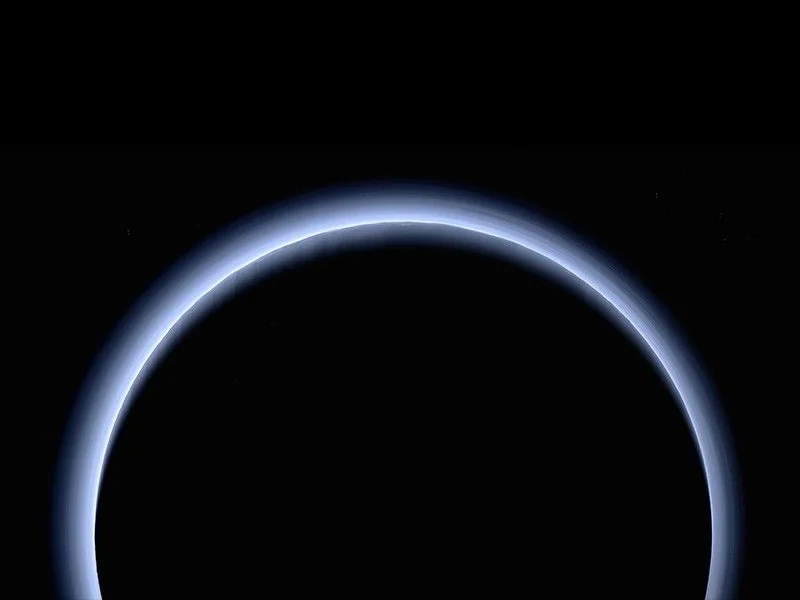
New Horizons launched on 19 January 2006 and made its closest approach to Pluto on 14 July 2015. Before that encounter, Pluto was known mainly through distant observations with limited spatial detail. The flyby transformed understanding of its surface, atmosphere and moons. Pluto’s classification as a dwarf planet did not reduce its scientific value. Categories help organise worlds, but exploration determines how varied and surprising those worlds can be.
Why it flew past
Entering orbit requires a large change in velocity, usually demanding fuel and a mission design very different from a fast encounter. New Horizons was a flyby mission, so its highest-resolution observations had to be scheduled around a brief close passage. The spacecraft collected data faster than it could send everything home immediately. Storing observations onboard and transmitting them over an extended period was therefore part of the mission strategy.
An unexpectedly active-looking landscape
The encounter revealed mountains, plains and surface patterns that pointed to a more complex geological history than a uniformly ancient cratered ball. Different materials behave differently at Pluto’s extremely low temperatures. Water ice can form rigid terrain while more volatile ices participate in other surface processes. Interpreting a landscape requires knowledge of temperature and composition, not simply matching its shape to a familiar feature on Earth.
Beyond Pluto
On 1 January 2019, New Horizons flew past the Kuiper Belt object Arrokoth. Its two-lobed form provided evidence relevant to how small bodies assembled in the early Solar System. A small primitive object and a larger differentiated world such as Pluto answer different questions. Visiting both demonstrates the value of a broader population study: one object cannot stand in for every body occupying a distant region.
Use the images as measurements
When examining a New Horizons image, look for its scale, illumination direction and processing notes. A bright area may reflect material differences, topography or lighting and scientists use multiple observations to distinguish these possibilities. Also notice the delay between taking an image and receiving it on Earth. Exploration at great distances depends on planned sequences and patient data return, not an operator steering immediately in response to a live camera feed.
PAUSE AND THINK
Why could a spacecraft continue sending encounter data long after it had passed Pluto?
Explore the answer
It stored observations onboard during the encounter and transmitted them later through a limited-capacity radio link.