On this page
Leftovers with individual histories
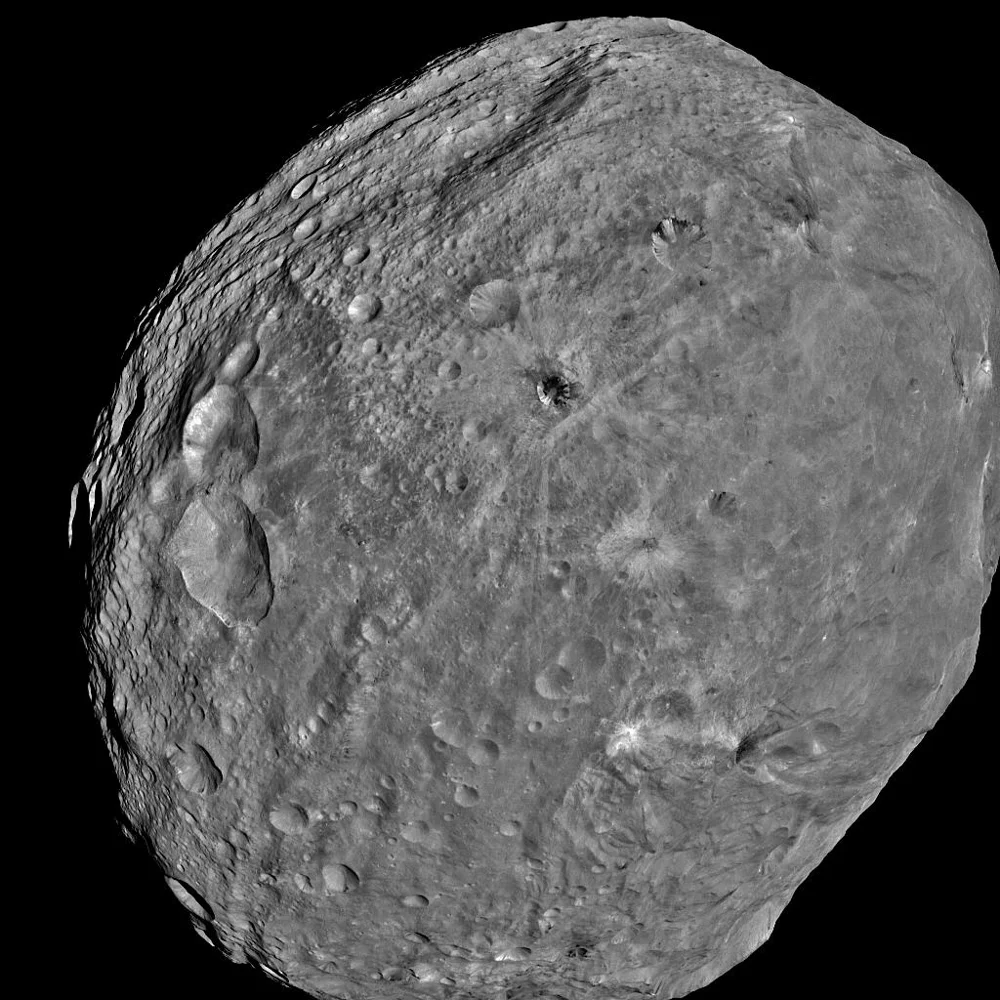
Asteroids are small rocky or metallic bodies orbiting the Sun. Many preserve material from the early Solar System, though collisions, heating and other processes have changed them over time. They vary in size, shape and composition. Some are relatively coherent bodies and others are loose collections of fragments held together by gravity. Treating every asteroid as a miniature smooth planet misses much of what makes them scientifically interesting.
THE BIG IDEAS
- Asteroids vary in composition and structure.
- The asteroid belt is mostly empty space.
- Orbit measurements are essential for identifying motion and assessing risk.
The main belt
Most familiar asteroids occupy the broad region between Mars and Jupiter known as the main asteroid belt. This is not a dense field of almost-touching rocks. The objects are separated by large distances compared with their sizes, so spacecraft can cross the belt without weaving through a continuous obstacle course. Illustrations usually enlarge asteroids to make them visible and should not be interpreted as accurate pictures of the spacing.
Not every asteroid stays in the belt
Asteroids also occupy other orbital families. Trojan populations share a planet’s orbital neighbourhood near stable gravitational regions, while near-Earth asteroids have paths that bring them relatively close to Earth’s orbit. Near-Earth is an orbital classification rather than an announcement of an imminent impact. Assessing risk requires repeated measurements, an orbit solution and consideration of uncertainty. One dramatic headline cannot replace that careful tracking process.
Small bodies can reveal big processes
Asteroids help researchers study how solid material accumulated and changed while planets were forming. A sample returned by a spacecraft can be measured in laboratories with instruments too large or specialised to send into space. It also provides a known collection context, unlike many meteorites found after weathering on Earth. Remote images, spectra and physical samples answer different questions and are strongest when interpreted together.
Observing and reasoning
Through a small telescope, most asteroids look like faint points rather than resolved rocky shapes. Their identity can be established by comparing positions against background stars over time. A single image of a dot does not show whether it is a star, asteroid or artefact. Timing and repeated measurements turn an ordinary-looking point into evidence of motion. This is an accessible example of why astronomy depends on records as well as impressive pictures.
PAUSE AND THINK
Why can a spacecraft cross the asteroid belt without constantly dodging visible rocks?
Explore the answer
Although the belt contains many objects, its volume is enormous and typical separations are large compared with asteroid sizes.