On this page
THE BIG IDEAS
- Repeat trials because individual marks vary.
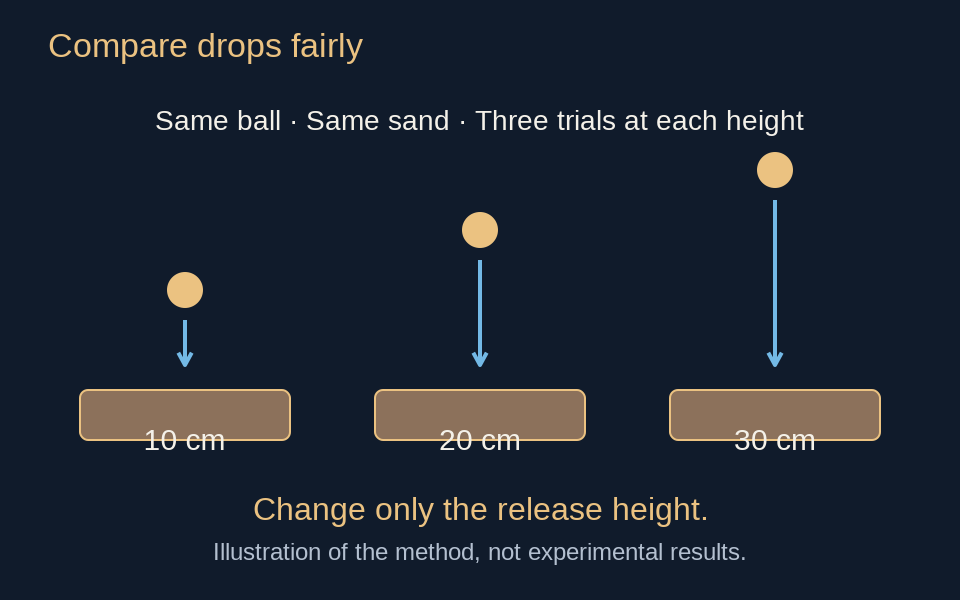
- Change one intended variable while keeping others similar.
- Small classroom impacts do not reproduce high-speed planetary impacts.
Ask a measurable question
Will the same clay ball make a wider mark when dropped from a greater height? This question is narrow enough to investigate with classroom materials. Write a prediction before beginning and explain why you expect it. A controlled investigation becomes useful when another group can follow your method and compare its results with yours.
Prepare a low-dust surface
Use a shallow tray of clean, slightly damp sand, a small smooth clay ball, ruler and scrap paper. Use clay firm enough to keep the ball’s shape and check it after each drop. Avoid flour, cocoa or dry powders that can become airborne.
Place the tray on the floor away from feet and fragile objects. Use short drops below knee height, keep faces away and do not throw the ball. Wash hands afterwards. An adult should check the materials and supervise.
Make a fair comparison
- 1. Smooth the sand to a consistent depth without packing one area more tightly than another.
- 2. Measure a release height of 10 centimetres from the bottom of the ball to the surface. Release without pushing.
- 3. Remove the ball gently without widening the mark. Measure the mark across its centre in two perpendicular directions using the same edge convention each time. Record both widths and take their mean as this trial’s width. If removal damages the edge, label the trial unreliable and repeat it.
- 4. Check that the ball has kept its diameter and shape. Smooth the sand to the same starting depth and repeat twice more at the same height.
- 5. Repeat the three trials at 20 centimetres and 30 centimetres, using the same ball and comparable sand conditions.
Look for a pattern
Compare the range of widths at each height rather than selecting only the tidiest mark. A higher drop gives the ball more time to accelerate before impact, but the observed shape also depends on the surface and the ball. If results overlap, explain that variation instead of claiming a perfect relationship.
Real impactors strike planetary surfaces at speeds far beyond this demonstration. Shock waves, melting and the properties of rock can matter greatly. The tray illustrates an impact making a depression; it does not reproduce the full physics or let you calculate the size of an asteroid from a classroom mark.
Improve the investigation
Find the mean of the three trial widths at each height. For example, hypothetical trial widths of 2.0 cm, 2.2 cm and 2.4 cm have a mean of 2.2 cm and a range from 2.0 cm to 2.4 cm.
Graph release height in cm on the horizontal axis and mean mark width in cm on the vertical axis. Keep the individual results so variation remains visible. For an extension, design a mass comparison with equal-diameter balls of similar shape and outer surface. If changing mass also changes these properties, explain why it would not isolate mass alone.
PAUSE AND THINK
Why should the sand be smoothed between trials?
Explore the answer
An existing hollow or ridge changes the starting surface. Resetting it makes the comparison between release heights more meaningful.
RECORD YOUR OWN EVIDENCE
Your activity sheet
You need: Shallow tray, clean slightly damp sand, small clay ball and ruler. Adult supervision.
Use heights of 10 cm, 20 cm and 30 cm from ball bottom to sand. For each trial, record two perpendicular mark widths in your notes and enter their mean in the table. Make three trials per height; reset sand and check ball shape each time.
Name or group: Date:
| Release height (cm) | Trial 1 width (cm) | Trial 2 width (cm) | Trial 3 width (cm) |
|---|---|---|---|
| 10 | |||
| 20 | |||
| 30 |
Calculate the mean of the three trial widths for each height. Compare their ranges and graph height horizontally against mean width vertically, with units.
Name three controlled conditions and one limitation of this impact model.
Record what happened, including uncertain results. Use the answer guidance in this resource to discuss your explanation.