On this page
A small nucleus with a large display
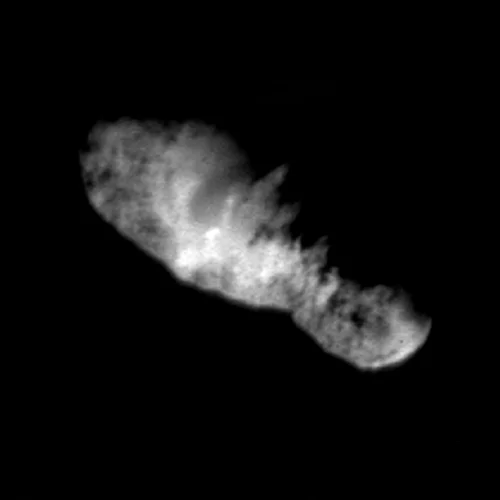
A comet contains a solid nucleus made of ice, dust and rocky material. Far from the Sun it can be an inconspicuous cold body. As it approaches the inner Solar System, solar heating allows volatile material to escape and carry dust with it. The surrounding cloud is called the coma. A comet can therefore look vastly larger than its nucleus without being a giant solid object.
THE BIG IDEAS
- A comet’s coma and tails are material escaping from its nucleus.
- Tails are shaped by the Sun rather than just the direction of travel.
- Comet chemistry can illuminate Solar System history.
Why tails form
Radiation pressure and the solar wind affect material escaping from the comet. Dust can form a broad curved tail, while ionised gas often forms a straighter tail influenced by the solar wind and magnetic field. The tail generally extends away from the Sun rather than simply trailing behind the direction of travel. A comet moving outward can even travel with its tail extending ahead of it in the broad sense.
An orbit is part of the story
Comets follow orbits that can carry them through very different environments. Some return on relatively short timescales, while others take thousands of years or more. Many originate in distant icy reservoirs associated with the Kuiper Belt or Oort Cloud. A close approach to a planet can alter an orbit. The familiar shape of a comet in a drawing represents one active part of a journey, not its appearance everywhere.
Why scientists study them
Comets preserve material that helps investigate the early Solar System. Spacecraft can examine their gases, dust and surface structure, while telescopes study their changing activity from a distance. Comparing comet water and organic compounds with other samples helps test ideas about planetary ingredients. Detecting organic molecules does not mean discovering life. In chemistry, organic commonly refers to carbon-containing compounds that can also form without living organisms.
Observations need an up-to-date guide
A comet’s brightness is difficult to predict precisely. Some become visible to unaided eyes, but many require binoculars, telescopes or imaging. Use a current position chart and begin with realistic expectations about a faint fuzzy object. Do not search close to the Sun with optical equipment. Record the date and surrounding stars in a sketch so a later observation can reveal motion and changes in the coma or tail.
PAUSE AND THINK
Does a comet always have a visible tail?
Explore the answer
No. Activity depends on its material and environment. Far from the Sun, many comets have little or no detectable coma or tail.