On this page
THE BIG IDEAS
- Rosetta accompanied a comet as its activity changed.
- Philae provided local measurements despite a difficult landing.
- Organic chemistry does not establish the presence of life.
A rendezvous rather than a glimpse
ESA’s Rosetta launched on 2 March 2004 and reached comet 67P/Churyumov–Gerasimenko in August 2014. Instead of passing quickly, it travelled with the comet and studied its changing activity. That approach allowed observations before and after the comet’s closest approach to the Sun. A comet is not a static object: heating changes how gas and dust escape, so time is a central dimension of the investigation.
Getting to a moving target
Rosetta used a long journey involving gravity assists and a period of deep-space hibernation. Reaching the comet meant matching its motion closely enough to investigate it rather than simply crossing its path. Operating near a small irregular body also differs from orbiting a large nearly spherical planet. Weak gravity, rotation, escaping material and an uneven shape complicate navigation and the choice of a safe observing distance.
Philae on the surface
The Philae lander was delivered to the comet in November 2014. Its landing did not unfold exactly as planned: it bounced before coming to rest, which affected illumination and operations. It nevertheless returned measurements. Describing both the difficulty and the scientific contribution gives a more accurate account than presenting the event as either flawless or worthless. Space exploration often produces useful results under conditions different from the original plan.
Material from the early Solar System
Rosetta investigated the nucleus, surrounding gas and dust, including chemical compounds relevant to questions about planetary origins. Comets preserve clues to early Solar System material, but they have also undergone change. A measured composition must therefore be interpreted with attention to heating and activity. Detecting organic compounds is a chemical finding, not a discovery of organisms. Researchers compare multiple kinds of evidence before proposing how cometary material relates to Earth’s history.
A changing world in the data
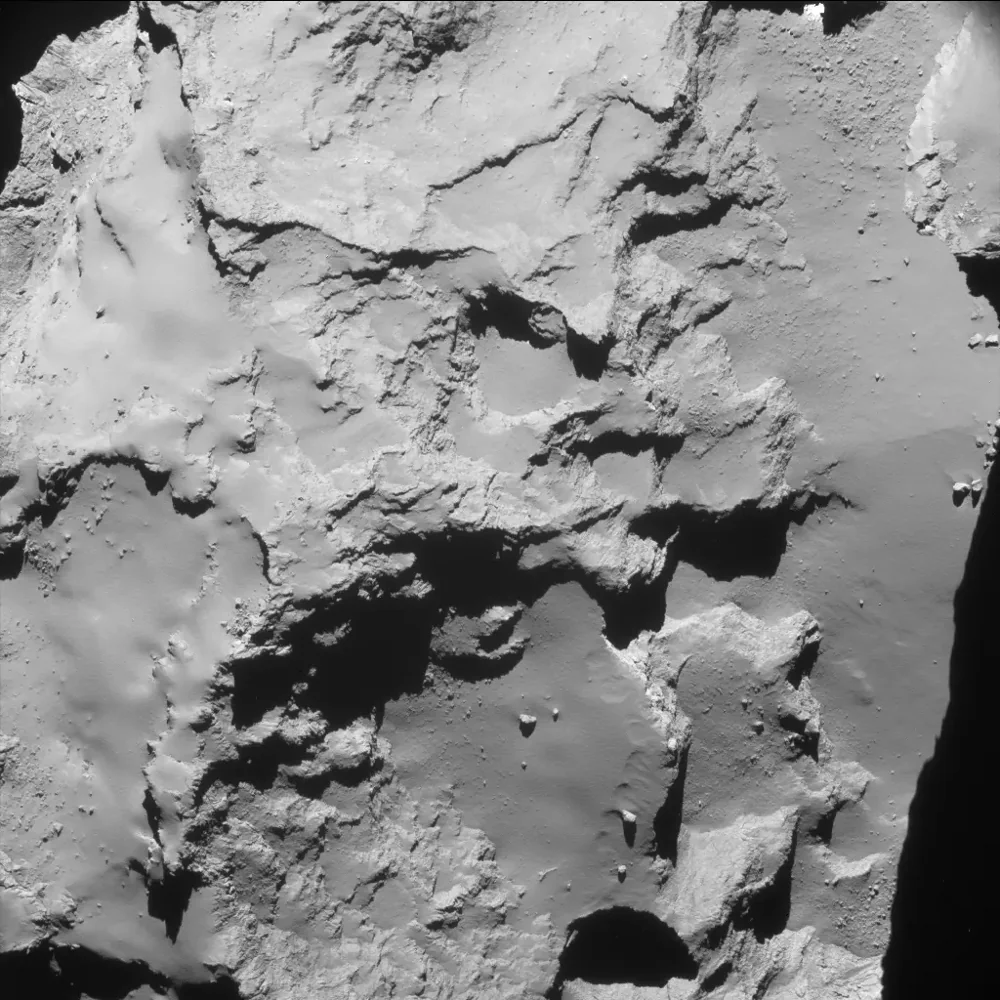
Rosetta’s mission ended with a controlled descent to the comet in September 2016. Its observations allow students to compare the same body at different stages of its orbit and ask what changed. Look for jets, illumination, surface features and measurement dates. A pair of images can be more informative than a single dramatic one when the aim is to understand a process. This is a general lesson for observing planets and even familiar landscapes on Earth.
PAUSE AND THINK
Why is following a comet toward and away from the Sun scientifically useful?
Explore the answer
It reveals how changing solar heating affects activity, allowing researchers to connect physical changes with the comet’s environment.