On this page
THE BIG IDEAS
- Efficient electric propulsion enabled a long two-destination investigation.
- Images, spectra and gravity answer different questions.
- A geological interpretation needs more than a bright patch.
One mission, two contrasting worlds
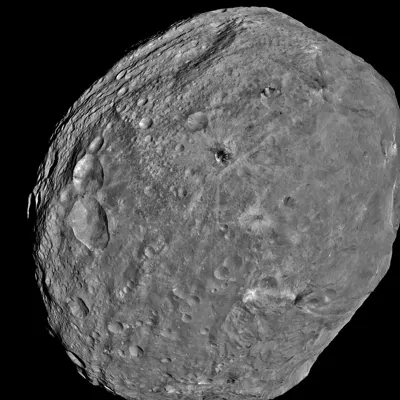
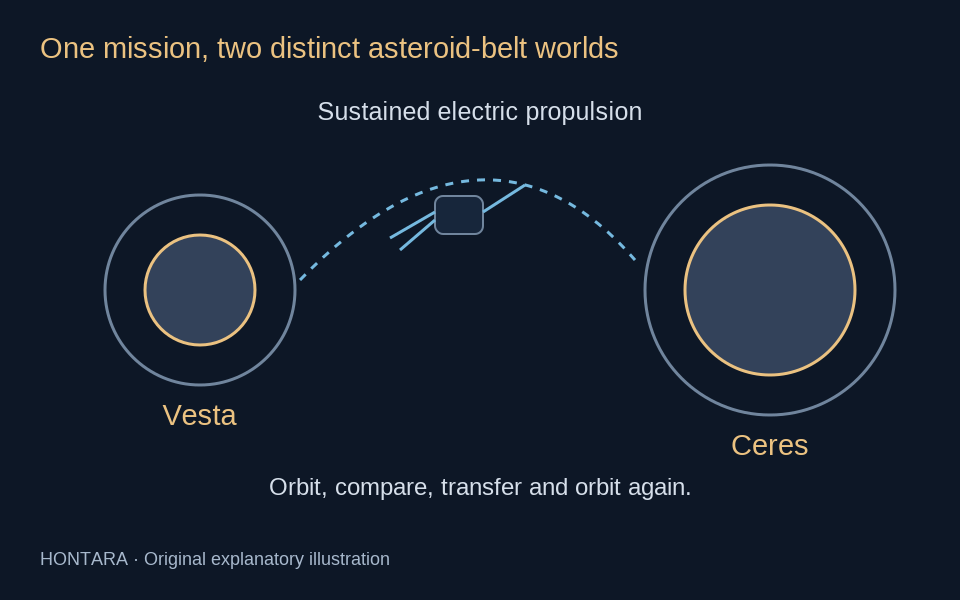
NASA launched Dawn in 2007 to study Vesta and Ceres, two large bodies in the main asteroid belt. Instead of treating the belt as a population of interchangeable rocks, the mission compared worlds with different geological histories. An extended stay at each destination supplied repeated measurements rather than a single brief flyby.
Dawn entered orbit around Vesta in 2011 and reached Ceres in 2015. Its mission ended in 2018 after its attitude-control fuel was exhausted. These historical observations remain available for analysis even though the spacecraft is no longer conducting science operations.
Connect propulsion with the observing plan
Dawn used ion propulsion: electrical energy accelerated charged propellant to produce a small sustained thrust. The important benefit was efficient accumulated velocity change over long periods. It was not a large instantaneous kick or an engine that supplied free energy without a power source.
Being able to alter its orbit gradually helped Dawn leave one destination and travel toward another. Distinguish the long propulsion campaign from the chemical launch that first carried the spacecraft away from Earth. Different parts of the journey required different engineering solutions.
Compare measurements rather than labels
Cameras mapped surface landforms while spectral measurements supplied information about surface materials. Tracking the spacecraft’s motion also helped constrain gravity and interior structure. Together these methods connected what the surface looked like with evidence about the worlds’ bulk properties and past processes.
Vesta showed evidence of a differentiated rocky body and major impact history. Ceres revealed a world strongly associated with water-bearing materials and salts. The bright deposits on Ceres are geological clues, not artificial lights or proof that every bright patch has the same origin.
Build a small evidence table
Make three columns headed observation, interpretation and further question. For an illustrative entry, write bright material in a mapped depression as the observation. A salt-rich deposit is an interpretation supported by spectral evidence; the timing and movement of material require additional geological reasoning.
Add a contrasting Vesta entry using a mapped crater or terrain boundary. Ask which instrument supports each statement and what alternative processes would need to be excluded. Do not infer an exact rock composition from visible brightness alone or assume that similar-looking craters share an identical age.
Use the comparison to ask a better question
The mission’s strength lies in joining orbital access, repeated imaging, spectra and gravity measurements. A useful question is how two early bodies in the same broad region developed different structures and surfaces. Their present categories do not replace that physical investigation.
When reading a Dawn image, retain the target, instrument, scale and caption. Some colour views emphasise differences between materials rather than reproducing an unaided-eye appearance. Follow a claim back to its measurement and keep the inferred history distinct from the raw image that first suggested it.
PAUSE AND THINK
Why did orbiting each target add information beyond a single flyby?
Explore the answer
Repeated views and changing orbital geometry supplied broader coverage, different scales and opportunities to combine imaging with other measurements. A flyby would sample a much more limited time and geometry.