On this page
THE BIG IDEAS
- A moving asteroid needs a current site-and-time prediction.
- Confirm reference stars and chart conventions before a target claim.
- A plausible point and a secure identification are different evidence levels.
Start with a named target and a realistic task
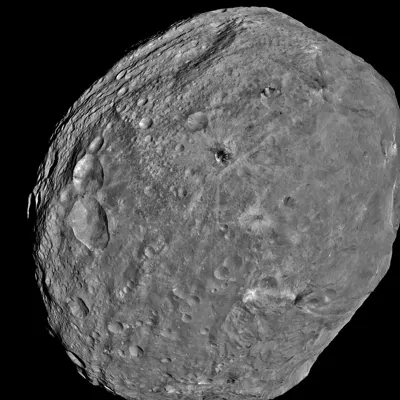
An asteroid in an ordinary small-telescope view will often resemble a stellar point rather than a resolved rocky world. Identifying it requires more than noticing an unfamiliar dot. Choose a named target whose predicted brightness and sky position are suitable for your equipment and observing conditions.
Confirm the designation through a reputable small-body source such as NASA/JPL’s database. Similar names, numbers or provisional designations can refer to different objects. Keep the exact selected identity with the observing record instead of relying on a shortened nickname.
Set the observer and clock explicitly
Generate a current ephemeris for the intended observing site and time interval. Inspect the time scale and location used by the service. A geocentric position and an observer-specific apparent position are not automatically identical, especially for a relatively nearby moving body.
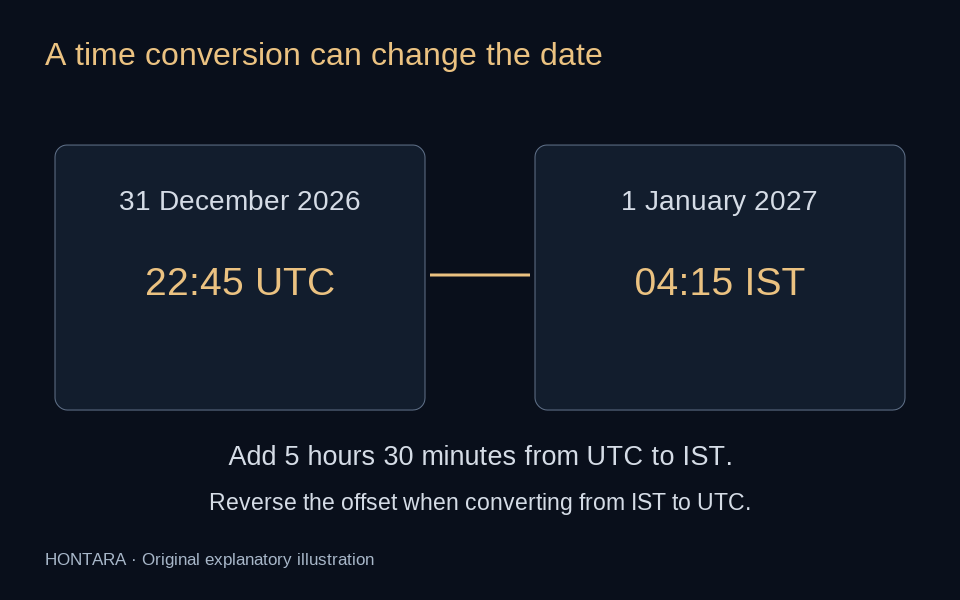
Convert between UTC and IST deliberately when necessary. A night session can cross a calendar-date boundary, so write the full date and time rather than only the hour. The ephemeris is a prediction for stated conditions, not a permanent finder position that can be reused in another month.
Build a chart with enough context
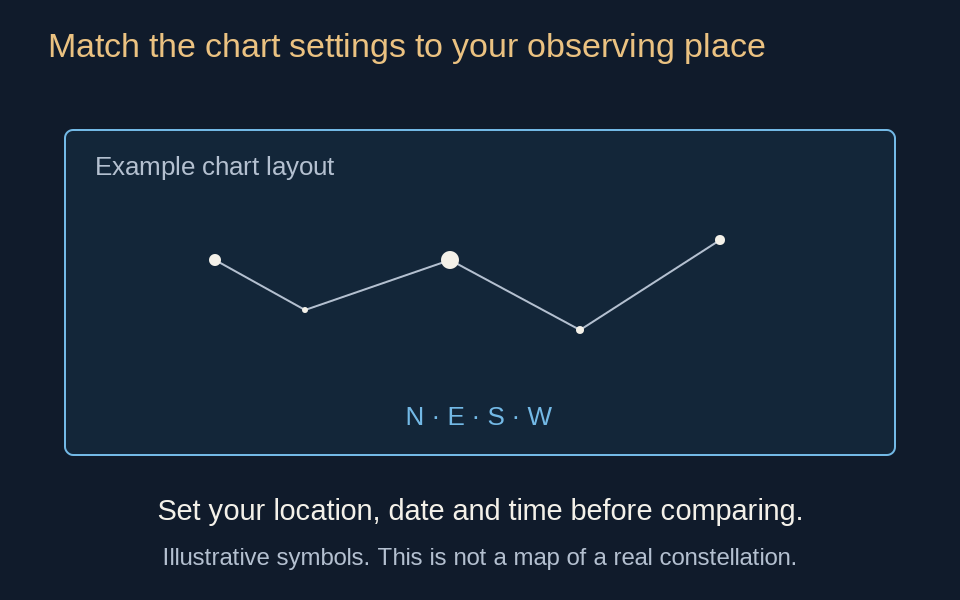
Use a chart that includes surrounding reference stars and the target’s predicted track at labelled times. Check angular scale, field orientation and coordinate convention before pointing. A right-ascension time unit is not an angular degree and an optical view can be mirrored or rotated relative to a screen chart.
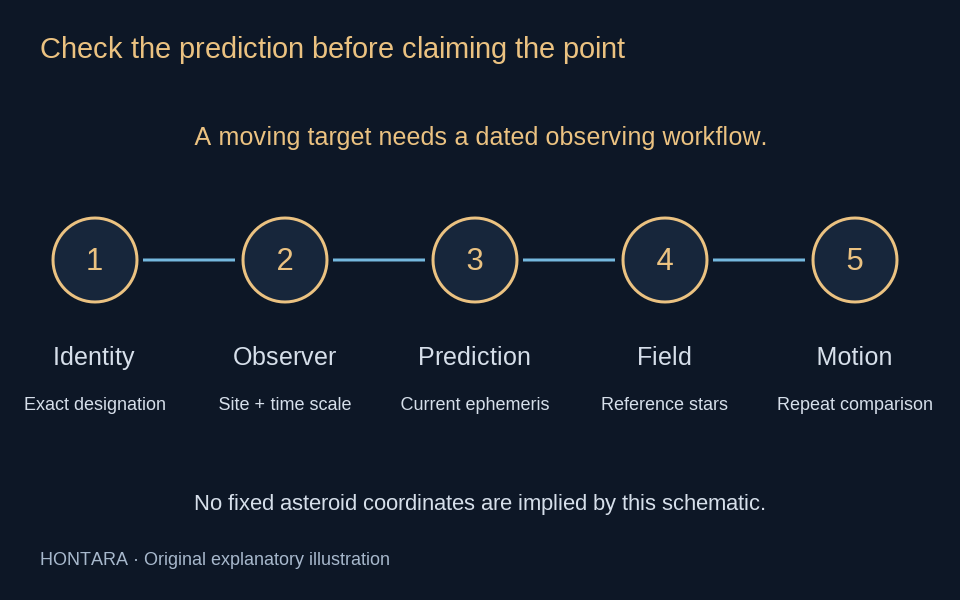
The workflow illustration here is deliberately a schematic rather than a dated asteroid map. For a real attempt, generate the chart from the current selected ephemeris. Note the data source and the chart’s creation time so you can later distinguish a pointing mistake from an outdated prediction.
Test motion against the reference field
Identify the surrounding stars first. Record a candidate’s position relative to at least two clear field references, then repeat after an interval appropriate to its predicted motion. Whether movement is detectable depends on the target, scale, timing and measurement uncertainty.
For a hypothetical example, a predicted shift smaller than your position uncertainty would not justify a confident motion claim after a short interval. A longer useful separation in time may help, but changing clouds or an uncertain field identification can still compromise the comparison. Do not invent a shift to complete the expected story.
Keep detection and identification separate
A point near a predicted position is a candidate observation. A consistent chart match and measurable relative motion strengthen the identification, while failure to detect a faint target remains a legitimate result. Record the limiting conditions rather than treating every attempted pointing as successful.
Do not infer size or surface composition from a stellar-looking point. Those questions need additional methods and data. A well-documented asteroid observation states the target, prediction, site/time convention and comparison evidence, making clear how a moving-body hypothesis was tested against the surrounding field.
PAUSE AND THINK
Can an asteroid finder chart generated for last month be assumed accurate tonight?
Explore the answer
No. The target moves relative to the stars. Generate and inspect a current ephemeris and chart for the intended site, date and time.