On this page
Measure the change in identifiable features
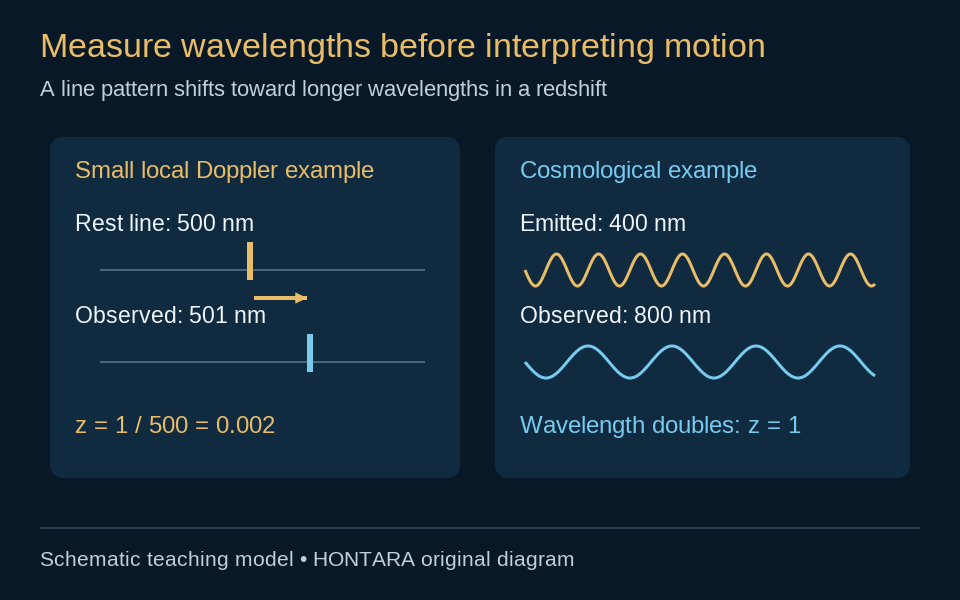
Spectroscopic redshift is z=(λobserved−λemitted)/λemitted. Identifying several features helps establish the pattern and avoid confusing one line with another. For cosmological expansion, light wavelengths stretch as the universe’s scale factor changes while the light travels.
The definition uses a dimensionless ratio. It does not by itself specify a distance in kilometres or an age in years. Those quantities require additional cosmological information and a clear statement of which distance or time measure is intended.
THE BIG IDEAS
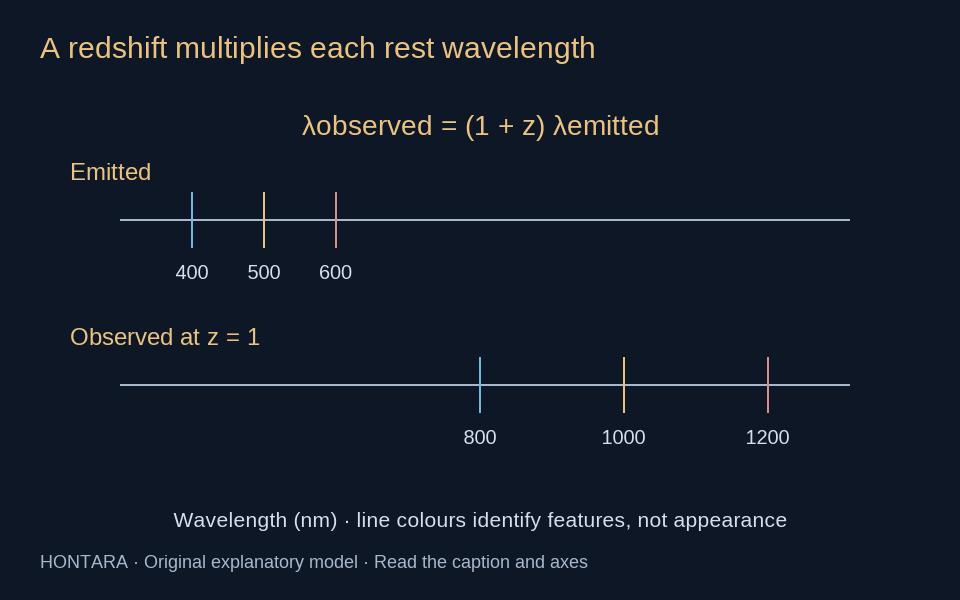
- Observed wavelength is multiplied by 1+z.
- A redshift alone is neither a unique distance nor a simple universal speed.
- Local motion and measurement method need to be considered.
Work directly with 1+z
The wavelength relation is λobserved=(1+z)λemitted. In a fictional example, a 500 nm feature observed at z=2 appears at 1,500 nm. The wavelength has become three times longer, not twice as long.
In the usual expanding-universe model, 1+z also equals the ratio of the present scale factor to its value when the light was emitted. If today’s factor is normalised to one, z=2 corresponds to an emission scale factor of one third. This is a ratio, not a drawing of a local object physically swelling.
Distinguish expansion from local motion
Galaxies also have motions relative to the large-scale expansion, which can produce Doppler contributions. Gravitational effects can shift wavelengths as well. A measured redshift may therefore combine more than one physical contribution.
At sufficiently small redshift, cz can be a useful approximate velocity expression under stated conditions. Applying v=cz without qualification at large cosmological redshift is misleading. High-redshift distance inference belongs to a cosmological model rather than a direct extension of a low-speed Doppler rule.
Keep several distances and times separate
Light-travel time, present proper separation and luminosity distance are not identical quantities in an expanding universe. The universe can expand substantially while a photon is in transit. A distance label should say which definition it uses.
A redshift value can constrain those quantities once a model and its parameters are specified. It cannot replace all of them with one universal multiplication. A calculator’s precise output would still depend on assumptions about expansion history and the adopted parameter values.
Use observations to test the interpretation
Compare multiple line identifications and distinguish a spectroscopic measurement from a photometric redshift estimate based on broad-band colours. Dust, source spectra and incomplete wavelength coverage can create degeneracies in the latter.
To read a claim responsibly, record the measured or estimated z, its uncertainty, the method and the cosmological model used for derived properties. This lets the same wavelength measurement support carefully defined inferences without pretending that redshift alone supplies a source’s complete history or exact distance.
Cosmological time intervals also carry a factor of 1+z in the usual model. A hypothetical ten-day rest-frame variation at z=2 is observed over about thirty days. This is a model time-dilation comparison, not a claim that every observed thirty-day light curve identifies a ten-day source or a unique redshift.
PAUSE AND THINK
At z=2, does a 500 nm spectral feature arrive at 1,000 nm or 1,500 nm?
Explore the answer
At 1,500 nm because the wavelength factor is 1+z=3. The value z is a fractional increase, not the total multiplying factor.