On this page
THE BIG IDEAS
- Separate signed coordinates from positive separations.
- A coordinate origin does not identify a special cosmic observer.
- The analogy provides a scale relation rather than a mechanism or measured history.
Specify what the analogy is for
Learners should calculate changing separations from two observer choices and explain why the initially selected zero point is not a privileged expansion centre. They should identify at least one feature of the paper that is not meant to represent the Universe.
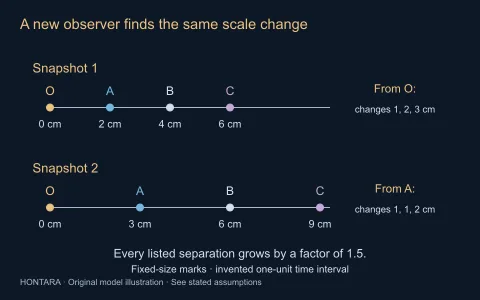
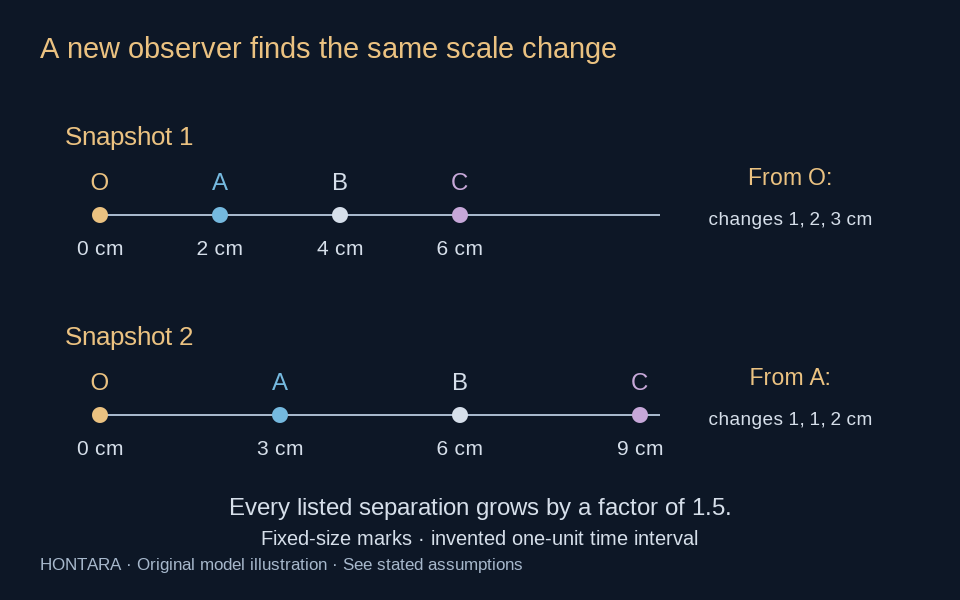
Prepare snapshots O,A,B,C at 0,2,4,6 cm and 0,3,6,9 cm. Use equal-sized marks in both. The relative scale changes by 1.5 over one arbitrary model-time unit. These values are invented to expose the proportional relationship without claiming an observational determination of an expansion rate.
Plan the 50-minute sequence
Use five minutes to define marks and separations, ten to draw snapshots, ten to measure from O, ten to repeat from A, ten for analogy limits and five for an exit explanation. Keep direction, separation and coordinate position as distinct labels.
Provide a preprinted coordinate table or read positions aloud where drawing is a barrier. All learners should calculate at least one later/earlier ratio and one absolute change. The task should not become a speed contest in ruler placement or a test of how evenly someone can pull an elastic band.
Use the two-observer answer guide
From O, the A/B/C separations are 2→3, 4→6 and 6→9 cm, with changes 1,2,3. From A, the O/B/C separations are 2→3, 2→3 and 4→6, with changes 1,1,2. Every later/earlier separation ratio is 1.5.
The absolute changes over the common model interval are proportional to the initial separations. A left-hand neighbour can have a negative signed coordinate relative to A while still having a positive increasing separation. Ask learners which quantity their table is actually recording before interpreting a minus sign.
Address observer and boundary misconceptions
If O is called the physical centre because it sits at zero, have the group repeat the account from A. The same ratios follow from the same pairwise geometry. The page origin is not evidence for a special cosmological location.
The strips have edges and lie in an external room, but neither property is a claim about cosmic boundaries or surrounding space. Fixed-size marks also avoid implying that every bound galaxy or laboratory object must expand. A model should retain its stated correspondence rather than turning every visible property into an astronomical conclusion.
Assess transfer and the missing physics
For the exit task replace the second snapshot with positions 0,4,8,12 cm. Expect a common growth factor of two and changes from O of 2,4,6 cm. Ask whether the new arithmetic alone supplies a real Hubble constant or a cosmic age. It does not.
For extension discuss what observed light and distance information would add. The two snapshots supply a kinematic scale relation, not the physical mechanism or full expansion history. Avoid explaining the result as rubber tension, an explosion from the paper origin or proof that the Universe has the same one-dimensional geometry as the strip.
PAUSE AND THINK
What changes in the exit case with second positions 0,4,8,12 cm?
Explore the answer
All separations double instead of increasing by a factor of 1.5. The exercise still lacks physical units and measurements needed for a real cosmological expansion rate.
RECORD YOUR OWN EVIDENCE
Your activity sheet
You need: Two paper strips or two rows on squared paper, ruler and pencil.
Verify both observer tables, identify the common scale factor and compare the alternative factor-two snapshot.
Name or group: Date:
| Separation | Snapshot 1 (cm) | Snapshot 2 (cm) | Change (cm) |
|---|---|---|---|
| O to A | |||
| O to B | |||
| O to C | |||
| A to O | |||
| A to B | |||
| A to C |
Explain why A sees the same fractional growth as O.
Distinguish a signed relative coordinate from a separation.
Name two paper properties that the analogy must not turn into physical cosmological claims.
Invented one-dimensional scale-change snapshots. Centimetres and the model-time unit do not supply a measured Hubble constant, cosmic age or three-dimensional cosmological solution.