On this page
THE BIG IDEAS
- All separations grow by the same factor in these snapshots.
- Changing the chosen observer does not change the pairwise distances.
- Paper edges and elastic forces are not cosmological conclusions.
Separate the marks from their spacing
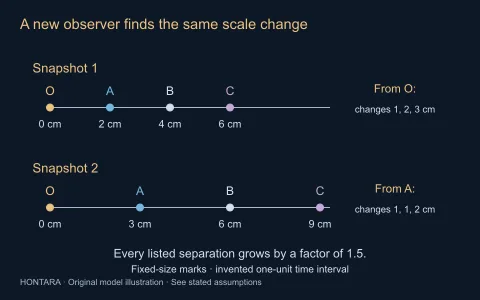
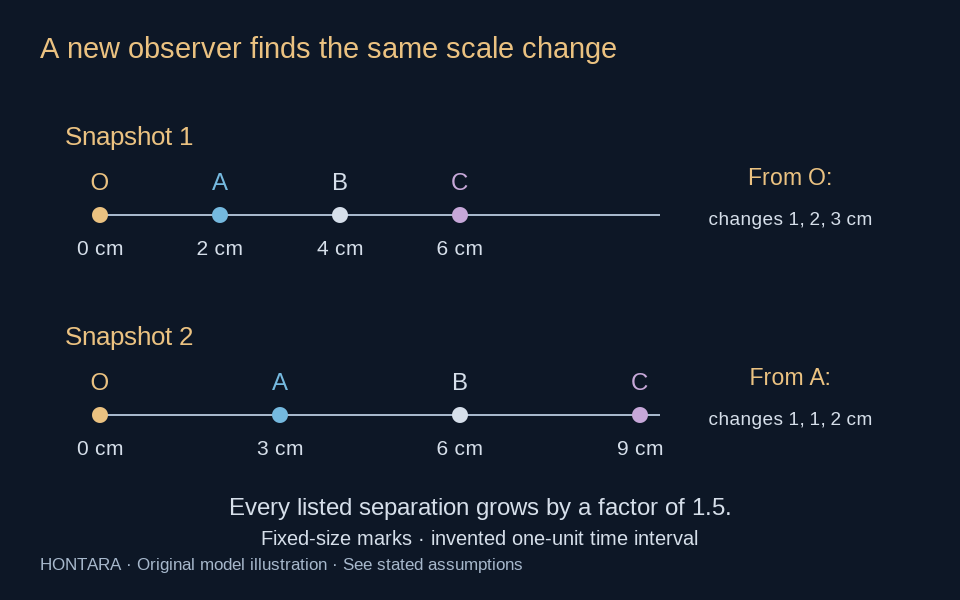
Draw four fixed-size marks labelled O, A, B and C along a paper strip. Their positions in the first snapshot are 0,2,4 and 6 cm. On another strip draw the same labels at 0,3,6 and 9 cm. The marks represent reference centres and remain the same drawn size.
These are invented one-dimensional snapshots with a scale factor changing from one to 1.5. They are not measurements of galaxies or a rubber-force explanation of cosmic expansion. The point is to compare separations when the whole coordinate scale changes uniformly.
Measure from the first observer
Treat O as the observer and record its separations from A, B and C in both snapshots. The pairs are 2→3, 4→6 and 6→9 cm. Their changes are 1, 2 and 3 cm across the same assigned one-unit model interval.
Calculate later separation divided by earlier separation. Each ratio is 1.5. The farther mark shows a larger absolute change even though all three separations share the same fractional growth. Keep a ratio distinct from a difference with centimetre units.
Change the observer label
Now treat A as the observer. Its separations from O, B and C are 2→3, 2→3 and 4→6 cm. The corresponding changes are 1,1 and 2 cm. Marks lie on both sides of A, so record direction separately if you use signed positions.
The same fractional growth appears without making O the uniquely central mark. The first drawing’s coordinate origin was a bookkeeping choice. Merely choosing another observer did not change any of the actual pairwise distances supplied in the two snapshots.
Check reciprocity: O-to-A and A-to-O have the same separation in each snapshot, although their signed directions differ.
Keep the model from becoming a literal universe
Do not enlarge the marks themselves. This represents a useful distinction between changing large-scale separations and assuming that every bound object must stretch along with them. The paper also has ends and sits in a room, features that the two-snapshot comparison does not assign to the Universe.
You may redraw the strips rather than physically stretching them. No elastic tension or external inflating force is part of the explanation. The model organises a scale relation; it does not establish a cause of cosmic expansion or a complete three-dimensional geometry.
Describe the limited result
For each observer, write a sentence comparing separation with absolute change over the shared model interval. A proportional pattern is built into the snapshots. It illustrates how one uniform scale change can be described from multiple marks without selecting a special centre among them.
The centimetres and arbitrary time unit cannot be converted into a measured Hubble constant or an age of the Universe without additional physical information. Real cosmology uses observed light, distance evidence and physical models. Keep those research measurements separate from the transparent ratios imposed on your paper.
PAUSE AND THINK
If O was drawn at zero, does that prove it is the physical centre of expansion?
Explore the answer
No. Zero is the chosen coordinate origin. Observer A obtains the same fractional separation growth in the supplied uniform-scale model.
RECORD YOUR OWN EVIDENCE
Your activity sheet
You need: Two paper strips or two rows on squared paper, ruler and pencil.
Draw fixed-size labelled marks O,A,B,C at positions 0,2,4,6 cm in snapshot 1 and 0,3,6,9 cm in snapshot 2. The snapshots are one arbitrary model-time unit apart. Calculate the listed separations and changes.
Name or group: Date:
| Separation | Snapshot 1 (cm) | Snapshot 2 (cm) | Change (cm) |
|---|---|---|---|
| O to A | |||
| O to B | |||
| O to C | |||
| A to O | |||
| A to B | |||
| A to C |
Does each listed separation grow by the same factor?
Why does choosing mark A as observer not make it a special expansion centre?
Which features of a finite paper strip must not be interpreted as physical properties of the Universe?
Invented one-dimensional scale-change snapshots. Centimetres and the model-time unit do not supply a measured Hubble constant, cosmic age or three-dimensional cosmological solution.