On this page
Separate expansion from its changing pace
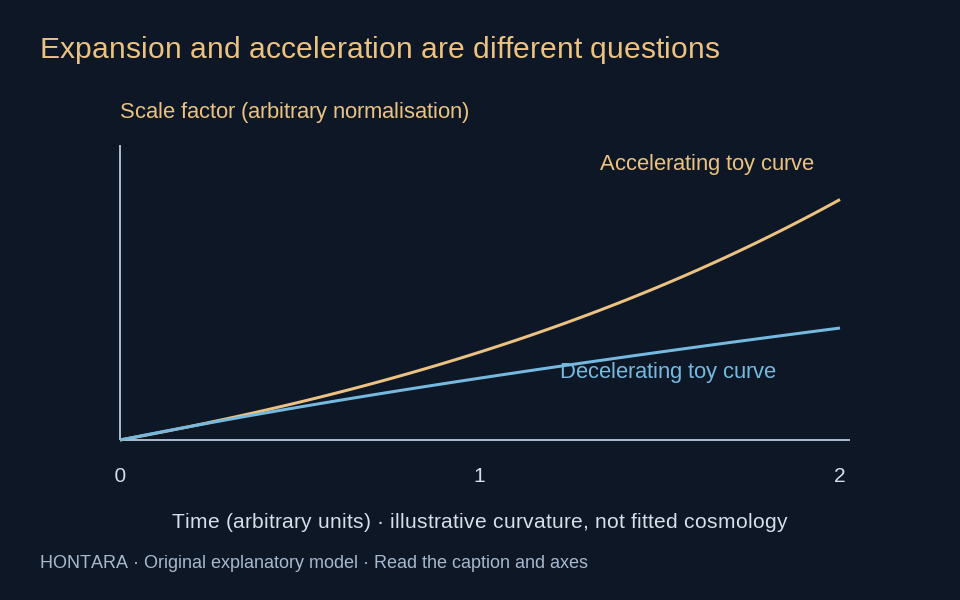
An expanding universe means that the large-scale scale factor changes with time. Accelerated expansion concerns the second time derivative of that factor. The statement is not simply that every nearby galaxy must be observed speeding away in a direct year-by-year movie.
The Hubble parameter and the acceleration of the scale factor are related but different quantities. In common models the scale factor can accelerate even while the Hubble parameter decreases. Avoid equating the word acceleration with one unqualified slope in every possible plot.
THE BIG IDEAS
- Accelerated scale-factor growth is not a direct movie of every galaxy.
- Distances and redshifts test an expansion model together.
- Dark energy’s underlying physical nature remains an open question.
Understand the distance–redshift comparison
Type Ia supernovae can be standardised using observed properties to estimate relative luminosities. Comparing their apparent brightnesses with redshifts tests how distance accumulates through an assumed expansion history. The evidence depends on a population and calibration rather than all explosions being perfectly identical bulbs.
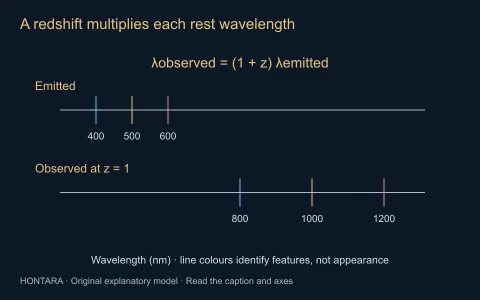
In the late 1990s, distant-supernova observations indicated greater distances than expected in simple decelerating models. Together with other cosmological observations, this supported a period of accelerated expansion. The inference compares models with measurements; redshift alone is not the acceleration measurement.
Keep dark energy as a model term
Dark energy names the component or explanation used for this late-time acceleration in the standard framework. A cosmological constant is an important possibility, but the microscopic physical nature is not established simply by giving it a name.
Other model possibilities involve evolving components or changes to gravitational descriptions. Their viability must be tested against data rather than treated as equally confirmed facts. A claim that one explanation has been measured needs to state which parameters and which observational combination support it.
Read a schematic with the axes visible
An illustrative graph of scale factor versus cosmic time can show a curve bending upward during an accelerating phase. It is a teaching diagram, not a fit that specifies the universe’s exact future or reproduces a particular supernova catalogue.
A graph of distance versus redshift is a different representation. Do not compare its curvature directly with a scale-factor curve without the intervening cosmological equations. The same physical model can look very different when plotted using different quantities.
Ask how uncertainty and alternatives were checked
Supernova calibration, dust, evolution, selection effects and other measurement issues are part of the analysis. Independent evidence, including the microwave background and large-scale structure, helps test the wider model and constrain possible expansion histories.
Distinguish a robust broad inference from a claim that every parameter or future outcome is settled. A useful account identifies the observations, the model being fitted and the remaining unknown physical interpretation. This is stronger than calling dark energy a directly photographed force or an explanation for ordinary local orbital motion.
An uncertainty comparison can hold the measured redshifts fixed while changing the adopted distance calibration within its allowed range. The fitted expansion parameters can shift. Reporting a parameter without the calibration assumptions obscures this dependency, even when the graph itself looks smooth and the numerical fitting procedure returns many decimal places.
PAUSE AND THINK
Does naming dark energy mean its microscopic composition has been identified?
Explore the answer
No. The name describes an inferred cosmological role or explanation. Its physical nature and possible evolution require further evidence.