On this page
Why a dark sky once seemed like a puzzle
Imagine a universe that is static and has always had the same population of stars spread uniformly in every direction. An individual star gets fainter with distance. But if you look in a layer twice as far away, that layer has about four times the area and can contain about four times as many stars for the same thickness. Each star then contributes about one quarter as much light.
In the idealised model the two effects cancel for each layer. With enough layers, almost every line of sight would end on a star and the sky would be bright. The discrepancy between that prediction and the dark sky is called Olbers’ paradox.
What changes in the real universe
Looking at distant objects means seeing their past. The universe is about 13.8 billion years old and stars formed after its earliest period. Light from arbitrarily distant regions has had no time to reach us. The population of luminous stars has also changed over time.
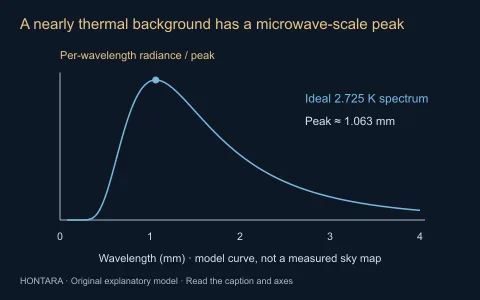
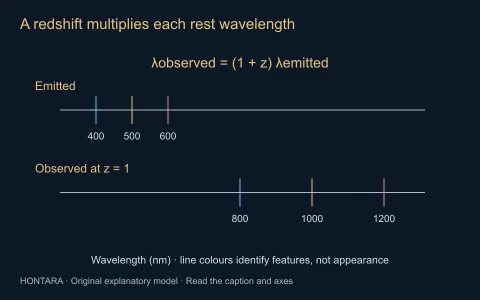
As the universe expands, the wavelengths of light from distant sources stretch. Distant radiation can arrive weakened and at wavelengths your eyes cannot see. For example, instruments can detect the cosmic microwave background in every direction even though it contributes very little visible light.
Why dark skies still vary from place to place
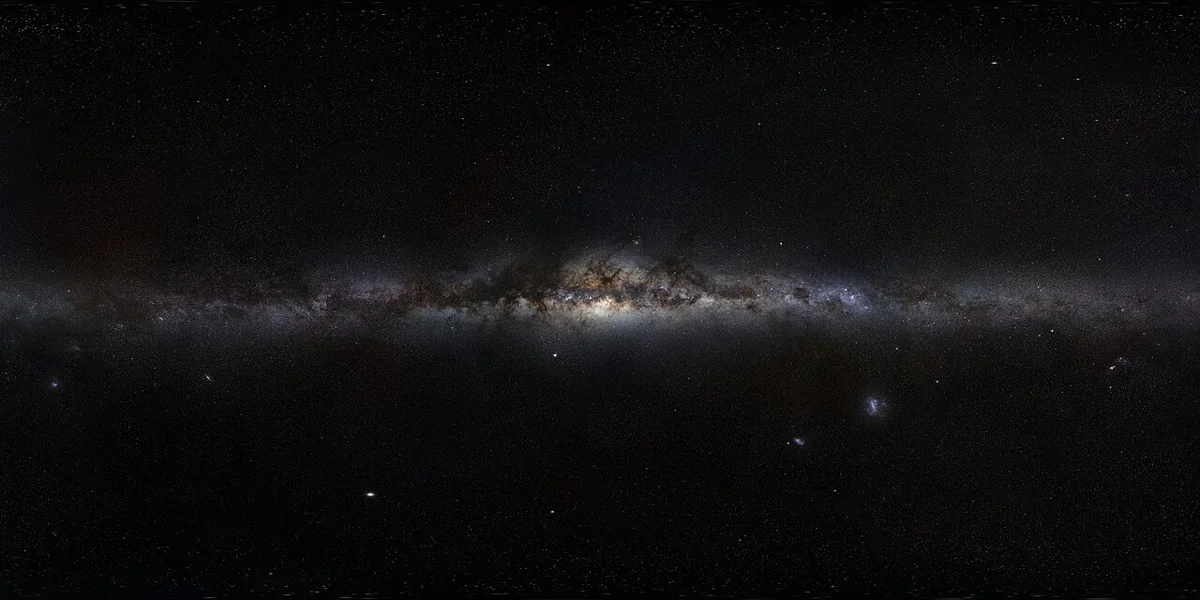
Earth’s rotation carries you onto the side of the planet facing away from the Sun. As twilight fades, less sunlight scatters into your view. After that, the Moon, nearby lights, haze and the glow of the Milky Way can still change how bright the sky looks.
Those local conditions tell you when a particular site is good for observing. The cosmology question asks why the background sky is dark even far from city lights on a clear, moonless night.