On this page
Start with a picture of the early universe
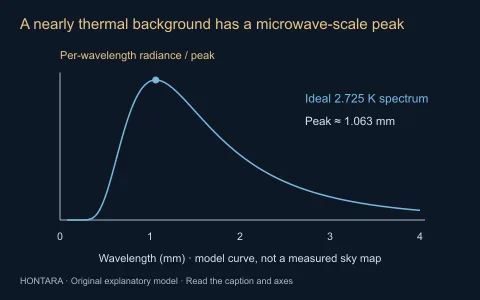
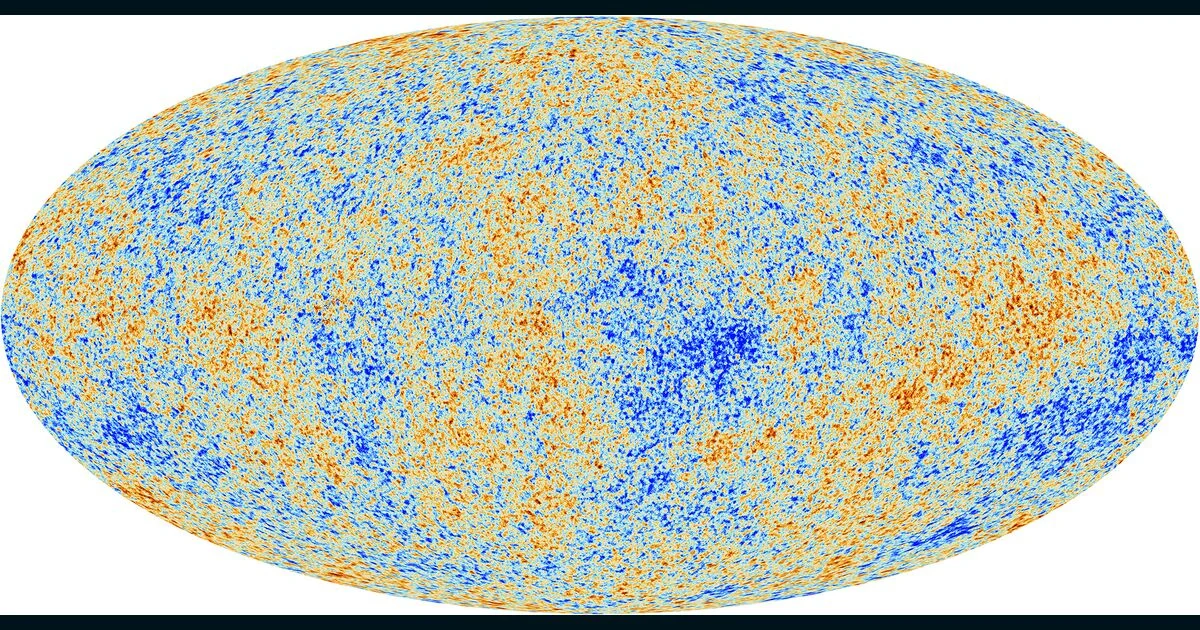
The cosmic microwave background is radiation released when the universe became transparent to light, about 380,000 years after the start of the hot Big Bang history. It contains small temperature variations. Their pattern across different angular scales depends on the contents and early expansion of the universe.
The Planck team measured these patterns and fitted a model containing ordinary matter, dark matter and dark energy. The fit gives a history of how the expansion rate changes, from the hot early universe to today. That history leads to an age of about 13.8 billion years.
Why the current expansion rate is only a starting point
Planck’s standard-model fit gives an expansion rate today of about 67 km per second per megaparsec. A megaparsec is about 3.09 × 10¹⁹ km. Dividing that distance by 67 km per second gives a benchmark of roughly 14.6 billion years.
The actual estimate uses a changing rate. Gravity from matter slowed expansion in earlier periods. In the more recent universe, dark energy is associated with faster expansion over time. Combining the different periods of the expansion history gives the smaller estimate, about 13.8 billion years.
How other evidence can check the age
The oldest stars give a lower bound. They formed after the early universe began, so an expansion model must leave enough time for those stars to form and age. Their ages come from different evidence, such as their brightness, colour and how models predict they evolve.
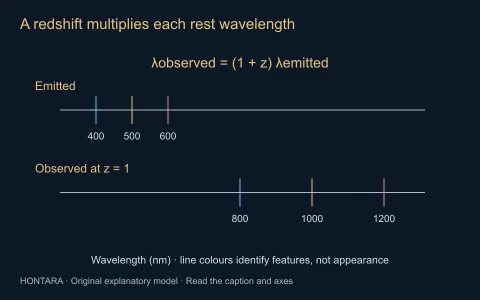
Distances and redshifts for galaxies also test how the universe expands. The age estimate depends on how well the assumed model fits the full set of observations.