On this page
THE BIG IDEAS
- Apollo 11 included landing and safe return.
- Collins remained in lunar orbit while Armstrong and Aldrin descended.
- Sample context is an essential part of scientific evidence.
The mission was more than a touchdown
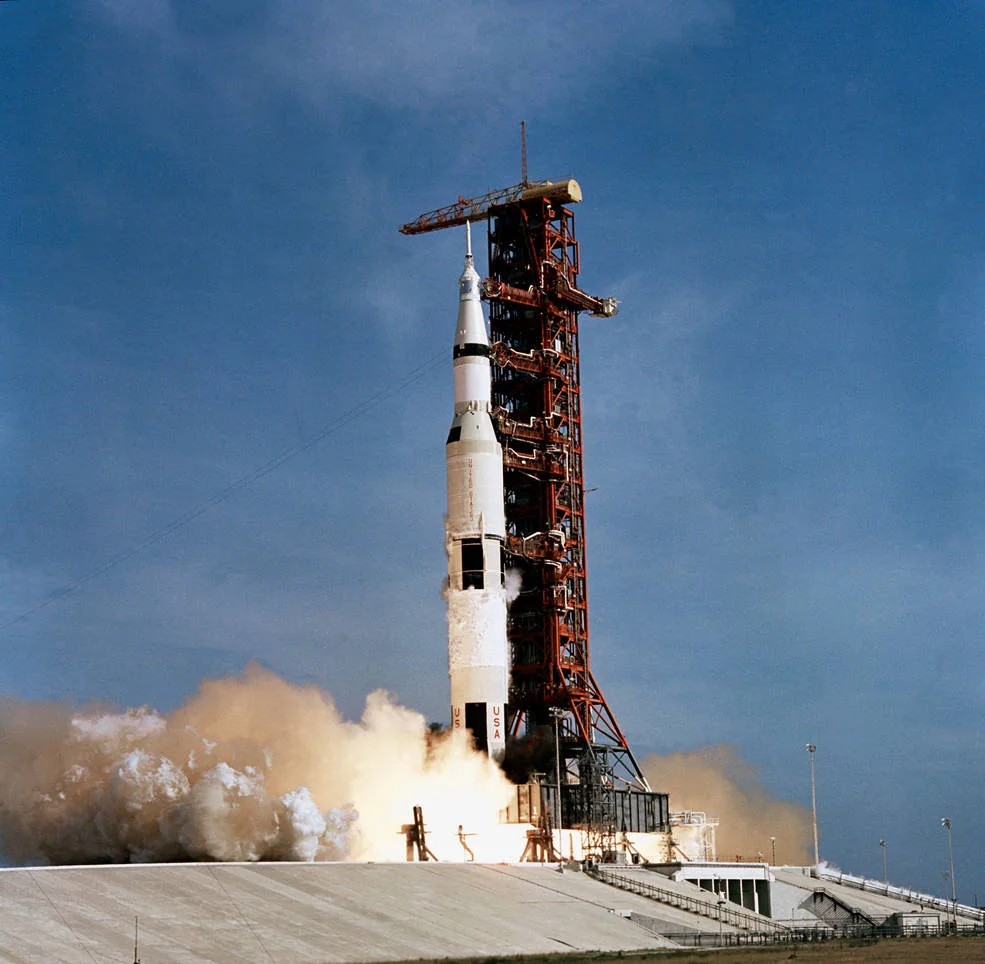
Apollo 11 launched on 16 July 1969 with Neil Armstrong, Buzz Aldrin and Michael Collins. Armstrong and Aldrin landed on the Moon on 20 July while Collins remained in lunar orbit. The crew returned to Earth on 24 July. Landing was a historic achievement, but the full objective included a safe return. Every mission stage depended on systems prepared for the next stage as well as the immediate task.
Two spacecraft roles near the Moon
The command and service module supported the journey and lunar-orbit operations. The lunar module separated to carry two astronauts down to the surface. Its ascent stage later lifted off to rendezvous with the orbiting spacecraft. This arrangement reduced the mass that had to land and launch again from the Moon. It also introduced demanding navigation and docking tasks, showing how solving one engineering problem can create another that must be managed.
Scientific work on the surface
The astronauts collected samples, documented the site and deployed experiments. Lunar rocks and soil became important evidence for understanding the Moon’s history. Their value includes the record of where and how they were collected. A labelled sample with geological context can answer questions that an attractive but unlocated stone cannot. The mission also demonstrated how human observation and judgement could contribute within a tightly limited time on another world.
Communication was not instantaneous presence
Radio carried voice, television and data between the spacecraft and Earth. Light-travel delay to the Moon is short compared with interplanetary missions but is still real. Communication equipment also had to function across enormous distances with limited power. The images viewed by audiences were transmitted signals, not a live window that eliminated physical distance. Understanding the link helps connect the human story with the electronics and ground infrastructure that supported it.
A useful way to study the mission
Draw the mission as a sequence: launch, Earth departure, lunar orbit, descent, surface work, ascent, rendezvous and Earth return. For each step, name a risk and the system used to manage it. This exercise makes the achievement concrete without treating it as magic or a single heroic moment. Apollo 11 depended on many people, tested hardware and carefully coordinated procedures whose importance becomes clearer when the stages are separated.
PAUSE AND THINK
Why did the whole spacecraft not land on the Moon?
Explore the answer
A separate lunar module reduced the mass required for descent and ascent, while the command and service module remained available for the return journey.