On this page
Compare the opening that collects light
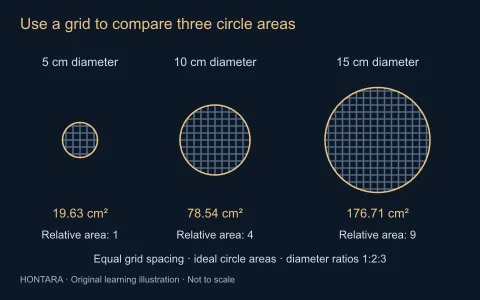
A telescope’s aperture describes the opening through which it gathers light, usually given as the primary lens or mirror diameter. A circular opening with diameter D has area πD²/4. For the same incoming light and observing interval, a larger useful collecting area intercepts more light.
Before comparing two instruments, make the diameter units match. An aperture of 10 cm is 100 mm. Confusing centimetres with millimetres changes the diameter by a factor of ten and the calculated area by a factor of one hundred. The tube’s outside diameter is not necessarily the optical aperture.
THE BIG IDEAS
- Circular collecting area scales with diameter squared.
- Central obstruction removes area according to its squared diameter.
- Area ratios do not predict every aspect of an eyepiece view.
Square the diameter ratio
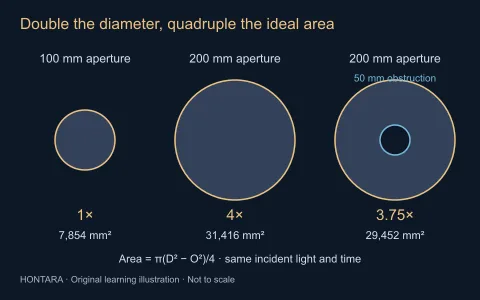
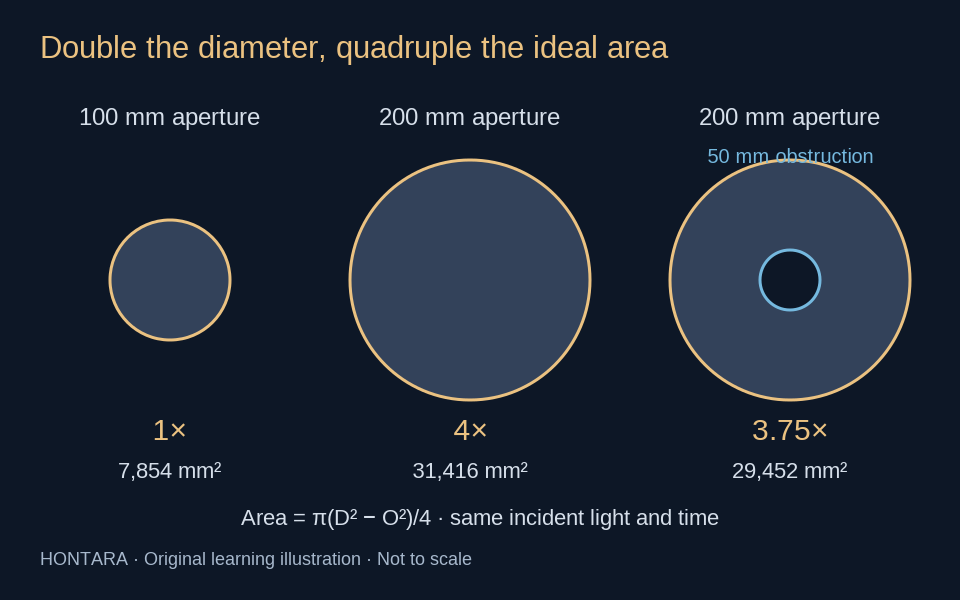
Compare ideal unobstructed apertures of 100 mm and 200 mm. Their areas are approximately 7,854 mm² and 31,416 mm². The larger opening has four times the area because (200/100)² = 4. Doubling the diameter does not merely double the collecting area.
Now compare 150 mm with 100 mm. The area ratio is 1.5² = 2.25. These are geometric ratios, not measurements of complete telescope performance. Mirror reflectivity, lens transmission, detector efficiency and losses along the optical path also affect how much useful signal is recorded.
Account for a central obstruction
Some designs place a secondary mirror or another obstruction in the incoming beam. For a simple circular central obstruction with diameter O, the remaining geometric area is π(D² − O²)/4. Use obstruction diameter rather than obstruction radius in that expression.
A 200 mm opening with a 50 mm obstruction has 93.75% of its unobstructed geometric area: 1 − (50/200)². Compared with an unobstructed 100 mm opening its area ratio is 3.75. This subtraction does not describe diffraction, support vanes or every optical loss.
Keep different telescope questions separate
Aperture is not magnification. The telescope and eyepiece focal lengths determine magnification; changing the eyepiece does not enlarge the main collecting opening. Resolution is another question, influenced by aperture, wavelength, optical quality and atmospheric conditions.
An extended object’s apparent surface brightness through an eyepiece also depends on magnification, exit pupil and the observer’s eye. You cannot turn an area ratio into a universal promise that every view looks four times brighter. Use the ratio to explain collection under stated conditions, then evaluate focus, contrast, handling and the actual observing task separately.
PAUSE AND THINK
Would changing a 25 mm eyepiece to a 10 mm eyepiece increase the primary collecting area?
Explore the answer
No. It changes magnification for a fixed telescope focal length. The main aperture remains the same, while the exit pupil and apparent view change.