On this page
THE BIG IDEAS
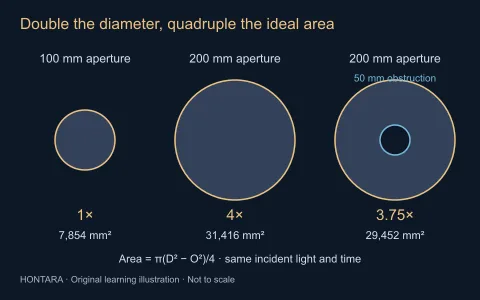
- Doubling a circular diameter quadruples its ideal area.
- A grid estimate and a formula answer should remain distinguishable.
- A paper aperture model does not test telescope image quality.
Make a prediction first
Imagine three unobstructed telescope openings with diameters in the ratio 1:2:3. Predict their relative collecting areas before calculating. Write whether you expect 1:2:3, 1:4:9 or another pattern and explain your reason. Keep that first prediction so you can compare it with your evidence.
Your circles represent collecting openings only. They do not form images or act as working telescopes. The activity stays indoors and uses paper, so no view of the Sun or any other bright source is needed.
Prepare three measured outlines
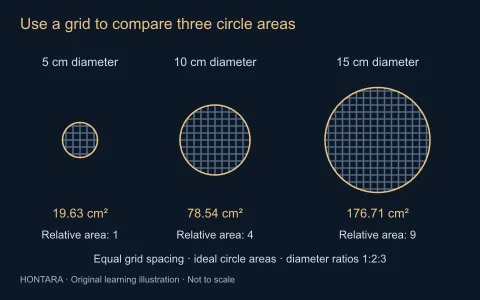
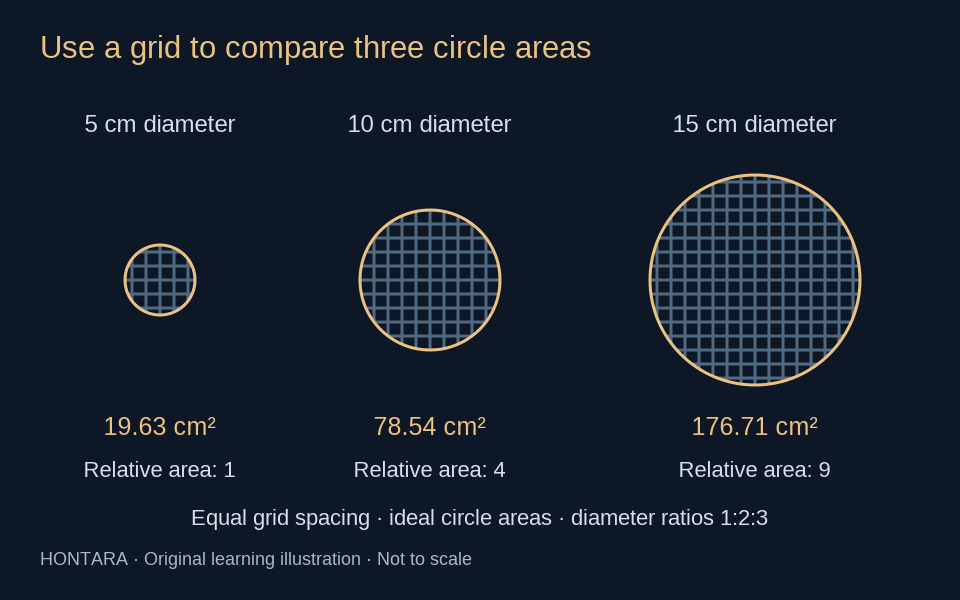
Use three sheets of 1 cm squared paper, a pencil, ruler and compass, or ask for prepared outlines. Draw circle A with diameter 5 cm, B with diameter 10 cm and C with diameter 15 cm. The corresponding compass radii are 2.5, 5 and 7.5 cm.
Put each circle on its own sheet. Measure across the centre to check the diameter and label both the diameter and its units. If using a compass, follow normal classroom handling instructions. No cutting is required. Keep the same grid spacing for all three drawings.
Estimate before using a formula
Count complete 1 cm² grid squares inside each circle. Estimate the partial boundary squares, for example by combining them into approximate whole squares. Record your rule so another group can repeat it. The boundary estimates will be imperfect, especially for the smallest circle.
Keep this grid estimate separate from the formula column. Do not erase it when the calculator gives another value. A difference can reveal how edge counting and drawing accuracy affect an estimate; it is useful information rather than a reason to replace your original record.
Calculate and compare ratios
Calculate area using πD²/4 with D in centimetres. The ideal values are approximately 19.63, 78.54 and 176.71 cm². Divide each by A’s calculated area. The ratios are 1, 4 and 9, even though the diameter ratios were 1, 2 and 3.
Use either unrounded formula values or the same value of π throughout the ratio calculation. Explain why rounding the smallest area early could slightly change your answer. Compare your grid-derived ratios with the ideal ones and describe the largest source of disagreement you noticed.
Return to the telescope claim
Write a conclusion that connects area to the amount of incident light intercepted under the same illumination and time. Include the word ideal because real telescopes have optical losses and may have central obstructions.
Do not conclude that circle C gives nine times the magnification or that every eyepiece view is nine times brighter. Those are different questions involving focal lengths, exit pupil and observing conditions. Finish by naming one real instrument property that your paper circles cannot test.
PAUSE AND THINK
Why is the compass radius for the 10 cm circle only 5 cm?
Explore the answer
A radius runs from the centre to the edge. The diameter spans the whole circle through the centre and is twice the radius.
RECORD YOUR OWN EVIDENCE
Your activity sheet
You need: Three sheets of 1 cm squared paper, pencil, ruler, compass or prepared circle outlines and calculator.
Make circles A, B and C with diameters 5, 10 and 15 cm. Estimate each area from the grid, then calculate πD²/4. Divide each calculated area by A’s area.
Name or group: Date:
| Diameter | Grid area (cm²) | Formula area (cm²) | Relative to A |
|---|---|---|---|
| A / 5 cm | |||
| B / 10 cm | |||
| C / 15 cm |
How do B and C compare with A by diameter? How do they compare by area?
Why might the grid estimate differ from the circle formula?
Name one telescope property this paper model does not measure.
Record your own estimates. The outlines model ideal unobstructed circular apertures, not complete telescopes.