TRY IT YOURSELF
Compare circular collecting areas
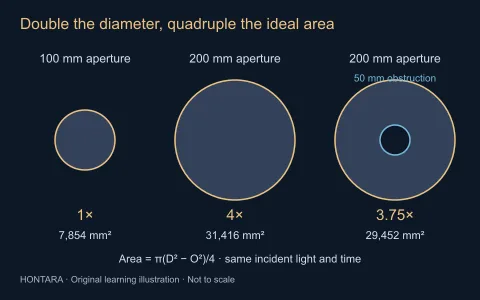
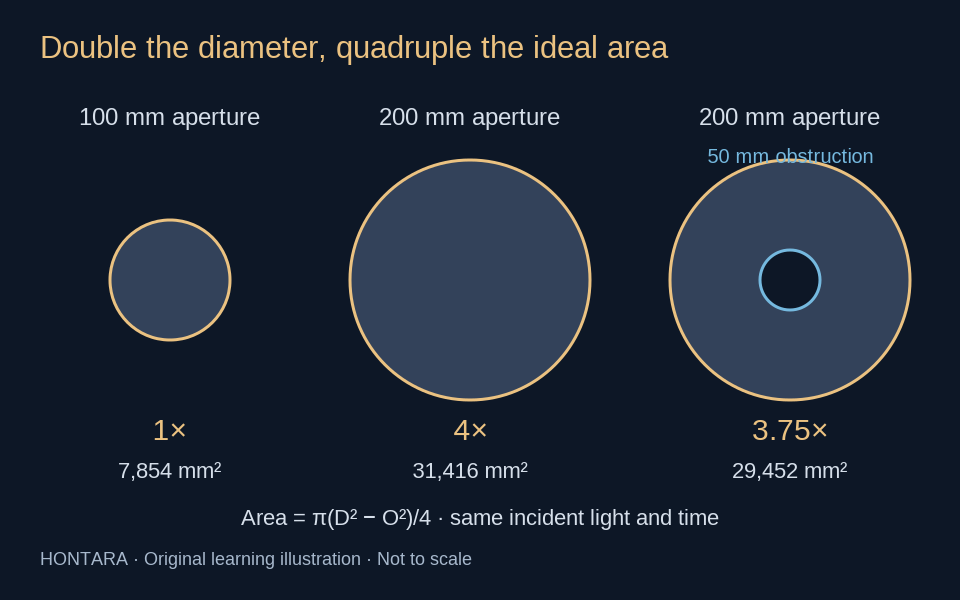
100 mm and 200 mm unobstructed apertures: B has four times the area of A. Use zero for no central obstruction.
On this page
THE BIG IDEAS
- The output compares B with A.
- Central obstruction diameter must use the aperture’s units.
- A geometric area ratio is not a complete performance rating.
Enter the optical diameters
Enter telescope A and B aperture diameters in millimetres. For an unobstructed opening enter zero as the central obstruction. If a design has a circular central obstruction, enter its diameter in the same units. Use the effective optical opening rather than the tube’s external width.
Each obstruction must be smaller than its own aperture. The comparison assumes circular openings and a circular central obstruction. It does not model segmented gaps, support vanes, vignetting, coatings or detector efficiency. Those require additional information about the actual system.
Follow the area calculation
The remaining geometric area is A = π(D² − O²)/4, where D is aperture diameter and O is obstruction diameter. The displayed ratio divides B’s area by A’s area. A ratio above one means B has more geometric area; a ratio below one means it has less.
With A = 100 mm and B = 200 mm, both unobstructed, the ratio is 4. Swap the two diameters and the ratio becomes 0.25. The result is directional: “B compared with A” is not the same comparison as “A compared with B”.
Try an obstruction example
Keep A at 100 mm with no obstruction. Set B to 200 mm with a 50 mm central obstruction. B’s remaining area is about 29,452 mm²; A’s is about 7,854 mm². The ratio is 3.75, so the obstruction reduces B’s advantage from the unobstructed ratio of four.
The obstruction’s diameter fraction is 50/200 = 0.25, but its area fraction is 0.25² = 0.0625. It removes 6.25% of the unobstructed geometric area, not 25%. This is a useful check before trusting a percentage quoted without saying whether it refers to diameter or area.
Use the result for the right task
For the same incident light and exposure, geometric collecting area is one factor in the collected signal. The calculator does not predict a limiting magnitude, a camera exposure time or the brightness of every object through an eyepiece. Sky background and optical throughput also matter.
Extended-object visual brightness depends on exit pupil and magnification as well as the observer’s pupil. Diffraction and contrast are not described by simple area subtraction. Use this calculator to explore the geometry, then consult the instrument’s actual specifications and the requirements of your observing task.
PAUSE AND THINK
What ratio should appear when A is 200 mm and B is 100 mm with no obstruction?
Explore the answer
B/A is (100/200)² = 0.25. B has one quarter of A’s geometric collecting area.