TRY IT YOURSELF
Exit pupil
150 ÷ 50 = 3 mm
On this page
THE BIG IDEAS
- Exit pupil equals aperture divided by magnification.
- Higher magnification produces a smaller exit pupil.
- Exit pupil and eye relief describe different things.
What the number describes
The exit pupil is the small circle of light leaving the eyepiece. For a telescope, its diameter is the aperture divided by the magnification. Enter the clear aperture in millimetres and the power you are actually using. The result is also in millimetres.
This is an optical measurement, not a measurement of your eye. Your own pupil changes with lighting and varies between people. The calculator cannot tell you its size.
Compare three eyepieces
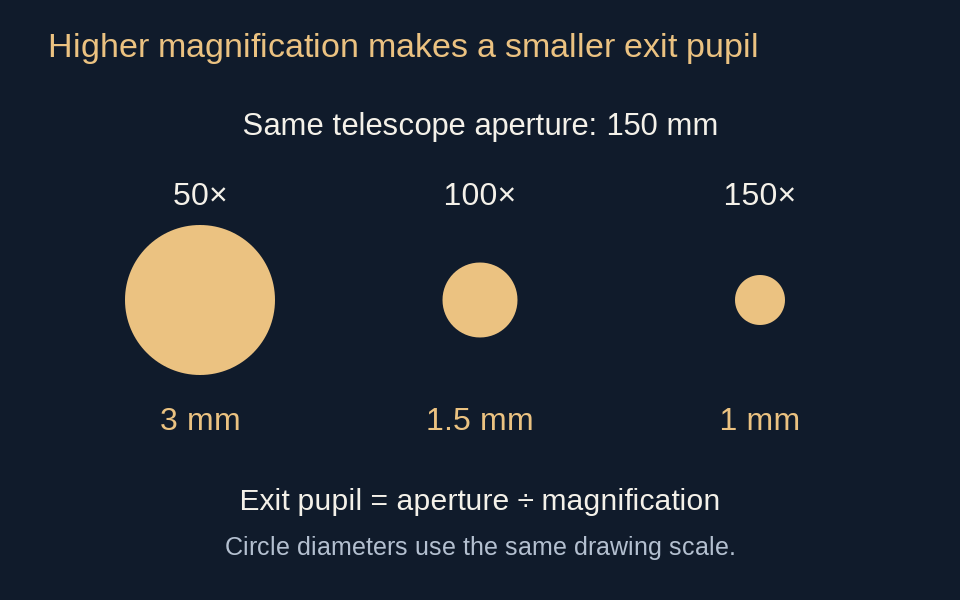
With a 150 mm aperture at 50×, the exit pupil is 3 mm. At 100× it is 1.5 mm. At 150× it is 1 mm. Doubling the magnification halves the exit-pupil diameter. You can calculate the same value by dividing eyepiece focal length by the telescope focal ratio.
Write down the exit pupil beside each magnification in your observing notebook. It helps connect an eyepiece’s numerical specifications with what you experience at night.
Brightness and detail work together
For an extended object such as the Moon or a nebula, a smaller exit pupil generally means a dimmer image per apparent area. However, increasing image size can make a small feature easier to recognise. The most useful compromise depends on the target, sky conditions and your vision.
If the exit pupil is larger than the pupil of your eye, some light misses your eye. A very small exit pupil can make floaters or focusing difficulties more noticeable. Neither situation is a universal pass-or-fail threshold. Test the view rather than choosing an eyepiece from this number alone.
What this tool cannot decide
Exit pupil is not eye relief. Eye relief is the distance your eye sits behind the eyepiece to see the full field. It matters especially for observers wearing glasses. Exit pupil also does not specify the field of view or the optical quality.
Use the calculator to compare combinations you already have. Observe the same target at two powers, noting brightness, steadiness and visible detail. Do not inspect an exit pupil with the telescope pointed anywhere near the Sun.
PAUSE AND THINK
A 100 mm telescope is used at 25×. What is its exit pupil?
Explore the answer
100 ÷ 25 = 4 mm. At 50× the same telescope would produce a 2 mm exit pupil.