On this page
THE BIG IDEAS
- Aperture belongs to the main lens or mirror.
- A stable mount is essential for useful detail.
- The finder aims while the focuser sharpens.
Follow the light
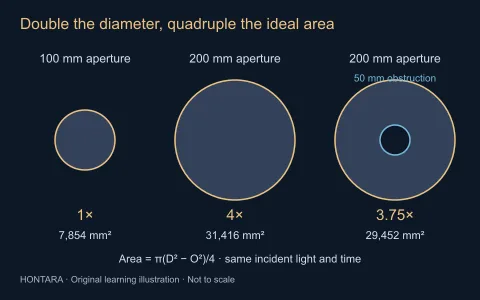
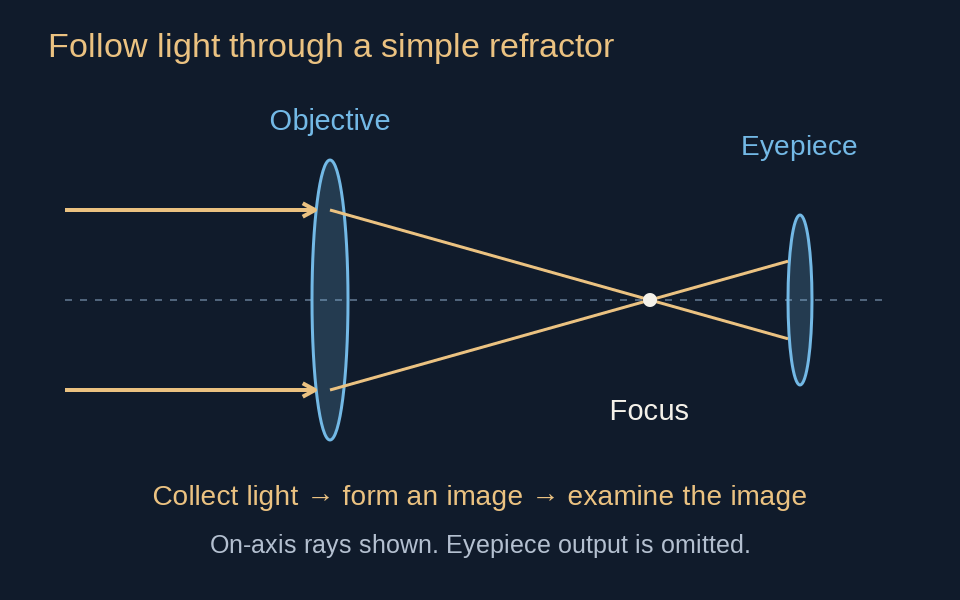
A telescope gathers light with a main lens or mirror and forms an image that an eyepiece lets you examine. The diameter of the main light-collecting surface is its aperture. Different designs fold or bend the light path differently, but the basic tasks are collecting light and forming a usable image.
The tube protects and supports the optical components. It is not itself the source of magnification. Changing an eyepiece changes the image scale without changing the diameter of the main lens or mirror.
The mount makes observation possible
The mount holds the tube and allows controlled movement. An altitude-azimuth mount moves up and down and around the horizon. An equatorial mount is arranged so one axis can be aligned with Earth’s rotation axis. Computerised mounts add motors and controls but still need a stable setup.
Do not loosen unfamiliar clamps while a heavy tube is unsupported. Assemble equipment in daylight using its manual and adult help when needed. Stability is part of optical performance: a vibrating image cannot reveal fine detail reliably.
Use the finder for aiming
A finder offers a wider view or a simple aiming reference so you can point the narrow-field telescope at a target. It must agree with the main telescope’s direction. Align it on a distant stationary target in daylight, choosing a direction far from the Sun.
Centre that target in a low-power eyepiece, then adjust the finder according to its manual. Recheck after transport because a small shift can make nighttime objects surprisingly difficult to locate.
Separate focus from magnification
The focuser moves the eyepiece or an internal optical element to sharpen the image. It does not make a blurry object detailed simply by moving farther. The best position depends on the eyepiece and sometimes the observer’s vision.
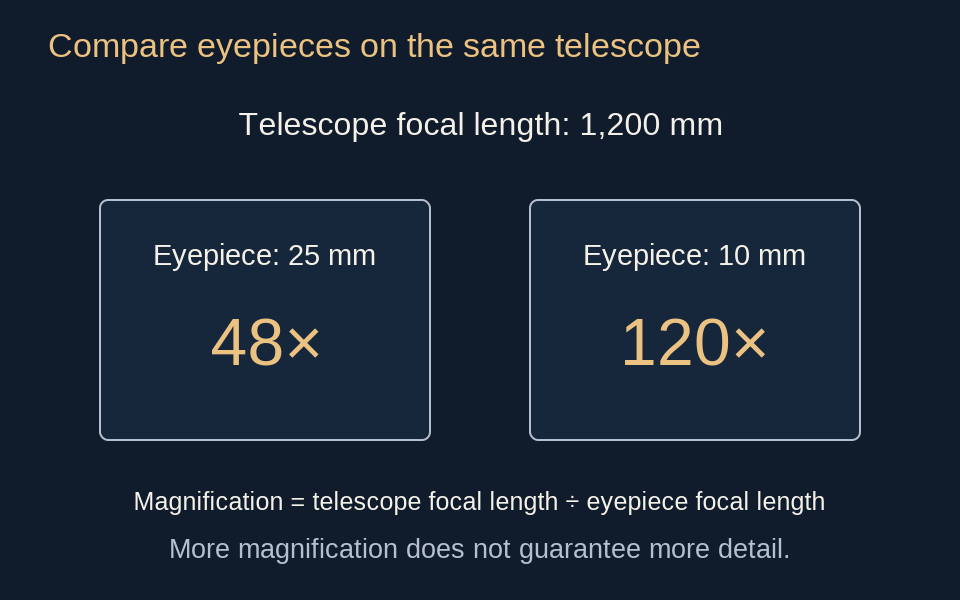
An eyepiece’s focal length helps determine magnification. For example, a 1000 mm telescope with a 25 mm eyepiece gives 40×. Start with a low-power eyepiece to find and centre the object before trying a smaller focal length.
Practise a complete sequence
Before a dark session, identify each control without looking at a diagram. Practise aiming, locking gently, focusing and changing an eyepiece while keeping small parts secure. At night, follow the same sequence on the Moon or another bright target. Never remove protective solar equipment or point an ordinary telescope toward the Sun. Knowing the controls reduces rushed decisions and lets you spend your attention on the sky.
PAUSE AND THINK
Does turning the focus knob increase magnification?
Explore the answer
No. It adjusts the image’s focus; magnification is mainly set by telescope and eyepiece focal lengths.