On this page
THE BIG IDEAS
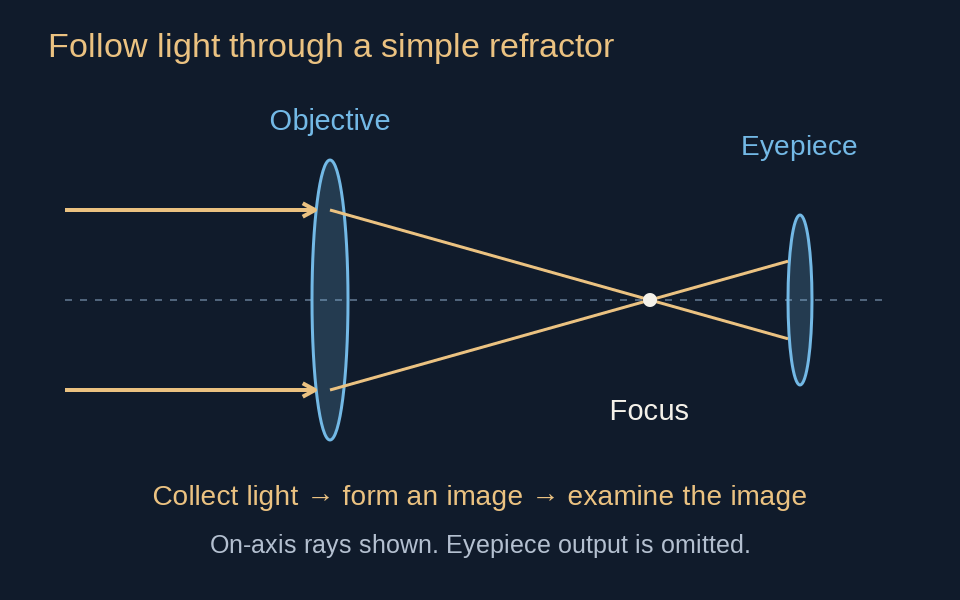
- The objective collects light and forms an image.
- The eyepiece changes the angle under which the image is viewed.
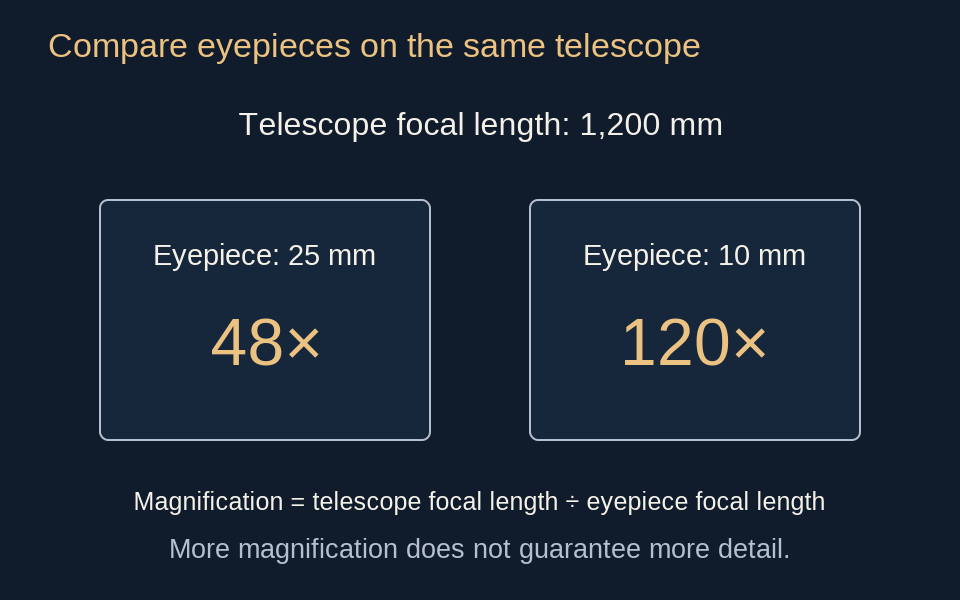
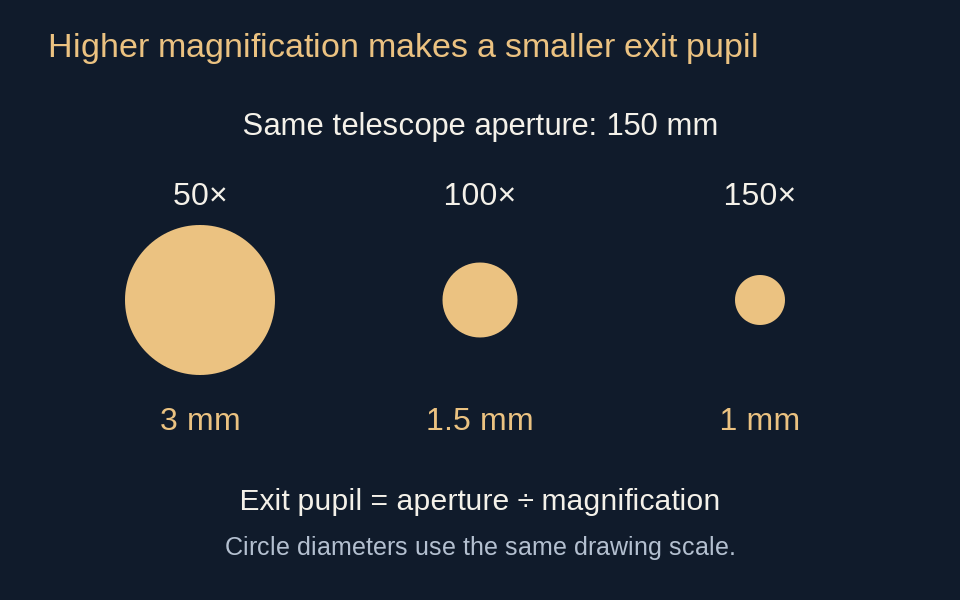
- More magnification does not guarantee more visible detail.
Follow the light before the equipment
A telescope can seem like a complicated tube with several knobs. A light-path drawing separates three jobs: collecting incoming light, forming an image and examining that image. This activity concentrates on a simple refracting telescope with a converging objective lens. It is a diagram exercise rather than instructions to assemble or point real optics.
Prepare a clear sketch
Use plain paper, ruler and two pencil colours. Draw a long horizontal optical axis. Draw a vertical line to represent the objective lens and mark a focal point to its right. Through that point draw a dashed line perpendicular to the axis and label it image plane. Label the left side distant target. Leave room to show the rays clearly.
Construct the ray diagram
- 1. Draw two incoming rays parallel to the optical axis, one above it and one below it, representing light from a distant point on that axis.
- 2. After the objective, angle both rays so they meet at the marked focus. Add arrows showing the direction of light travel.
- 3. Add a slightly tilted pair of parallel incoming rays for a neighbouring target point. Draw one through the centre of the thin-lens symbol without changing its direction. Its intersection with the image plane locates the new image point. Bend the other ray at the lens so it reaches that same point.
- 4. Mark the image region in that plane. Different target points form corresponding image points there in this ideal model.
- 5. Add an eyepiece beyond that region and label its role as examining the image under a larger angle.
Explain what each part does
A larger objective collects more light from a target than a smaller one under comparable conditions. The objective brings rays from each distant point together at corresponding image points. The eyepiece helps the eye view that image at increased angular size. Increasing magnification alone does not create detail that the objective and observing conditions failed to resolve.
Reflecting telescopes use a curved primary mirror for the main light-gathering and focusing task. Their ray paths bend back after reflection, but the need to form and examine or record an image remains. A camera sensor can record an image without someone looking through an eyepiece.
State the simplifications
Your straight-line lens symbol does not represent its physical shape. Real lenses and mirrors have optical limitations and telescope designs can contain extra elements. The sketch also exaggerates angles for visibility. Explain these choices beside the drawing. Finish by tracing one ray with a finger from distant target to image, then describing separately what happens when an eyepiece is changed. Never use an ordinary telescope to inspect the Sun.
PAUSE AND THINK
Would a powerful eyepiece make a very small objective collect more light?
Explore the answer
No. The objective’s collecting area is unchanged. An eyepiece can enlarge the apparent image without adding the missing light or resolution.
RECORD YOUR OWN EVIDENCE
Your activity sheet
You need: Plain paper, ruler and two pencil colours.
Draw parallel rays entering an objective and converging in an image plane perpendicular to the axis through the focus. For a tilted incoming bundle, use an undeviated ray through the lens centre to locate its image point. Label the eyepiece separately.
Name or group: Date:
| Part | Job | What happens to light? | One limitation |
|---|---|---|---|
| Objective | |||
| Image plane / focus | |||
| Eyepiece |
Why does greater magnification alone not create new detail?
Identify a feature you exaggerated or left out of the diagram.
Record what happened, including uncertain results. Use the answer guidance in this resource to discuss your explanation.