On this page
Keeping one face toward Earth requires rotation
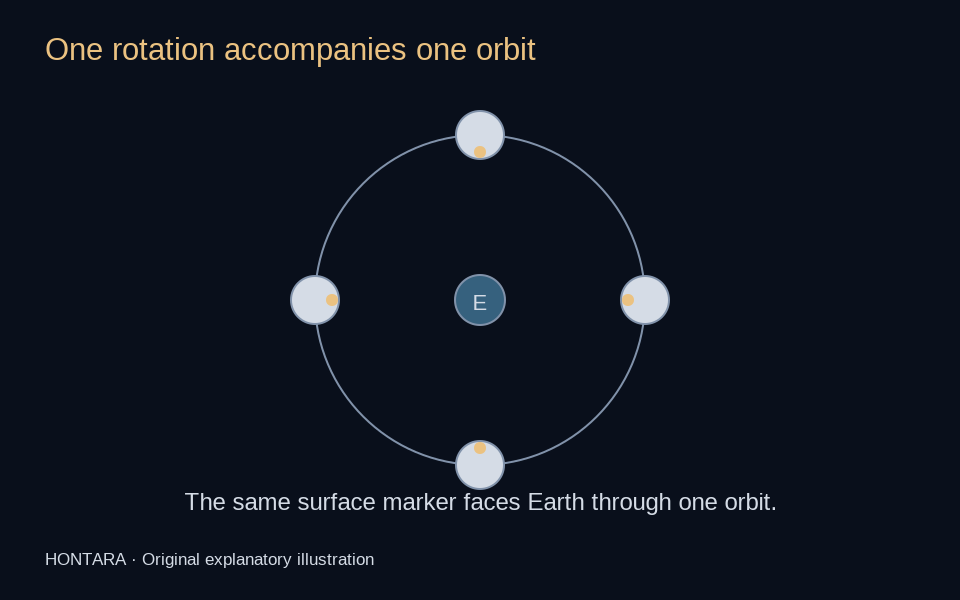
The Moon turns once on its axis in approximately the same time that it completes one orbit relative to distant stars: about 27.3 days. This relationship is called synchronous rotation. It keeps approximately the same lunar hemisphere facing Earth. A Moon that did not rotate would present different sides to us as it travelled around its orbit.
Rotation describes an object turning about its own axis. Revolution describes travelling around another body. Neither word tells you the rate without specifying a reference and a timescale. Here the important relationship is one rotation for one orbital circuit.
THE BIG IDEAS
- The Moon rotates once per orbital circuit relative to the stars.
- Near side and far side are different from day side and night side.
- A ball model demonstrates the orientation but not the history of tidal locking.
Use a marked ball
Place an Earth marker on a table and mark one side of a separate ball with a removable paper dot. Move the ball around the Earth marker while keeping that dot pointed inward. At four quarter-orbit positions, note which room wall the dot faces. Its direction relative to the room changes through a complete turn.
Repeat while keeping the dot pointed toward the same wall throughout. This second ball does not rotate relative to the room. From the Earth marker, different parts of its surface come into view. Compare the two trials before choosing the one that represents the Moon.
Why the match developed
Tidal interactions between Earth and the Moon gradually changed the Moon’s rotation. Gravity acts slightly differently across an extended body and deformation with dissipation can transfer energy and angular momentum. Over long times the Moon reached the present rotational relationship. It was not fixed in place by an invisible rigid connection.
A hand-held ball cannot reproduce that physical history. It demonstrates the resulting geometry only. Separate the statement the model shows one face kept inward from the explanation of how gravitational interactions established that state.
Far side does not mean permanently dark
The hemisphere turned away from Earth is the far side. It receives sunlight during much of each lunar cycle. Near side and far side describe orientation toward Earth; day side and night side describe illumination by the Sun. These are different pairs of labels.
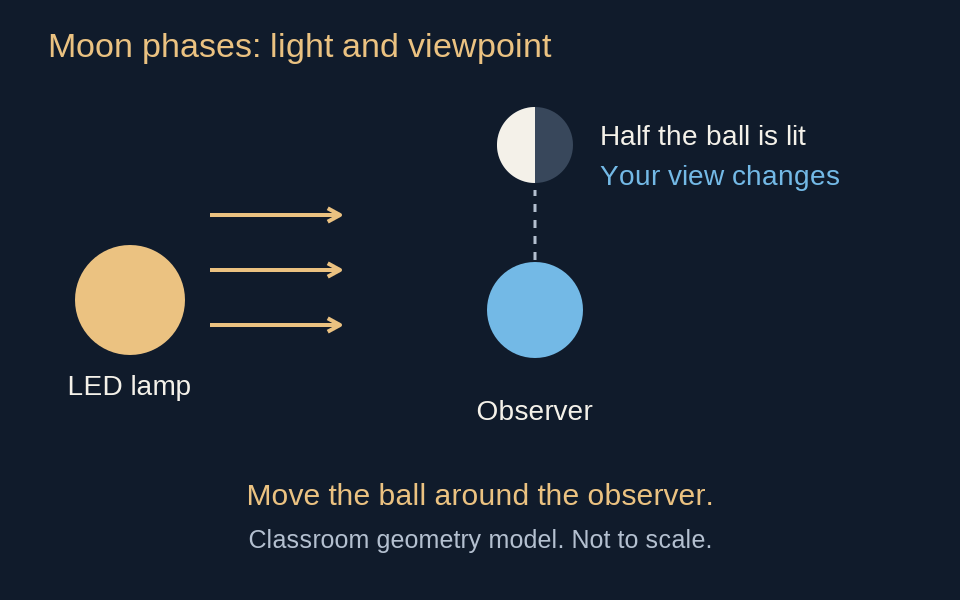
Place a cool LED lamp well outside your tabletop orbit. The marked near side can face Earth while its illumination changes as the ball moves. At one position it is largely lit; at another it is largely unlit. Keep the lamp still and avoid blocking its light with the Earth marker unless specifically demonstrating an eclipse.
Why we say approximately the same face
The lunar orbit is not a perfect circle and its orientation is tilted. These features produce apparent rocking motions called librations. Over time observers can see a little around different edges rather than exactly one unchanging half. This does not undo the basic synchronous relationship.
Finish your model record with three labels: rotation, orbital motion and illumination. Explain one observation using each. A drawing that answers all three with a single arrow is likely to mix distinct ideas. Use dated images to investigate libration rather than assuming a hand-held model predicts its amount.
PAUSE AND THINK
What would an observer at the Earth marker see if the ball always kept its dot facing the same room wall?
Explore the answer
Different ball surfaces would face Earth at different orbital positions. Keeping the same surface toward Earth requires the ball to turn relative to the room as it moves.