On this page
Begin with observations rather than a picture
Dark matter is the name given to an inferred gravitating component that does not emit or absorb light in the ordinary ways used to identify stars and gas. The case rests on several kinds of measurement. Astronomers compare motions, gravitational lensing and cosmic structure with predictions made from the matter that can be detected electromagnetically.
This is an inference under physical models including gravity. A blue patch labelled dark matter in a composite image is normally a visualisation of an inferred mass distribution. It is not a photograph of blue dark-matter particles. Separating measured light from model-dependent reconstruction makes the evidence easier to assess without understating its strength.
THE BIG IDEAS
- Independent gravitational measurements support additional unseen mass.
- Lensing maps are reconstructions rather than particle photographs.
- The nature of dark matter remains an open question.
Rotation tests the mass distribution
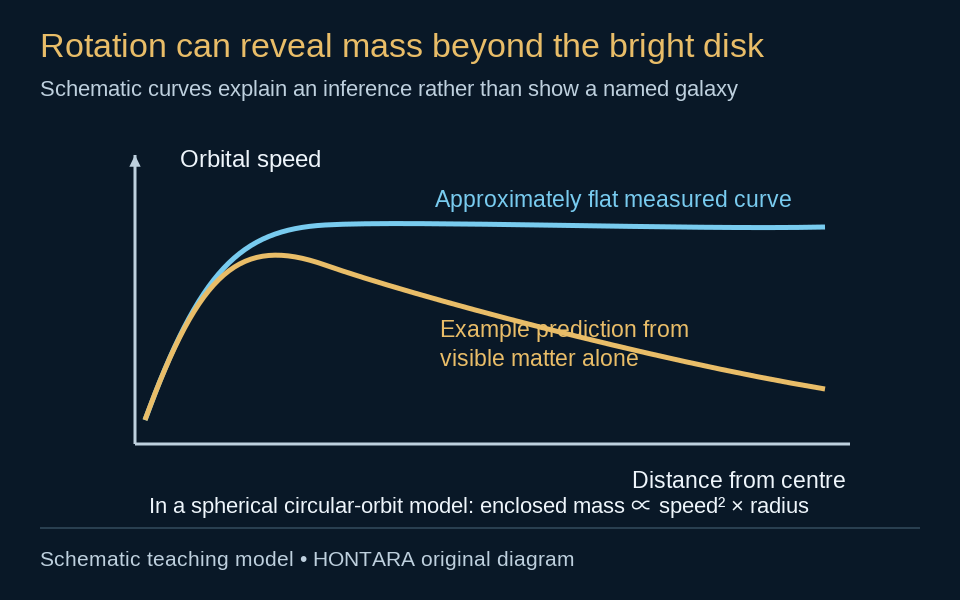
In many spiral galaxies, gas and stars far from the bright centre move faster than a model containing only the observed ordinary matter would predict. Their orbital speed often remains approximately level over a substantial range of radius. An extended distribution of additional mass can explain this behaviour under the usual gravitational description.
For a simplified spherical system with circular orbits, enclosed mass is proportional to speed squared times radius. If speed stays constant while radius doubles, the inferred enclosed mass doubles. This worked example explains why a flat rotation curve suggests mass extending outward. A real disk galaxy is not spherical and estimating its stellar mass requires assumptions about its population and light.
Lensing supplies a different test
Gravity deflects light from background sources. Astronomers use the resulting distorted images to estimate a foreground mass distribution. This method probes gravity through light paths rather than orbital speeds. Ordinary matter also lenses light, so the relevant question is whether the measured stars and gas account for the total inferred mass.
In the Bullet Cluster, X-ray observations locate hot gas while lensing maps locate much of the gravitating mass elsewhere after a collision. The separation is strong evidence for a component that behaves differently from the colliding gas. It does not directly identify an elementary particle. Careful interpretation combines the gas, galaxies and lensing geometry rather than relying on a single coloured overlay.
What remains unresolved?
The identity of dark matter remains unknown. Laboratory searches and astronomical tests constrain possibilities. Cold dark matter is a useful model component whose particles would move slowly compared with light when cosmic structures begin forming. The word cold describes that motion in the model rather than a thermometer measurement of an invisible cloud.
Alternative descriptions modify gravity or its application and must confront the same combined evidence. Matching one galaxy’s rotation curve is not sufficient by itself to explain clusters and the wider universe. Try labelling three statements as observation, inference or open question: gas moves quickly; extra mass improves the gravitational model; the component is a particular particle. Only the last would require an identification beyond the gravitational evidence described here.
PAUSE AND THINK
Does a lensing mass map identify what dark matter is made of?
Explore the answer
No. It estimates the distribution of gravitating mass under a lensing model. Particle identity needs additional evidence.