On this page
Put three parts in the right order
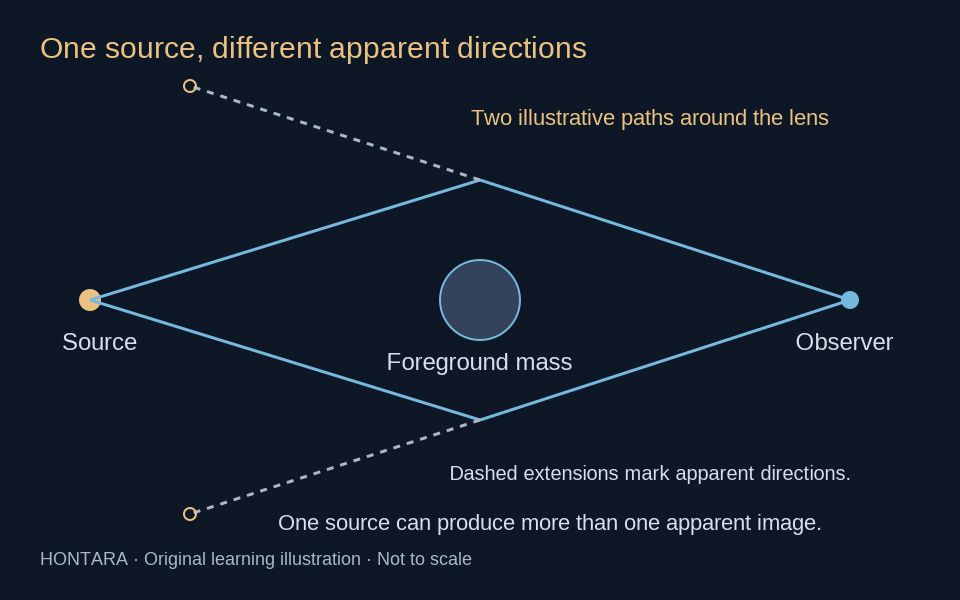
A gravitational-lensing system has a distant light source, foreground mass along a relevant line of sight and an observer. General relativity describes how mass and energy curve spacetime. Light follows paths through that curved geometry, so its apparent direction can change near a massive foreground object.
The lens need not be a transparent glass-like body. A galaxy or galaxy cluster can act as the foreground mass distribution. The background source and lens are generally at different distances even when they overlap on a two-dimensional image.
THE BIG IDEAS
- The foreground lens and background source are different parts of the system.
- Multiple images can come from one physical source.
- Magnification requires careful interpretation and modelling.
Understand what an arc represents
For suitable alignments, the background source can appear stretched into arcs, multiply imaged or approximately ring-shaped. Different light paths can connect the same source with the observer. Several apparent images can therefore represent one physical source rather than several new galaxies.
The shape depends on alignment and the distribution of foreground mass. A neat complete ring is a special configuration, not the inevitable result of putting any galaxy in front of another. Most alignments do not create a dramatic picture-book lens.
Use magnification carefully
Lensing can increase the apparent area and total received flux of an extended background source, helping astronomers study otherwise difficult targets. In an ideal transparent lens, surface brightness is conserved: magnification does not simply turn every square arcsecond into a brighter patch.
The image is also distorted. Reconstructing the source requires a lens model and introduces uncertainty. A magnified view does not automatically supply a perfectly undistorted photograph or an exact source size without further analysis.
Look beyond dramatic examples
Strong lensing can produce conspicuous arcs or multiple images. Weak lensing instead involves small systematic shape distortions that are studied statistically across many background sources. Microlensing can be recognised through changing brightness when separate images are not resolved.
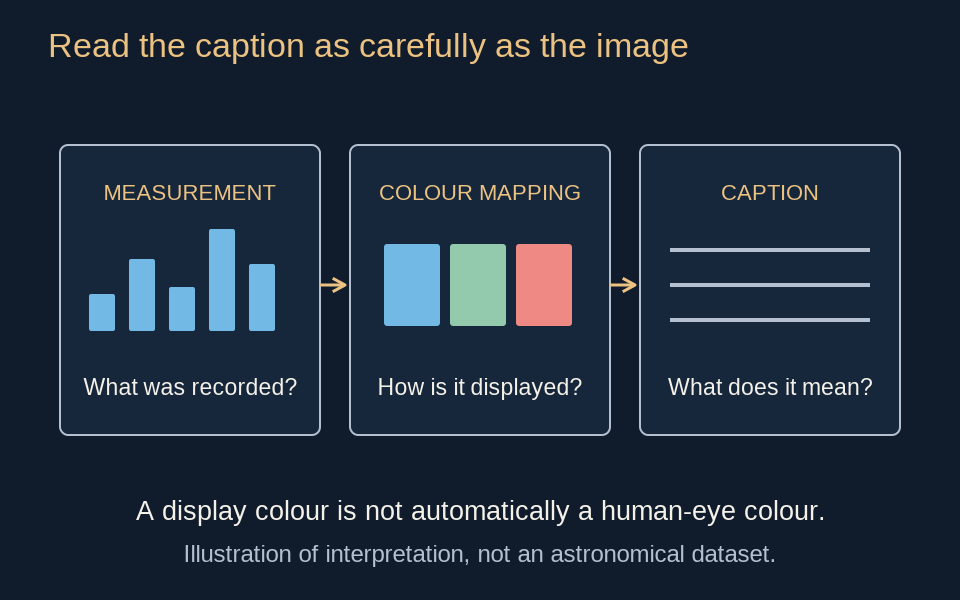
For a first image exercise, label the foreground lens and the candidate background arcs using the official caption. Record which structures are actually identified there and which are your own questions. Similar colours or curved shapes alone are not sufficient to confirm a lens or a source’s distance.
PAUSE AND THINK
Do four lensed images necessarily mean that there are four separate background objects?
Explore the answer
No. Multiple paths can produce several apparent images of the same physical source. Identifying those images requires evidence and a model of the lensing system.