On this page
Element identity belongs to the nucleus
An element is defined by its number of protons. Chemical reactions rearrange atoms and their electrons but do not ordinarily change one element into another. Explaining where carbon, oxygen or gold originated therefore requires nuclear processes. The atoms in everyday materials record a history extending well before the Sun and planets formed.
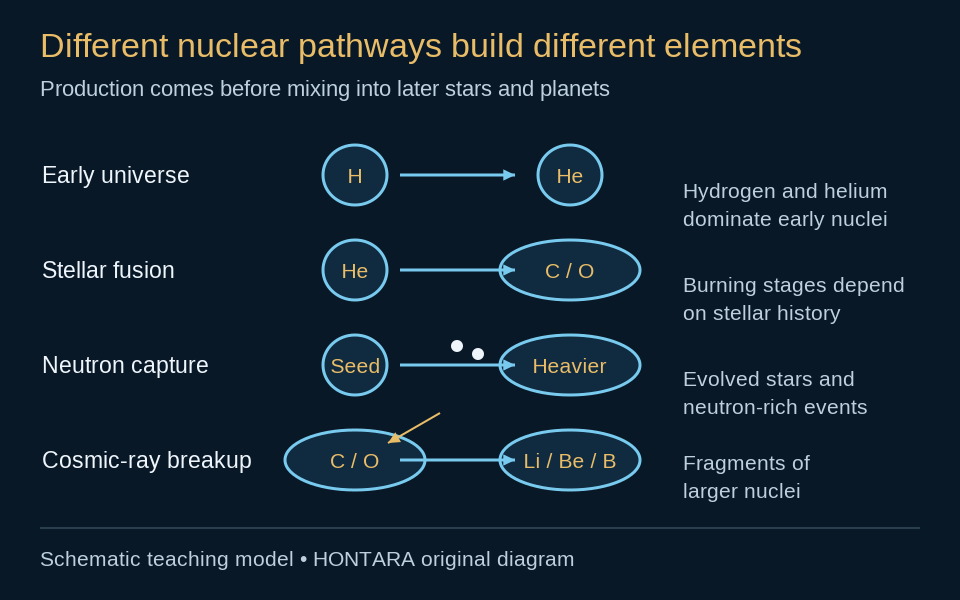
The early hot universe produced mostly hydrogen nuclei and helium nuclei with small amounts of other light nuclei including lithium. Neutral atoms formed much later when conditions allowed electrons to remain attached. Keep these stages separate: making a helium nucleus is not the same event as assembling a neutral helium atom or forming a helium-rich star.
THE BIG IDEAS
- Nuclear processes establish element identity before later chemistry builds materials.
- Winds and explosions recycle stellar material into new systems.
- Neutron capture and cosmic-ray fragmentation add distinct production routes.
Stars build and redistribute nuclei
Inside stars, fusion can turn hydrogen into helium. Later stages in suitable stars make carbon and oxygen while massive stars can build heavier nuclei through further burning stages. The details depend on temperature, density and stellar history. Not every star runs every reaction and the Sun will not proceed through all the burning stages of a massive star.
Material reaches interstellar space through stellar winds and other mass loss as well as explosions. New generations of stars form from gas enriched by earlier generations. For a concrete example, the oxygen in water was produced in stellar nuclear reactions while most of its hydrogen has a much earlier origin. Combining those atoms into water is a later chemical step.
Heavier nuclei need several routes
Many nuclei heavier than iron form through neutron capture followed by radioactive changes. Slow neutron capture operates in certain evolved stars. Rapid neutron capture requires a very neutron-rich environment, with neutron-star mergers providing a confirmed important site. Explosive events also produce and distribute many elements through additional reaction pathways.
Observations of the 2017 neutron-star merger GW170817 connected gravitational waves with a changing electromagnetic source consistent with freshly produced heavy material. This supports the merger pathway without assigning every gold atom to one observed collision. Relative contributions can vary by element and isotope and remain subjects of measurement and modelling. Saying that all heavy elements come from ordinary supernovae erases these important distinctions.
Build a more accurate origin map
Write hydrogen, carbon, iron and gold on four cards. Connect hydrogen mainly to early-universe production, carbon to stellar reactions, iron to stellar and explosive production and gold to neutron-capture pathways including mergers. Use more than one connection where appropriate. An element can have contributions from several environments rather than one exclusive birthplace.
Add lithium, beryllium and boron as a challenge. Fragmentation of larger nuclei by energetic cosmic rays contributes to these light elements, so simply ranking elements from light to heavy does not supply their origin story. Finally place the solar-system cloud after these production pathways. The diagram tracks the creation and mixing of nuclei; it does not claim that Earth’s rocks or living organisms formed inside an exploding star.
PAUSE AND THINK
Why is “everything heavier than hydrogen was made in supernovae” inaccurate?
Explore the answer
Early-universe helium, elements produced in long-lived stars, merger-related neutron capture and cosmic-ray fragmentation all require additional pathways.