On this page
Where atmospheric escape happens
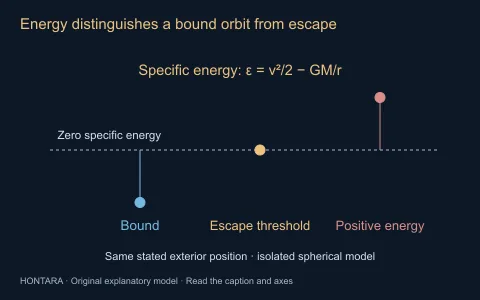
An atmosphere’s upper layers interact with solar radiation and the surrounding plasma environment. Some particles can acquire enough energy to leave the planet’s gravitational influence. The process is not determined simply by a surface thermometer or by whether the sky looks clear.
Near the upper atmosphere, collision frequency and particle energy distributions matter. Escape speed decreases with distance from the planet’s centre, so an upper-atmosphere calculation should not automatically use a surface value without stating the approximation.
THE BIG IDEAS
- Escape involves upper-atmosphere conditions and particle energies.
- Thermal and non-thermal pathways can contribute differently.
- Present loss rates do not automatically reconstruct the entire past.
Thermal escape from fast-moving particles
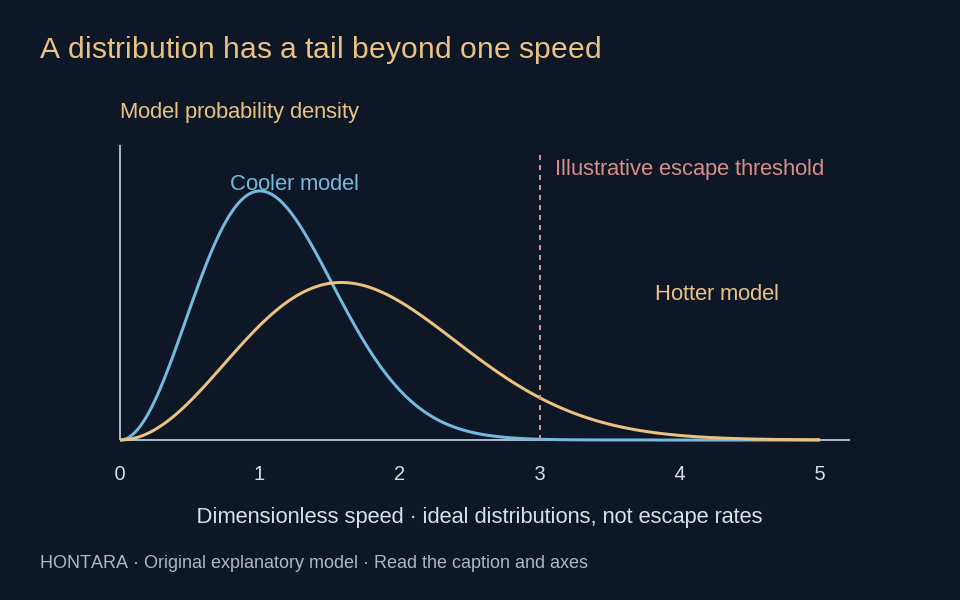
At the same temperature, lighter particles have higher characteristic thermal speeds than heavier particles. A high-speed tail in the particle distribution can contribute to thermal escape under suitable conditions. Larger gravitational binding makes that process harder, other things being equal.
The relationship is statistical rather than a switch that releases every molecule when one average speed crosses a line. Temperature, composition, gravity and collisions all enter. A single escape-speed number cannot supply a complete loss rate for a mixed, evolving atmosphere.
Non-thermal escape at Mars
Radiation can ionise or dissociate atmospheric particles, while charged-particle interactions and magnetic processes can give particles additional energy. Sputtering is one mechanism in which energetic incoming particles can knock atmospheric material out through collisions.
In 2025, scientists reported the first direct observations of sputtering at Mars. They used MAVEN measurements to map high-altitude argon and compare it with the locations where energetic particles struck the atmosphere. The argon appeared above those regions, as expected if collisions had knocked it upward. Estimates of total loss over the planet’s history require a model of how those conditions changed.
Balance loss with sources and chemical change
Volcanic outgassing, impacts, surface reservoirs and chemical reactions can change an atmosphere as well as remove or supply material. Long-term evolution depends on the balance of processes and on the planet’s changing environment.
In an invented budget, a reservoir losing two units per interval but receiving one unit has a net loss of one. The arithmetic is simple, but real escape estimates require measured or modelled rates, uncertain past conditions and a consistent definition of the reservoir being counted.
Avoid a one-factor habitability rule
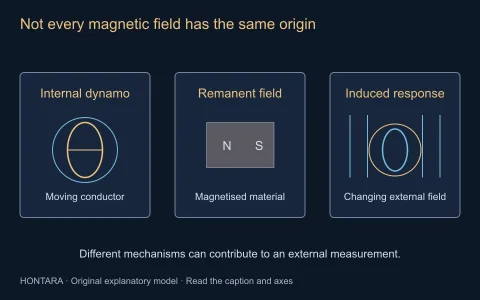
A global magnetic field alters interactions with the solar wind, but atmospheric retention is not decided by field strength alone. Atmospheric mass, composition, planetary gravity, stellar activity and the details of escape pathways all matter.
For a useful comparison, name the proposed mechanism, identify the upper-atmosphere measurements supporting it and distinguish a present rate from a historical reconstruction. This keeps a physical explanation of atmospheric change separate from a categorical claim that one planet must retain all air or another must lose it immediately.
Start with the calculator’s Earth example. Change the mass field from 5.9722 to 23.8888 and leave the distance at 6,371 km. The mass is four times larger and the ideal escape speed doubles from about 11.2 to 22.4 km/s. Estimating how much gas escapes also requires information about particle energies, collisions and external sources of energy.
PAUSE AND THINK
Does one measured present-day escape rate prove that the same rate operated throughout a planet’s history?
Explore the answer
No. Stellar forcing, atmospheric composition and the planet’s environment can change. Historical totals require a justified model and uncertainty assessment.