On this page
Describe a process rather than a hidden object
Earth’s global magnetic field is generated mainly by motions of electrically conducting fluid in its outer core. The dynamo involves fluid motion, electric currents and magnetic fields sustaining one another. It is not a literal permanent iron bar magnet sitting at the centre.
Rotation helps organise the flow, while sources of buoyancy and heat transport influence the available motion. Conducting material alone is not enough to predict a particular global field strength without the dynamical and thermal conditions.
THE BIG IDEAS
- A dynamo requires moving electrically conducting material.
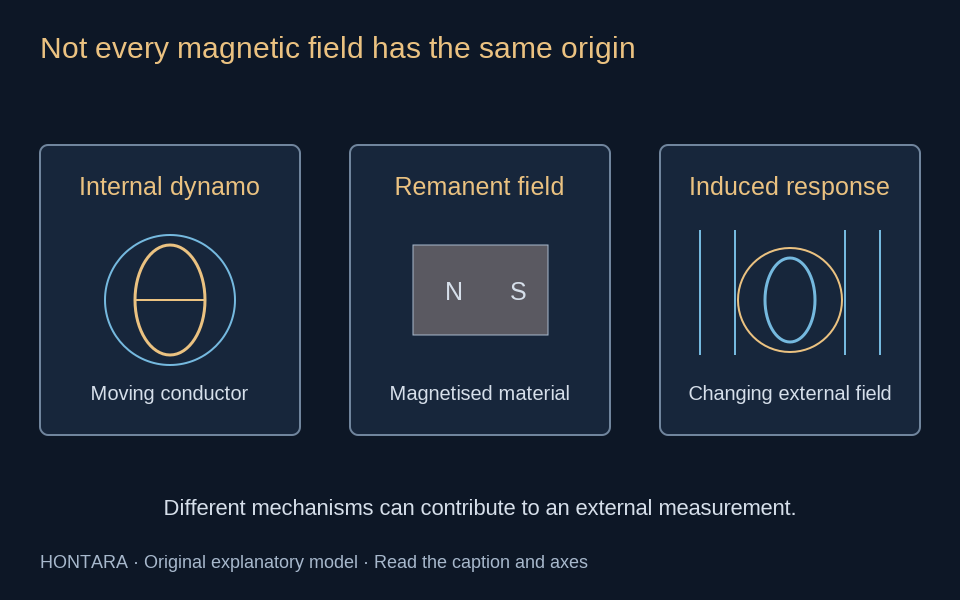
- Internal, remanent and induced fields are different mechanisms.
- External magnetic measurements need an interior and environment model.
Separate several kinds of magnetic evidence
An internally generated field differs from magnetisation retained in crustal rocks and from a field induced by an external changing environment. These mechanisms can leave different spatial and temporal signatures. An absence of a strong global dynamo does not mean no magnetic measurements can be made near a world.
Venus, for example, lacks an Earth-like internally generated global field but interacts with the solar wind through its upper atmosphere and induced magnetic environment. That comparison is different from assuming every planet has the same interior engine at a different strength.
Compare different conducting interiors
Earth’s conducting liquid-metal outer core and Jupiter’s deep electrically conducting hydrogen illustrate that dynamo ingredients need not be identical materials. Pressure and temperature affect the phases and conductivity of planetary interiors.
A field measurement at a spacecraft does not directly photograph the generating fluid. Researchers infer internal structure by combining the field’s geometry and changes with gravity, composition and thermal models. The inverse problem can admit more than one detailed internal arrangement.
Read the external geometry carefully
A dipole is a useful first approximation for some fields, but real planetary fields can include substantial higher-order structure and offsets. The magnetic axis need not align with the rotation axis. A simple north–south sketch is not a complete three-dimensional map.
The surrounding magnetosphere also responds to solar-wind conditions and plasma sources. Changes measured outside a planet can reflect both external processes and the internal field. Identify the measurement location, time and model components before attributing every variation to the core.
Link the mechanism to testable questions
Ask whether observations require an internal dynamo, preserved crustal fields or induction. Then identify which field components or time variations distinguish those explanations. Complementary measurements are more useful than choosing an explanation from a planet’s size alone.
Avoid equating the strongest field automatically with the most habitable surface or complete atmospheric protection. Field geometry, atmosphere, stellar environment and escape processes interact. A dynamo explanation establishes one important physical mechanism, not a single numerical ranking of planetary safety or biological potential.
For an observation record, include field direction as well as strength and specify the location relative to the planet. A strong reading at one point is not automatically the global dipole strength. Repeated tracks and different positions help separate spatial structure from changes occurring with time in the surrounding magnetic environment.
PAUSE AND THINK
Does finding a magnetic response automatically prove a permanent internal bar magnet?
Explore the answer
No. Dynamos, magnetised material and induced responses are different possibilities. Their signatures and physical settings must be examined.