On this page
A flow of charged particles
The solar wind is an outward flow of plasma from the Sun’s outer atmosphere. It contains charged particles, mainly electrons and protons, together with other ions. Plasma also interacts with electric and magnetic fields, making its behaviour different from an ordinary neutral-gas breeze near Earth’s surface.
This material carries the Sun’s magnetic influence into interplanetary space. Spacecraft measure properties such as particle speed, density, temperature and magnetic-field direction. These are measurements of a changing environment rather than one fixed condition throughout the Solar System.
THE BIG IDEAS
- Solar wind is plasma, not sunlight travelling at light speed.
- Flares, coronal mass ejections and solar-wind streams are distinct.
- A travel-time calculation is not a space-weather forecast.
Keep plasma and sunlight distinct
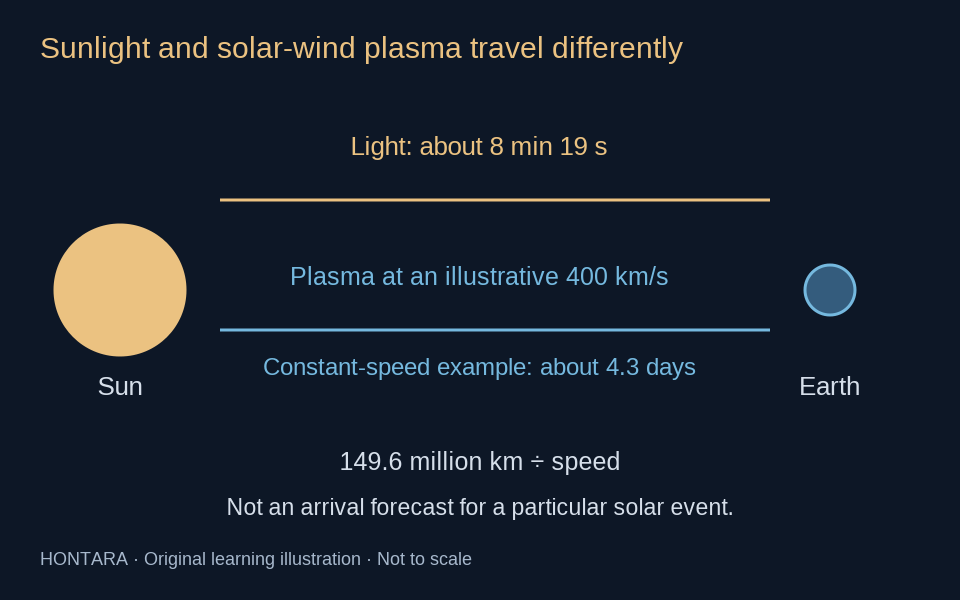
Sunlight is electromagnetic radiation and travels through vacuum at the speed of light. The solar wind consists of particles moving much more slowly. A bright view of the Sun is therefore not a photograph showing the immediate arrival time of the surrounding plasma at Earth.
For an illustrative constant-speed calculation, 149.6 million km divided by 400 km/s gives about 4.3 days. Light crosses roughly the same distance in about 8 minutes 19 seconds. The particle calculation is only a simplified travel-time example, not a forecast of a specific solar disturbance.
Separate the background flow from eruptions
The solar wind continually changes and includes streams with different properties. A coronal mass ejection is a large eruption of magnetised plasma. A solar flare is a burst of radiation associated with magnetic activity. These phenomena can be related without being interchangeable names for the same thing.
An eruption’s effects near Earth depend on its direction, speed, evolution and magnetic interaction with the surroundings. A dramatic solar image alone does not establish that Earth will experience a particular geomagnetic response at an exact time.
Connect the flow to a planetary response
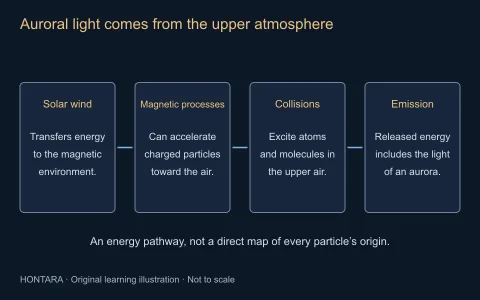
Earth’s magnetosphere interacts with the solar wind rather than acting as a rigid wall. Energy transfer and magnetic changes can drive processes that accelerate particles and contribute to auroras. Other planets respond according to their magnetic fields, atmospheres and surrounding plasma environments.
Compare a spacecraft particle plot with an optical image only after checking what each instrument measures. A useful record names the quantity, units, place and time. Keep explanation of the solar-wind mechanism separate from a local aurora prediction or an unsupported claim that a particular display must occur.
PAUSE AND THINK
Does seeing a solar flare mean that the same material reaches Earth eight minutes later?
Explore the answer
No. Radiation and plasma have different propagation behaviour. Roughly eight minutes is a light-travel time, not the general travel time of solar-wind or ejected material.