On this page
THE BIG IDEAS
- Separate viewpoints can constrain projection ambiguities.
- STEREO-B no longer supplies data; preserve each image’s spacecraft identity.
- Timing and feature evolution matter in multi-view comparisons.
Two original viewpoints, a changing mission
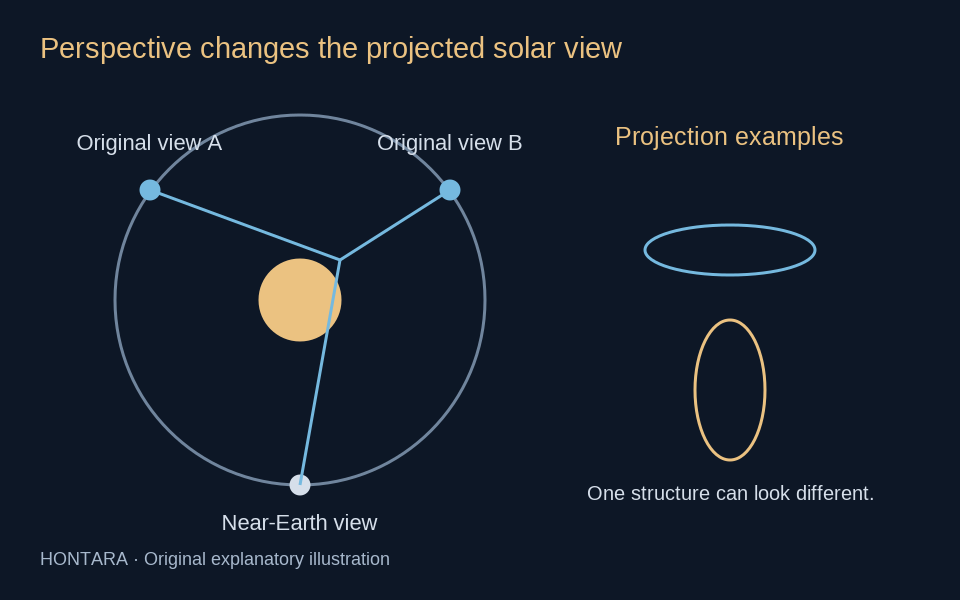
NASA launched the two STEREO spacecraft in 2006 to study the Sun and heliosphere from separated vantage points. The names Ahead and Behind described their different heliocentric observing geometry. Their views were especially useful when combined with observations near Earth.
Contact with STEREO-B was lost in 2014. Brief contact in 2016 did not restore its science mission and recovery efforts ended in 2018. STEREO-A continued the mission’s single-spacecraft observations. Historical two-spacecraft images therefore need to be distinguished from later observations made by STEREO-A alone.
Remember that an image is a projection
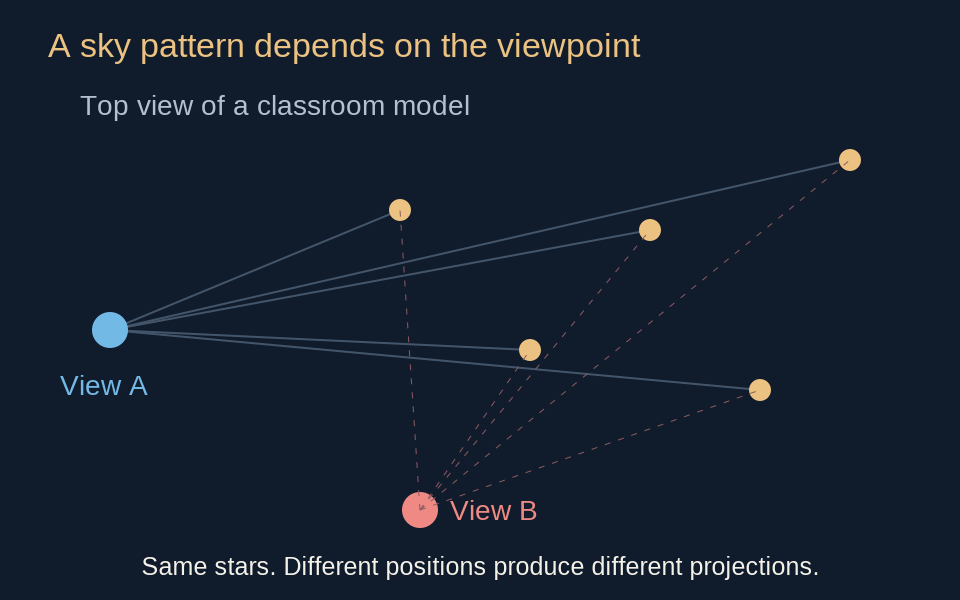
A coronal feature spread across a two-dimensional frame can have several possible three-dimensional arrangements. From one direction it may appear close to the Sun’s edge; another observer can see it against a different background. Viewpoint affects the apparent position and shape without physically changing the feature.
A simple classroom model places two observers around a lamp and an irregular wire loop. Their sketches can differ even though the loop stays fixed. This is an analogy for projection, not a physical model of plasma dynamics or a calibrated reconstruction of an actual solar eruption.
Combine images with timing and instrument information
Useful multi-view comparisons need compatible timestamps, image scales and knowledge of the observing bands. A feature can evolve while images are being taken, so an apparent difference need not arise solely from viewing direction. Instrument response can also affect which material is visible.
For a hypothetical comparison, label observer A’s frame at 12:00 UTC and observer B’s at 12:20 UTC. Before treating their different outlines as a pure stereo pair, ask what could have changed during those twenty minutes. Geometry and time must be handled together.
Use the extra view to constrain a question
Separated observations help investigate the structure and propagation of coronal mass ejections and the surrounding solar wind. A feature’s projected speed in one frame is not automatically its full velocity through space. Additional viewpoints can reduce ambiguities when combined with an appropriate model.
The inference still depends on identifying corresponding structures and understanding what the cameras detect. Not every bright patch has one unambiguous counterpart in another view. A careful analysis records uncertainties instead of forcing a match because a three-dimensional answer is desired.
Read a dated sequence before a headline
Keep the spacecraft identifier attached to each image. Note whether a product is a direct observation, a processed composite or a model. An archive image from the two-spacecraft era is not proof that two spacecraft are supplying the same observing coverage today.
STEREO’s lasting lesson is that perspective can be a measurement resource. A claim about an eruption’s direction becomes more persuasive when viewpoints, timing and instruments are all documented. The mission helps explain solar structure while also showing why one attractive image is not a complete space-weather forecast.
PAUSE AND THINK
If a feature looks different from two spacecraft, must the difference be caused entirely by viewpoint?
Explore the answer
No. It may also evolve between exposures or appear differently through different instrument responses. Compare times, bands and scales before isolating geometry.