On this page
Start outside the glowing atmosphere
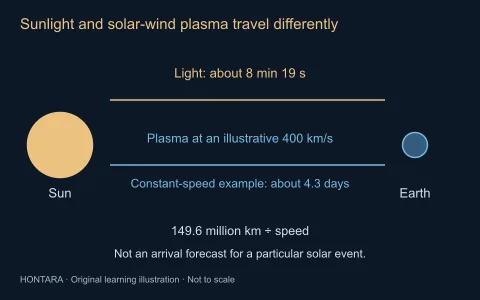
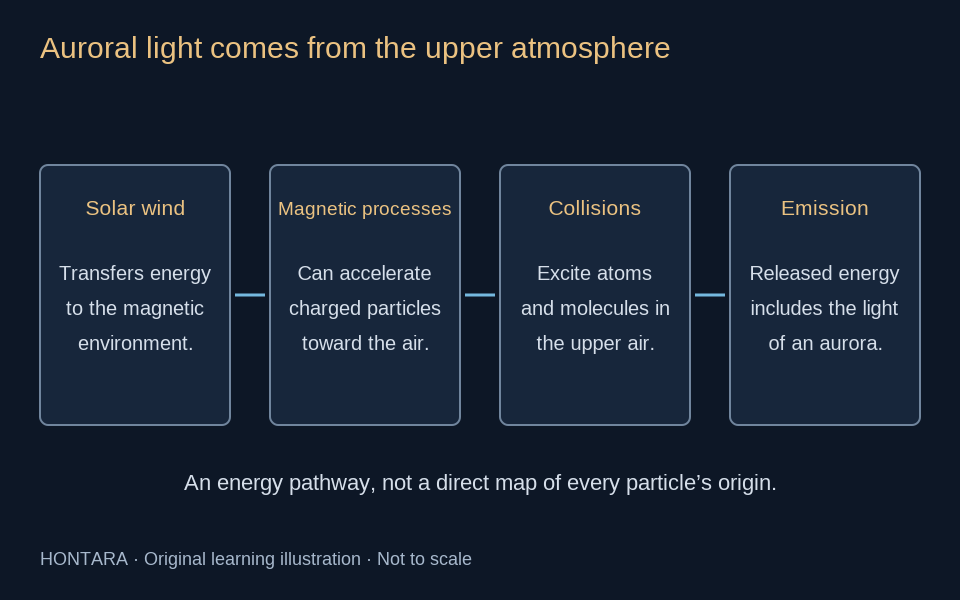
The solar wind interacts with Earth’s magnetosphere and can transfer energy into it. Magnetic processes can accelerate charged particles, often electrons, toward the upper atmosphere. The story is more than a stream of particles passing straight from the Sun to every glowing spot.
In Earth’s auroral regions, particles follow magnetic geometry into atmospheric gas. Collisions can excite atoms and molecules. When those excited states release energy, some of it appears as emitted light. The familiar curtains and arcs trace a changing physical system.
THE BIG IDEAS
- Auroral light comes from excited atmospheric atoms and molecules.
- Magnetic geometry helps organise Earth’s auroral regions.
- A mechanism explanation is not a local visibility forecast.
Ask what determines the colour
Oxygen and nitrogen contribute different auroral emissions. Oxygen can produce green and red light; nitrogen-related emissions can contribute blue, violet or pink tones. Altitude, particle energy, atmospheric composition and observing conditions affect which emissions are prominent.
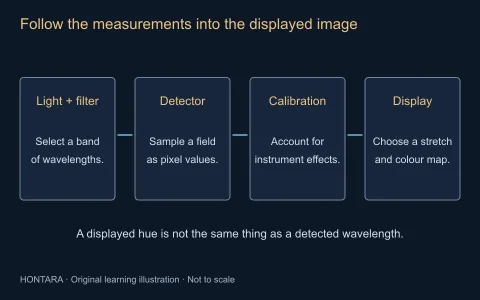
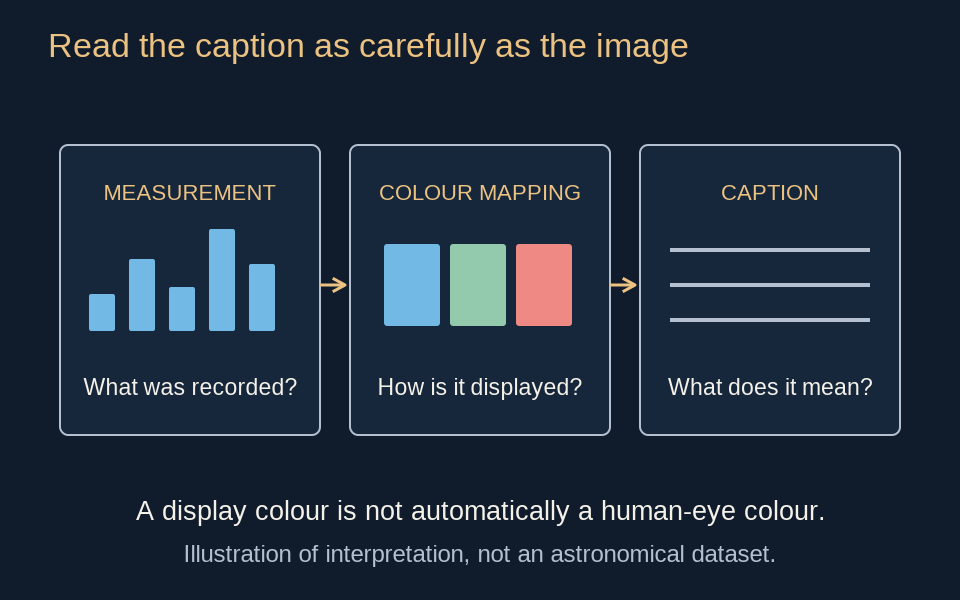
A camera image also depends on exposure, sensitivity, white balance and processing. A displayed colour is not by itself a complete measurement of height or particle energy. Read the image documentation and distinguish the physical emission from the way the camera presents it.
Use magnetic geography
The usual auroral ovals are organised around Earth’s magnetic poles, which are not the same as its geographic poles. During strong disturbances the regions where auroras can be observed may expand. Visibility still depends on the observer’s location, darkness, clouds and the display itself.
A map of geomagnetic activity is not a guarantee that a bright aurora will be visible from a particular town. This explanation does not imply routine aurora viewing near Honavar. Use current official space-weather guidance for a dated question rather than treating a general science page as a live forecast.
Compare mechanisms before generalising
Other planets can have auroras, but their particle sources and magnetic environments need their own explanations. Do not assume that every planetary aurora is driven in exactly the same way as Earth’s. A similar-looking image can involve a different mixture of processes.
For an image-reading exercise, label the planet, instrument and wavelength range from the official caption. Then describe which features are observations and which statements explain a mechanism. Keep atmospheric airglow, sunlight scattered by clouds and an aurora separate rather than calling any coloured sky an auroral event.
PAUSE AND THINK
Why is a photograph alone insufficient to guarantee that someone nearby saw the same colours with unaided eyes?
Explore the answer
A camera integrates light and applies settings or processing that can differ from human visual perception. Conditions and observer location also matter.