On this page
Specify the starting distance
For an isolated spherical attracting body, the ideal escape speed at radius r is √(2GM/r). Radius means distance from the body’s centre, not height above its surface. The model describes an unpowered object that can continue outward without returning under this body’s gravity alone.
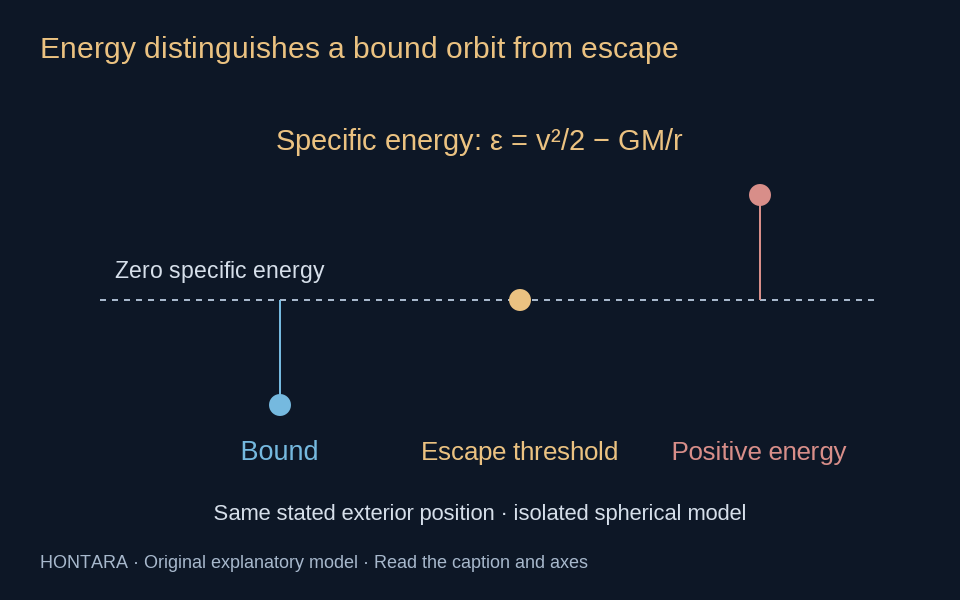
At the threshold its speed approaches zero at infinite distance. Faster outward motion can retain a positive speed far away. This definition is an energy statement; it does not mean gravity suddenly stops acting at a particular altitude.
THE BIG IDEAS
- Escape speed is defined at a particular centre distance.
- Circular speed is smaller by a factor √2 at the same radius.
- Powered flight is not the same problem as an unpowered escape threshold.
Compare with a circular orbit
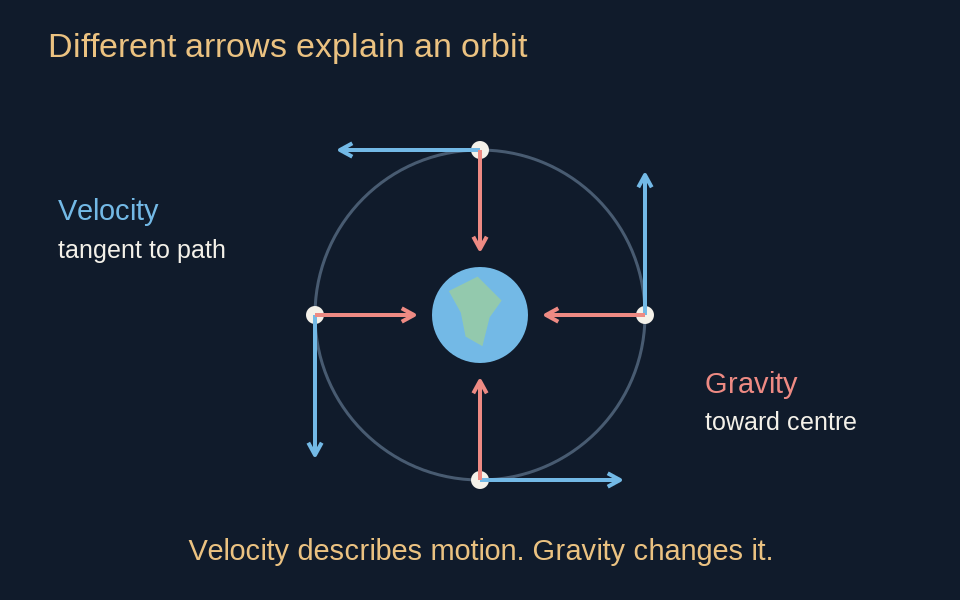
At the same radius, circular-orbit speed is √(GM/r), so escape speed is √2 times larger. A satellite below escape speed is not necessarily falling straight down: with a suitable sideways velocity it may remain on a bound orbit. Direction and position still matter.
Using a rounded Earth example near its surface gives circular speed about 7.9 km/s and escape speed about 11.2 km/s. The imaginary circular path at that radius ignores atmosphere, terrain and Earth’s rotation. It is a comparison of equations, not a safe flight trajectory.
Read the square-root scaling
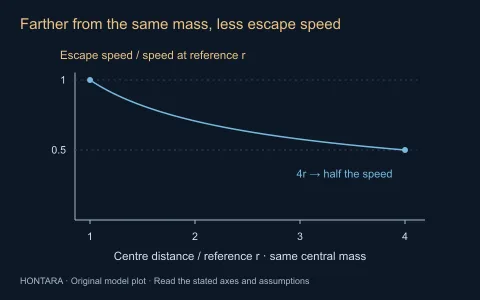
Double r while keeping M fixed and escape speed falls by a factor √2. Multiply mass by four while keeping radius fixed and the threshold doubles. These comparisons reveal why a larger distance reduces the required ideal speed without making gravitational attraction vanish.
Suppose an invented body has an escape speed of 6 km/s at one reference radius. At four times that radius the ideal threshold is 3 km/s. The statement requires the same attracting mass and an isolated spherical approximation; it does not describe a journey through several planets’ gravity fields.
Separate powered departure from a thrown object
A rocket can continue receiving thrust as it climbs. It does not have to acquire the entire ideal surface escape speed instantaneously at the launch pad. Actual mission planning accounts for changing mass, thrust direction, losses, atmosphere and the gravitational influence of other bodies.
Likewise, escaping Earth does not automatically mean escaping the Sun. The reference gravitational system and the spacecraft’s existing heliocentric velocity matter. A speed quoted without a location and reference frame cannot answer every question about a transfer or departure.
Use the threshold as a model check
Compare mass and radius inputs in the linked calculator before interpreting the result. If the radius input is an altitude, add the attracting body’s radius first. Keep km and metres consistent through the calculation or use the units explicitly requested by the tool.
The formula is Newtonian and is not a complete treatment of motion close to a black hole. Its useful role here is to connect gravitational potential energy with kinetic energy and to distinguish an ideal threshold from the engineering of a real launch.
PAUSE AND THINK
Does a rocket have to reach 11.2 km/s instantaneously while still on Earth’s surface?
Explore the answer
No. That rounded value describes an ideal unpowered threshold in a simple Earth model. A powered trajectory changes conditions continuously and needs a separate mission calculation.