TRY IT YOURSELF
Ideal exterior escape speed
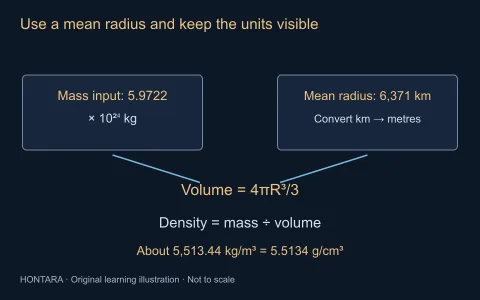
Earth example: 5.9722 × 10²⁴ kg at 6,371 km from the centre gives about 11.186 km/s.
On this page
THE BIG IDEAS
- Use distance from the centre rather than altitude.
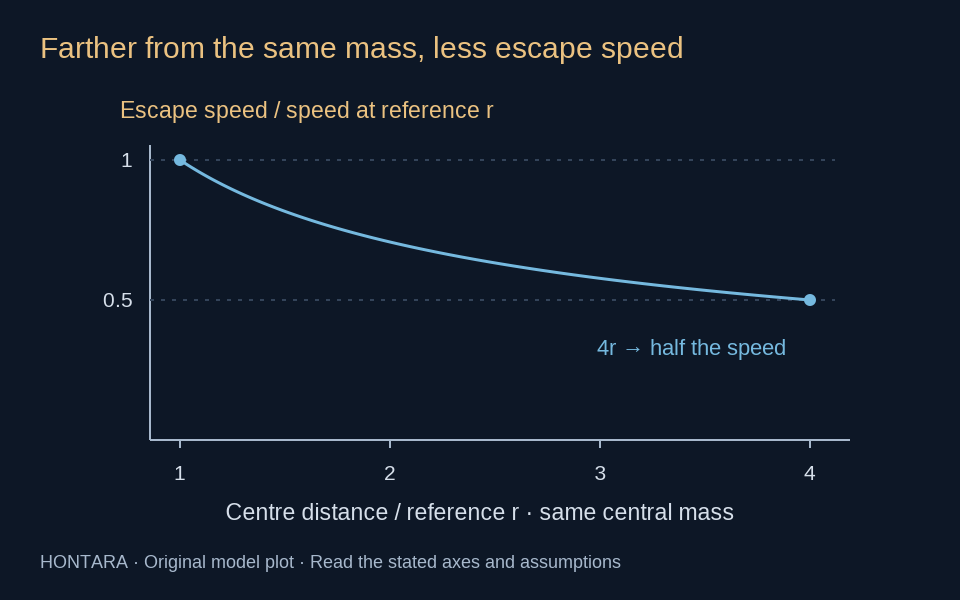
- At fixed mass escape speed falls as r⁻¹ᐟ².
- An ideal escape-speed value is not a launch-performance calculation.
State where the calculation applies
Enter the central body’s mass in units of 10²⁴ kg and the test object’s distance from that body’s centre in kilometres. For an exterior position around a spherical body, the ideal escape speed is √(2GM/r). A surface example uses the body’s relevant radius for r.
The distance is not altitude above the surface. If a model gives both radius and altitude, add them to obtain centre distance before using this relation. The simple exterior formula is not generally valid at an interior point where the enclosed mass and gravitational potential require a different treatment.
Use a clear energy meaning
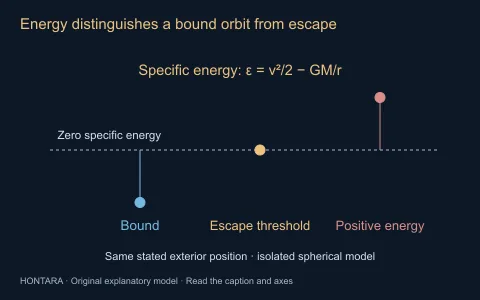
Escape speed is the speed associated with zero total orbital energy in the ideal isolated model: after an unpowered departure, the object can approach arbitrarily large distance with speed tending toward zero. A greater initial speed leaves positive asymptotic kinetic energy under the same assumptions.
The calculation is not a model of a real rocket firing through an atmosphere. It excludes drag, the body’s rotation, propulsion, other gravitating bodies and operational constraints. Calling it a launch speed without those qualifications would hide the difference between a simple energy relation and an actual flight problem.
Check the Earth example
Using mass 5.9722 × 10²⁴ kg and centre distance 6,371 km gives about 11.186 km/s. The calculation uses G = 6.67430 × 10⁻¹¹ m³ kg⁻¹ s⁻² from the CODATA listing. The physical input values are rounded and the result is an idealised exterior example.
If the same model mass is kept but the centre distance becomes four times larger, escape speed is halved. If distance is fixed and mass increases fourfold, escape speed doubles. The square roots make these useful arithmetic checks.
At nine times the original exterior centre distance, that same Earth-mass model gives about 3.729 km/s. The central mass has not changed; the potential-energy difference from that new starting position is smaller.
Distinguish escape from circular motion
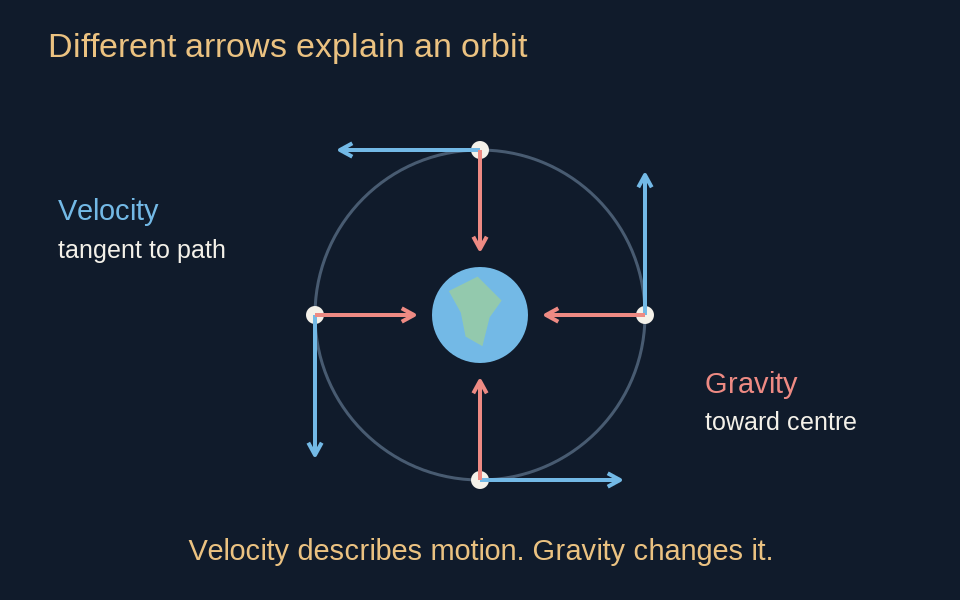
The circular orbital speed at the same exterior radius in the same isolated spherical model is √(GM/r). Escape speed is √2 times that circular value. Having enough speed to orbit and having enough specific energy to escape are different conditions.
A real object’s direction and state determine its orbit, while the ideal energy threshold concerns speed at a stated position. Neither result identifies a safe flight path through terrain or atmosphere. Keep the problem’s coordinate origin and assumptions visible beside the number.
Use the comparison as a model
This tool is intended for learning how gravitational energy scales with central mass and radius. It can help compare fictional worlds or check a simplified textbook example without claiming to reconstruct a body’s full gravity field.
For a rapidly rotating, strongly nonspherical or compact relativistic object, additional physics is required. Keep derived speeds separate from measured properties, formal uncertainty estimates and engineering decisions. A numerical result cannot supply the missing physical model.
PAUSE AND THINK
What happens if centre distance is multiplied by nine while central mass stays fixed?
Explore the answer
The ideal escape speed is divided by three because it is proportional to the inverse square root of centre distance.