On this page
Compare equivalent quantities
Venus has a much hotter mean surface than Mercury despite orbiting farther from the Sun. A meaningful comparison needs to distinguish a surface average from a daytime maximum, a nighttime minimum or an atmospheric temperature at a particular pressure level.
Mercury’s very thin exosphere and large day–night temperature variation differ strongly from Venus’s dense atmosphere. A list of planet temperatures is not automatically a set of identical surface measurements, especially when giant planets are included using atmospheric reference levels.
THE BIG IDEAS
- Distance alone does not determine a planet’s surface temperature.
- High albedo and a strong greenhouse effect can coexist.
- Present measurements and reconstructed climate histories are different evidence.
Follow energy through the atmosphere
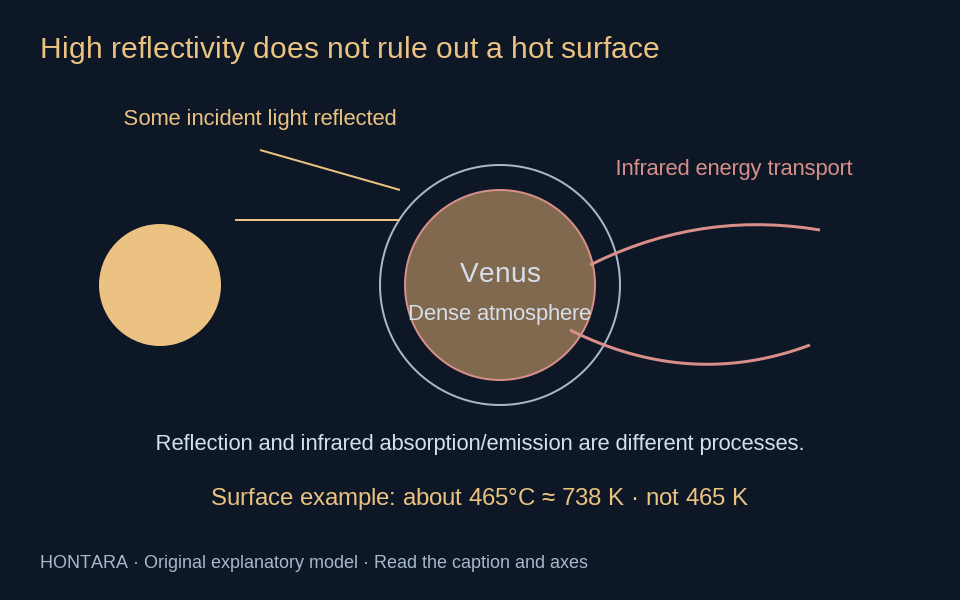
Venus reflects a substantial share of incoming sunlight because of its clouds. The sunlight that is absorbed supplies energy that must ultimately leave to space. Its thick, mostly carbon-dioxide atmosphere interacts strongly with outgoing thermal infrared radiation.
The greenhouse effect does not create energy from nothing or seal the planet in a perfectly closed box. It changes the relationship between the hot surface and the altitude from which energy can effectively escape to space. A hotter lower atmosphere and surface can coexist with overall energy balance.
Separate reflectivity from surface temperature
High reflected brightness does not force a low surface temperature when atmospheric infrared effects are substantial. Likewise, being closer to the Sun does not uniquely fix surface conditions. Absorbed energy, atmospheric structure, circulation and radiative properties must be considered together.
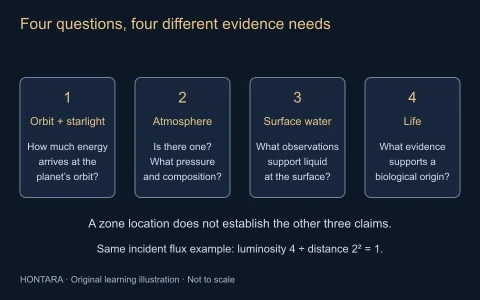
For an illustrative contrast, two planets can receive the same stellar flux but differ in both albedo and greenhouse behaviour. You cannot order their surface temperatures from only one of those quantities without a model of the other energy pathways.
Use present-day measurements without inventing the past
Venus’s surface is roughly 465°C and its surface pressure is around ninety times Earth’s sea-level pressure, with exact quoted rounded values varying by reference. These are conditions established by observations, not a recipe derived from orbital distance alone.
The planet’s earlier water inventory and climate evolution remain research questions. A plausible runaway-greenhouse scenario is not equivalent to a complete observed history. Keep evidence for present atmospheric properties separate from model-dependent reconstructions of how those conditions developed.
Make the explanation transferable
When comparing planets, list incoming flux, reflected fraction, atmospheric composition and the meaning of the temperature being quoted. Then ask which observations constrain the outgoing infrared radiation and atmospheric structure.
This framework helps interpret exoplanets without calling every Earth-sized world an Earth-like climate. It also avoids treating greenhouse processes as a single universal number. Venus provides a powerful atmospheric example, while any quantitative calculation still needs properties and boundary conditions appropriate to the planet under study.
A unit check also matters when comparing temperature models: 465°C corresponds to about 738 K, not 465 K. Radiation laws use absolute temperature. Substituting the Celsius number into a fourth-power emission relation would change the result drastically while leaving an apparently plausible but physically incorrect calculation on the page.
PAUSE AND THINK
Does Venus’s bright reflected appearance mean its surface must be colder than Mercury’s?
Explore the answer
No. Reflection constrains absorbed sunlight, while the dense atmosphere also changes how thermal energy escapes. Surface temperature depends on the combined energy system.