On this page

Think about the area and the pattern
When astronomers say a galaxy is in Ursa Major, they mean its direction lies within the constellation boundary. The galaxy can sit far beyond the stars and outside the picture suggested by the name. Stick figures on charts help you recognise a few stars inside the area. Different charts may draw those figures differently.
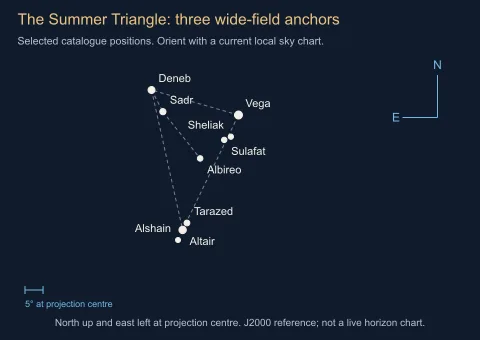
Asterisms are useful signposts. A familiar pattern may cover only a small part of a constellation, such as Orion’s Belt. A pattern might also join stars from several constellations, as the Summer Triangle does.
| Pattern | Where to find it |
|---|---|
| Big Dipper | Seven bright stars within Ursa Major. |
| Orion’s Belt | A row of three bright stars in Orion. |
| Summer Triangle | Vega in Lyra, Deneb in Cygnus and Altair in Aquila. |
Why stars in the pattern can be far apart
Looking at the sky shows the direction to a star. It hides depth. Two stars next to each other in a pattern may be at very different distances from Earth. Some groups also form real clusters, such as the Pleiades in Taurus. Other patterns are mainly a matter of perspective.
People in different regions have joined and named stars in different ways. The International Astronomical Union’s boundaries give astronomers a shared way of describing a direction in the sky.
Use a pattern as a route to something else
Find the three stars of Orion’s Belt when Orion is up. Look beside the row for the Sword area and the Orion Nebula. Or find the Big Dipper’s bowl and use the pair of stars at the outer edge to point toward Polaris. A recognisable pattern is often easier to find than a single faint target.